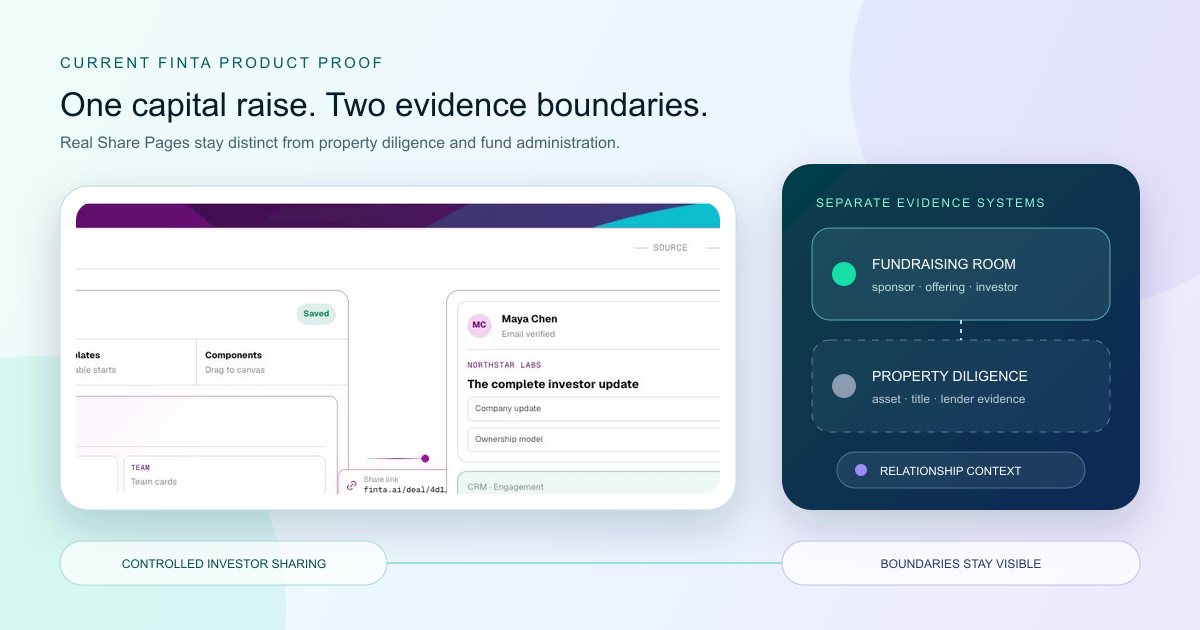
Finta helps real estate sponsors keep investor relationships, fundraising materials, meetings, commitments, and reviewed follow-through connected in one workspace. A sponsor can organize approved property and offering materials in Documents, present them through a Share Page, and use Aurora to prepare supported work from the permitted context around each prospective investor.
Finta is not a property database, underwriting engine, broker-dealer platform, subscription system, fund administrator, or property-management system. It does not verify title, calculate returns, accept investments, move money, or determine whether an offering complies with securities law.
Who this is for
This solution is for sponsors, operators, and emerging real estate fund managers raising equity or debt through relationship-driven outreach. It fits teams that need to coordinate both the opportunity and the people evaluating it.
A useful operating model separates two related layers:
| Layer | What belongs there | Finta role |
|---|---|---|
| Opportunity and diligence | Approved property summary, operating plan, financial materials, legal documents, market information, and requested diligence files | Documents and Share Pages organize and present approved material. |
| Investor relationship | Contact history, relationship owner, possible introduction path, meetings, questions, commitments, stage, and next action | CRM, Networks, tasks, calendar and inbox context, and Aurora support reviewed follow-through. |
The layers should connect, but they should not collapse into each other. A polished room does not prove that an investor is qualified, interested, or committed. A relationship record does not prove that a property or offering is sound.
A relationship-driven fundraising flow
1. Define the raise and sharing boundary
Record the opportunity, the intended investor audience, the current fundraising stage, and the person accountable for every external claim. Decide which materials are broadly shareable, which require controlled access, and which should remain internal.
2. Organize approved materials
Use Documents to upload files or folders and preserve a useful hierarchy. Typical categories may include the sponsor overview, track record, property summary, market material, operating assumptions, capital structure, financial model, legal documents, third-party reports, and risk disclosures. These are examples, not a universal checklist.
Counsel, finance, tax, insurance, engineering, environmental, and other qualified reviewers should determine what is required for the actual asset and offering. Aurora can help compare supported indexed documents with a checklist supplied by the team, but it cannot certify accuracy, completeness, or legal sufficiency.
3. Build the investor-facing page
Create a Share Page with approved Documents, text, links, buttons, forms, team cards, meeting links, deal terms, and other supported presentation components. Aurora can prepare custom HTML from instructions, attached files, and supported document-library search. The sponsor must review the resulting page before publication. Use the designated legal and transaction systems for signatures, identity checks, payment details, and closing records.
Choose public, email-required, or email-verified access based on the material and intended recipients. Supported gated pages can use dynamic watermarking and configured download controls. Access controls reduce some sharing risk but do not replace information classification or recipient diligence.
4. Connect the room to investor context
For identified visits, supported Share Page activity can be associated with the relevant contact. The team can review page activity alongside meetings, open questions, pipeline stage, relationship history, and promised next steps.
Anonymous public visits remain anonymous. Session time, previews, downloads, and forms are activity evidence, not proof of investment intent, suitability, accreditation, approval, or commitment.
5. Prepare the next reviewed action
Aurora can gather the available record, summarize open diligence questions, prepare a meeting brief, propose tasks, or draft a follow-up. A person confirms the source, recipient, claims, attachments, and timing before any consequential external communication.
Worked example: a sponsor raising equity for one property
A sponsor is raising equity for a multifamily acquisition. The operating partner owns the investment thesis, the controller owns the model, and outside counsel owns the offering documents. The sponsor has an existing network of investors and several possible introduction paths.
The team creates a source-of-truth opportunity record and uploads only approved materials to Documents. Aurora prepares a Share Page outline with the property overview, team, model, due-diligence files, meeting link, and a form for questions. The sponsor removes an unsupported market claim, corrects a date, and selects email-verified access.
One known investor reviews the operating assumptions after requesting them in a meeting. Finta preserves the identified activity alongside the request and current pipeline stage. Aurora prepares a concise draft that addresses the open question and proposes a call. The sponsor reviews the answer with the controller before sending it.
A second visitor reaches a public overview page anonymously. The team does not infer identity or trigger personal outreach from that visit.
What Finta supports
- Contact, company, and investor relationship records
- Relationship ownership, notes, stages, tasks, and next actions
- Network evidence and possible introduction pathways
- Documents with folder hierarchy and supported Aurora search
- Share Pages with supported components and access choices
- Identified page activity in relationship context
- Aurora research, synthesis, drafting, and eligible workspace actions
- Human-reviewed meeting preparation and follow-through
What Finta does not replace
- Property sourcing databases or listing services
- Asset underwriting, valuation, return calculations, or scenario certification
- Title, survey, zoning, environmental, engineering, insurance, or appraisal review
- Broker-dealer, placement-agent, or securities-law compliance
- Investor eligibility, suitability, accreditation, KYC, or AML determination
- Subscription documents, e-signature, escrow, banking, or payment processing
- Fund accounting, capital calls, distributions, tax reporting, or investor portals
- Property management, leasing, construction, or asset-management systems
- Legal, tax, accounting, investment, or real estate advice
Safe stops
Stop before sharing when a document version, recipient identity, disclosure permission, claim owner, or legal boundary is unclear. Stop before following up when the activity is anonymous or when the investor has asked not to be contacted. Record uncertainty instead of converting it into a confidence score.
Build one reviewed investor experience
Start with one active opportunity, one approved material set, and one accountable relationship owner. Explore Finta's fundraising workspace or use the investor data-room creation workflow.