Professional services
Business Development Relationship Management for Strategic Partnerships
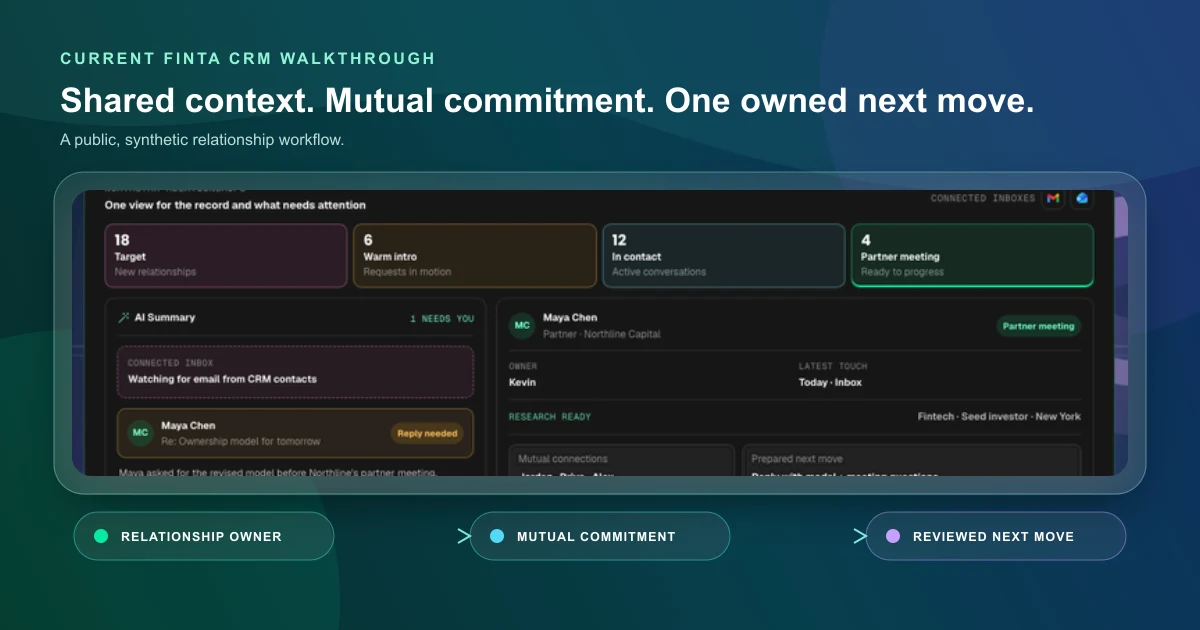
Connect partner research, people, relationship paths, meetings, documents, commitments, and reviewed follow-through in one relationship-driven workspace.
- Best for
- Strategic partnership leaders, Business development teams, Founders
- Relationship value
- A partnership depends on context, trust, mutual commitments, and the people responsible for moving shared work forward.
- Recurring workflows
- Research partner candidates, Inspect relationship paths, Prepare meetings, Review commitments, Decide the next action
- Information sources
- CRM records, Inbox and calendar, Documents, Individual networks, Tasks and meeting notes
- Network scale
- Partnership teams coordinate several people and possible relationship paths across multiple organizations without treating every connection as permission.
- Works with
- Gmail, Outlook, Google Calendar
Business development relationship management connects partner research, people, commitments and the next approved action. Finta gives strategic-partnerships teams a workspace for that relationship-led process, using permitted CRM, inbox, calendar, document and network context. Keep each partnership motion's thesis, owner and review date visible, while partner portals, deal registration, commissions and commercial approvals remain in their designated systems.
Finta is not a partner portal, PRM, deal-registration system, commission platform, or channel-attribution engine. Teams that need those program capabilities should use the appropriate specialist system and define how it works alongside Finta.
Why partnership work gets fragmented
Strategic partnerships rarely belong to one pipeline alone. A single organization may be a technology partner, referral source, distribution path, customer, event collaborator, or future investor. Several people on each side may carry different pieces of the history.
The operating risk is simple: the team can remember the company name but not the relationship context, the approved thesis, the last commitment, or the person who must act next.
Finta helps organize four connected layers:
| Layer | What the team needs to know | Finta role |
|---|---|---|
| Organization | What the company does and why a partnership may fit | CRM records, public research, notes, and documents |
| People and paths | Who is involved, who owns the relationship, and which paths may be relevant | Contacts, Networks evidence, and introduction pathways |
| Partnership motion | What is being explored, designed, activated, paused, or reviewed | Configurable stages, tasks, and next actions |
| Follow-through | What was promised, what changed, and what requires a decision | Permitted communication context, Aurora, and Automations |
A relationship-first operating model
Start with one durable partner record and keep each active motion distinct.
- Research the organization: Confirm the company, current people, public strategy, and relevant constraints.
- Write the shared thesis: Name the audience or customer and the outcome that may become more valuable together.
- Inspect possible paths: Review relationship evidence and identify the appropriate owner without treating a connection as permission.
- Run a stage-gated motion: Move from thesis to mutual fit, joint design, commitment, activation, and review only when the evidence supports it.
- Close the loop: Record decisions, owners, promised work, pauses, and respectful exits.
The result is not a bigger database. It is a smaller set of relationship records that explain what matters and what should happen next.
Where Aurora acts
Aurora works across supported Finta tools and available connections. It can research public company context, inspect permitted CRM and communication history, synthesize open questions, prepare a meeting brief, draft follow-up, propose tasks or record changes, and complete eligible workspace actions.
This makes Aurora useful as an agent inside a bounded partnership workflow. For example, it can move from “prepare for this partner review” to gathering the available record, finding unresolved commitments, drafting an agenda, and proposing owner-specific tasks.
Consequential decisions stay controlled. A person verifies the identity and sources, decides whether a relationship path is appropriate, approves external communication, and owns any commercial commitment. Tool availability, permissions, provider state, and credits can limit what Aurora can complete.
A weekly partnership desk
Use one review to answer five questions:
- Which partnership motions gained new evidence this week?
- Which active record has no owner or dated next action?
- Which commitment is waiting on us, the partner, or a third party?
- Which possible relationship path needs a permission decision?
- Which motion should advance, change, pause, or close?
Aurora can assemble a candidate review from available records and sources. The partnership lead validates the evidence and makes the stage decisions.
Worked example: a regional ecosystem partnership
A software company wants to partner with an accelerator that supports companies in its target market. Public research shows a plausible audience fit. One executive has a previous relationship with the accelerator's program director, while the business-development lead owns the current thesis.
Aurora gathers the authorized internal context, researches the accelerator's current program, and prepares a short brief. Finta Networks surfaces the possible relationship path. The business-development lead reviews the evidence, asks the executive for permission, and prepares a concise introduction request. A connection is not sent automatically.
After both sides confirm interest, the team creates a partnership motion with a shared outcome, owners, a review date, and open questions. Aurora prepares meeting context, turns approved commitments into tasks, and helps draft follow-up. The human owners decide what is shared and whether the motion advances.
What Finta supports
- Contact and company relationship records
- Configurable stages, owners, tasks, and next actions
- Permitted inbox and calendar context
- Network evidence and possible warm paths
- Aurora research, synthesis, drafting, and eligible workspace actions
- Documents and share pages for approved materials
- Configured Automations with explicit review and stop conditions
- Finta MCP access from compatible AI clients when authorized
What Finta does not replace
- Partner portals and external partner-user administration
- Partner onboarding and certification
- Deal registration and channel-conflict controls
- Lead distribution to channel partners
- Commissions, rebates, incentives, or market-development funds
- Partner-sourced revenue attribution
- Contract lifecycle management
- Legal, privacy, security, or commercial review
Limitations and safe stops
Relationship context can be incomplete or stale. Public research can be wrong. An email open, shared event, or social connection does not establish interest or consent. A partnership thesis is not mutual until both sides confirm it. AI output can omit constraints or attribute a statement to the wrong person.
Stop when the identity, relevance, permission, approved information, or accountable owner is unclear. Keep drafts separate from sent messages and proposals separate from commitments.
Sources
- Finta Aurora
- Finta CRM
- Finta Networks
- Finta Automations
- Salesforce partner lifecycle overview
- ISO 44001 collaborative business relationship management
Build the next partnership action from real context
Start with one active partnership motion and one decision your team needs to make. Start free with Finta and put the relationship, evidence, and next step in one reviewed workspace.