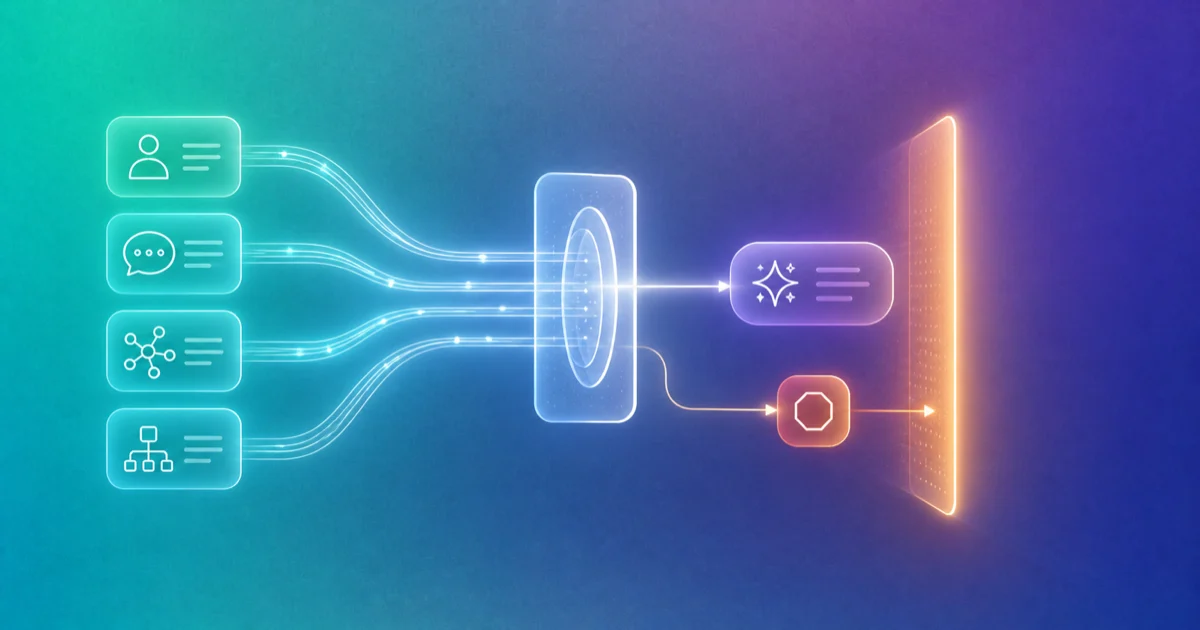
Direct answer: Model Context Protocol (MCP) can connect an AI assistant to private-capital systems, but MCP is not the intelligence. The useful layer is permissioned relationship context: who knows whom, what has happened, what is changing, which commitments remain open, and what action is appropriate next. Finta's thesis is that private-capital agents become valuable when that context is attached to workflow state and controlled execution.
The distinction matters because capital work is not a generic database problem. A list of companies, funds, or investors can tell you who exists. It cannot tell you who matters to your current process, what your team already knows, whether a relationship owner is willing to help, or whether the next move should be a follow-up, an introduction request, more research, or a deliberate stop.
What Model Context Protocol changes for private capital
The official Model Context Protocol specification describes an open protocol through which AI applications can use external resources, prompts, and tools. Anthropic introduced MCP as a standard way to connect AI assistants with the systems where data lives. Read Anthropic's MCP announcement.
That connection can remove a familiar sequence of work: open an application, search for a record, copy the result, paste it into an AI chat, and then move the answer back into the system. A compatible MCP server can make permitted context and supported tools available inside the AI client instead.
But the protocol does not determine whether the underlying record is current, whether a relationship inference is justified, whether a person has consented to an introduction, or whether an external action is wise. MCP supplies a connection layer. The quality of the result still depends on the data, permissions, workflow design, and judgment behind it.
Private capital is a relationship-context problem
Private-capital decisions draw on several different kinds of knowledge. Public and licensed market data can describe a company, fund, transaction, sector, or investor. Private relationship context can change the decision that follows: who on the team knows a person, when they last spoke, what was promised, what objection remains unresolved, and who owns the next step.
Affinity's May 2026 launch article says its MCP can connect supported AI tools to live CRM and relationship data, including search, meeting preparation, pipeline questions, and note creation. Its later private-capital MCP guide argues that financial-data connectors and relationship-history connectors solve different problems. These are Affinity's product and editorial claims, not independent performance evidence. They nevertheless show that private capital is becoming an important MCP category. Read Affinity's MCP launch and its private-capital MCP guide.
Finta advances the argument one step further. Relationship data is not valuable merely because an AI can retrieve it. It becomes useful when the system preserves source, ownership, recency, uncertainty, and the boundary between a possible action and an approved one.
The Private Capital Context Ladder
The following Finta framework separates six layers that are often compressed into the word intelligence.
| Layer | Question it answers | Evidence required | Failure when missing |
|---|---|---|---|
| Market data | Who exists? | Current company, fund, sector, transaction, stage, and geography data. | The agent invents or relies on stale market facts. |
| Fit | Who could be relevant? | Explicit criteria, source dates, exclusions, and unanswered questions. | A large universe is mistaken for a prioritized list. |
| Relationship intelligence | Who knows them, and what happened? | Interaction history, relationship ownership, recency, direct statements, and possible pathways. | A visible connection is mistaken for trust, permission, or interest. |
| Workflow state | What is moving now? | Pipeline stage, meetings, open commitments, delivered material, decisions, and next tasks. | Activity is reported without showing progress or blockage. |
| Judgment | What should happen next? | Alternatives, supporting evidence, uncertainty, owner, and a pause or stop condition. | The agent presents a confident guess as a decision. |
| Controlled action | What may the agent do? | Tool scope, permissions, confirmation rules, receipts, reversibility, and failure state. | Access becomes an unintended or reputationally costly action. |
A useful private-capital MCP does not need to own every layer. It does need to be explicit about which layers it can support and which remain outside its scope. A market-data connector may answer who exists. A relationship system may answer what the team knows. A workflow tool may create a note or update a stage. The AI client still needs to preserve the boundary between retrieval, inference, recommendation, and execution.
What a useful private-capital MCP should expose
For relationship-driven capital work, six capabilities matter more than a long tool count:
- Clear entities and workflow state. The agent needs to distinguish people, organizations, funds, deals, stages, owners, and open tasks.
- Source-supported relationship history. A summary should remain traceable to the records, interactions, or documents that support it.
- Relationship ownership and possible pathways. The system should identify who owns a relationship without implying that the person has agreed to make an introduction.
- Bounded tools. Reading a record, preparing a brief, updating a stage, and sending a message are different actions with different consequences.
- Permission alignment. The MCP should not silently broaden what a user or client is allowed to access.
- Receipts and failure states. The user should be able to see which source or tool informed an answer, what changed, and what could not be completed.
The MCP authorization specification and current security guidance make clear that authorization, token handling, audience validation, client consent, and scope minimization require deliberate implementation. MCP should not be described as secure automatically. Review the MCP authorization specification and current MCP security guidance.
A worked capital-raising example
Imagine that a founder or emerging fund manager asks an AI assistant: Which investor relationships deserve attention this week, and why?
A responsible workflow would not jump directly from the question to an email. It would move through the context layers:
- Retrieve permitted records. Inspect the active pipeline, available investor research, recent interactions, open commitments, and scheduled meetings.
- Separate fit from access. An investor can fit the strategy without a relationship path. A warm path can exist to an investor who is not appropriate for the current raise.
- Check timing and evidence. Identify what changed, how fresh the source is, and which facts remain unknown.
- Prepare a decision brief. Present a small working set with the reason each relationship matters, the open question, and a proposed next move.
- Keep the decision with the owner. The founder or GP decides whether to research, follow up, request an introduction, defer, nurture, or stop.
This example is an operating model, not a claim that one product or MCP currently performs every step. It also is not a prediction of investor interest. A relationship path is evidence to review, not a probability of funding.
Where Finta Aurora MCP fits
Product details in this section were verified August 16, 2026. Finta documents a public Aurora MCP server and setup workflow for compatible AI clients. Its current setup article describes CRM and deal-context queries and supported actions such as listing contacts, adding targets, and updating stages. For the connection URL, client instructions, and current examples, use the canonical guide: Introducing Finta's Aurora MCP.
Finta's broader product provides the relationship layer around that connection:
- Finta CRM keeps pipeline stage, available research, mutual connections, and supported inbox context on a working relationship record.
- Finta Networks presents available relationship-strength evidence and possible warm paths. Finta explicitly distinguishes interaction evidence from the likelihood that an introduction will happen.
- Aurora works from available Finta workspace and supported connection context, can show source and tool receipts, and indicates when confirmation is required.
- Fundraise OS organizes founder and GP capital-raising workflows around a pipeline, warm paths, outreach preparation, meeting preparation, documents, and Aurora skills.
These product-wide capabilities should not be confused with a claim that every Aurora source or action is available through every MCP client. Availability depends on the connected client, tools, workspace access, permissions, credits, and workflow. Finta's documented communication and introduction workflows keep consequential external actions under user review.
That is Finta's distinct position in the private-capital MCP category: connect AI tools not only to records, but to the relationship evidence and capital-raising state needed to prepare a responsible next move.
How to evaluate an MCP for private capital
Before connecting an AI client to sensitive relationship or deal data, ask six questions:
- What exact sources can it access? Look for an explicit list of records, fields, connections, documents, and exclusions.
- Whose permissions apply? Confirm whether the MCP preserves the user's existing access and whether additional scopes are requested.
- Can an answer be traced? A reviewer should be able to identify the record, source, or tool call supporting a consequential claim.
- Which tools can change data? Separate read operations from note creation, stage changes, contact creation, communication, and other side effects.
- Which actions are reversible or confirmed? Ask what is logged, what can be undone, and where human confirmation remains required.
- How does it fail? Missing connections, stale records, permission denials, unavailable tools, and partial results should remain visible.
For the broader operating model, read AI CRM Agents for Relationship-Led Teams. For a reusable action policy, use Finta's human-approval framework. To understand the evidence-to-action loop, read How Relationship Intelligence Works.
What MCP does not solve
An MCP connection does not correct a stale CRM, resolve conflicting notes, establish investor fit, obtain a connector's consent, or turn a possible warm path into an introduction. It does not make an AI recommendation investment advice, and it does not replace the firm's legal, regulatory, security, recordkeeping, or compliance processes.
Memory also needs governance. A useful relationship system should distinguish durable facts, current workflow state, evidence, and temporary working context. Read AI Agent Memory for Relationship Workflows for a practical retention and verification model.
Most importantly, no MCP can guarantee a meeting, introduction, commitment, or completed raise. Finta helps organize and operate relationship-driven capital workflows. Outcomes still depend on fit, timing, market conditions, judgment, and execution.
Frequently asked questions
What is MCP for private capital?
It is the use of Model Context Protocol to connect compatible AI applications with authorized private-capital data sources and tools. Depending on the implementation, that may include market data, CRM records, relationship history, pipeline state, documents, or supported workflow actions.
Does Finta have an MCP server?
Yes. Finta documents Aurora MCP at `https://finta.ai/mcp`. See Finta's current Aurora MCP setup guide for supported clients, connection steps, and examples.
What can Aurora MCP currently access or change?
Finta's current public guide describes access to supported Finta Deal and CRM context, along with examples such as listing contacts, adding targets, asking pipeline questions, and updating stages. Exact tools and availability can change, so verify the live setup guide and the permissions shown by your client before connecting.
Does MCP make private data secure automatically?
No. MCP is a protocol. Security depends on the implementation, authorization flow, client, server, scopes, token handling, permissions, infrastructure, and operating controls.
Can an MCP agent act without human review?
That depends on the tools and workflow. Reading a record, preparing a brief, changing a stage, and sending an external message have different consequences. Finta's current product pages preserve user review for documented consequential communication and introduction workflows, but not every internal record operation should be described as requiring the same confirmation.
Connect relationship intelligence to the AI tools you use
MCP makes the connection possible. Relationship intelligence makes the connection useful. The goal is not to give an agent more data for its own sake. It is to help a person see the relevant evidence, understand the state of the relationship, and choose a responsible next move.
Connect Finta Aurora MCP to a compatible AI client, or explore Aurora's context-aware workflow.
Limitations and disclosure
This article provides general operational education, not investment, legal, security, regulatory, broker-dealer, placement-agent, recordkeeping, compliance, or fundraising-outcome advice. Product capabilities reflect the cited public pages on the research date and may vary by connection, permission, client, credit balance, and workflow.
AI outputs, relationship evidence, and suggested actions can be incomplete or incorrect. They do not establish consent, endorsement, investor interest, suitability, introduction likelihood, commitment, or a business outcome. Verify material information and sensitive external actions with the appropriate people.
Research updated August 16, 2026. Written by Kevin Siskar.
Sources
- Anthropic: Introducing the Model Context Protocol
- Model Context Protocol: 2025-11-25 specification
- Model Context Protocol: Authorization specification
- Model Context Protocol: Current security best practices
- Affinity: Affinity is Building the Best MCP for Private Capital
- Affinity: Essential MCPs for Private Capital
- Finta: Introducing Finta's Aurora MCP
- Finta Aurora
- Finta CRM
- Finta Networks
- Finta Fundraise OS