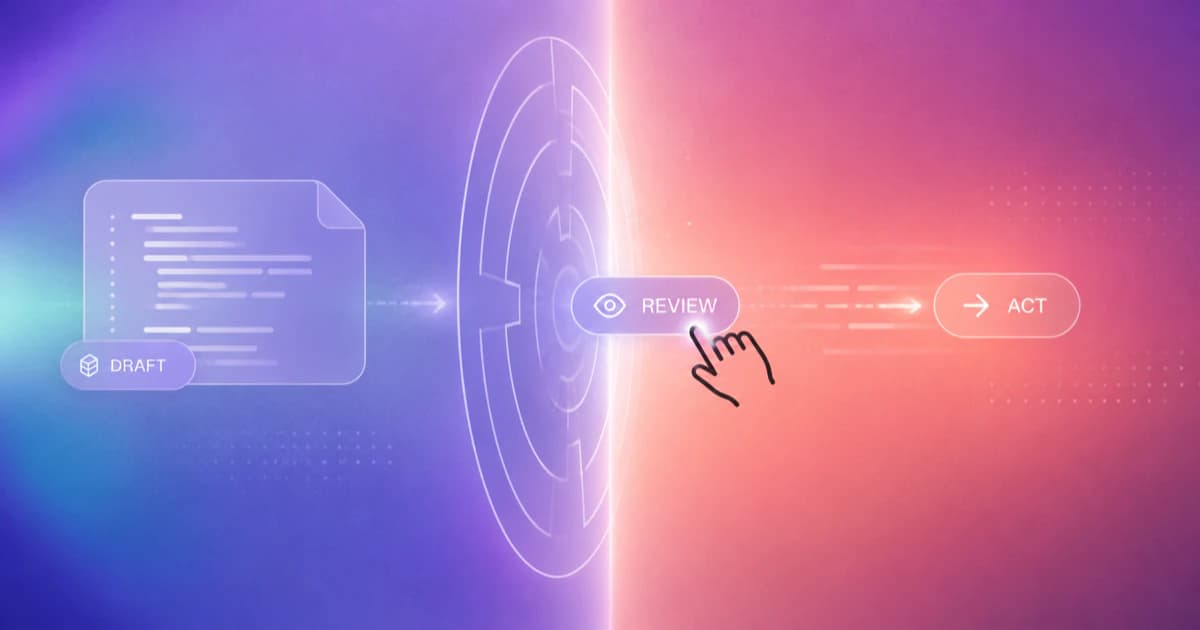
Direct answer: AI can reduce administrative work in relationship workflows, but a team should set explicit approval boundaries before it summarizes sensitive context, drafts an external message, changes a durable record, shares material, or makes a commitment. The right boundary depends on reversibility, impact, uncertainty, and who bears the consequence.
Research update: This article was initially published on June 23, 2026 and was reviewed against current sources on August 8, 2026.
Set the boundary before the workflow becomes routine
A useful policy does not ask whether AI is good or bad. It asks which action is proposed, what could go wrong, and who is accountable for the result. The NIST AI Risk Management Framework is voluntary guidance for managing risks to people and organizations associated with AI. This article translates that risk-management posture into a practical relationship-workflow matrix. It is not a NIST certification or a complete governance program.
Four questions before allowing an AI action
- Is the action reversible? A private draft is easier to correct than a sent email, shared document, or accepted meeting commitment.
- Does it create an external effect? Outreach, access changes, and calendar invitations can change a relationship even when the text is accurate.
- Is the context sensitive or uncertain? Confidential deal information, incomplete notes, or ambiguous relationship history deserve closer review.
- Who owns the outcome? A named person should be responsible for approving actions that represent the team or create a durable record.
Human approval matrix for relationship workflows
| AI task | Default handling | Why | Minimum control |
|---|---|---|---|
| Summarize an internal thread | Automate with source links and periodic review. | It is reversible and stays internal, but omissions can still shape a later decision. | Show source references and label the output as a summary. |
| Prioritize relationships or suggest a next action | AI may recommend. A relationship owner decides. | Prioritization can embed incomplete context or a stale assumption. | Record the evidence, owner, and accepted or rejected recommendation. |
| Draft an external message | AI may draft. A person reviews and sends. | Tone, timing, facts, and implied commitments are relationship-specific. | Human review of recipients, claims, attachments, and timing. |
| Update structured CRM fields | Permit only bounded, well-defined updates with logs and review. | A wrong durable record can mislead future decisions. | Field-level rules, change history, and exception review. |
| Send, share, schedule, or change access | Require explicit human approval. | The action affects another person or exposes information externally. | Named approver, confirmation screen, and activity record. |
| Make financial, legal, employment, or strategic commitments | Never delegate the decision to AI. | The impact is high and often requires qualified judgment and authority. | Human decision-maker and applicable internal approval process. |
Worked example: preparing an investor follow-up
Consider a team that wants help after a meeting with a prospective investor. A safe workflow is not an all-or-nothing automation.
| Step | Permitted assistance | Human responsibility |
|---|---|---|
| Capture | Summarize the meeting notes and identify open questions. | Check that the summary does not omit a commitment or misstate a fact. |
| Prepare | Draft a follow-up using the approved context and meeting notes. | Validate recipients, tone, factual claims, attached materials, and timing. |
| Decide | Suggest a next action and a reminder date. | Accept, revise, or reject the recommendation based on the live relationship. |
| Act | Create an internal task or queue a draft. | Send the external message only after approval. |
| Remember | Propose a structured record of the outcome. | Confirm the durable CRM entry reflects what actually happened. |
The example is illustrative. It is not a claim that every relationship workflow, AI tool, or Finta configuration supports the same controls.
Make approval visible, not ceremonial
An approval rule is useful only when it is visible at the moment of action. Keep the rule close to the workflow: identify the action owner, show the source context, state what will happen externally, and record the decision. If the team cannot explain why an action is safe to automate, treat it as a review-required step until the evidence and controls improve.
Use evaluation criteria for deep-research AI agents to test sources, uncertainty, approval boundaries, and handoff before enabling a research workflow.
Use Finta for context, with people accountable for action
Finta's public product page describes Aurora as using connected inbox, calendar, documents, CRM, and network context to surface next steps and drafts. A team can use Finta to organize the context behind an action, while keeping its own human-approval policy for outreach, sharing, permissions, and commitments. Verify current capabilities and account settings before configuring a workflow, and do not infer autonomous sending or approval features from this article.
Limitations
This is general operational guidance. It does not determine legal authority, privacy obligations, contractual duties, regulated communications requirements, or the suitability of any AI system. Escalate high-impact decisions and sensitive data handling to the people with the appropriate authority and expertise.
Continue the relationship intelligence playbook
- AI CRM Data Privacy Checklist Before Connecting Email and Calendar
- Relationship-Led Sales: A Practical Playbook for Founder-Led Teams
Editorial review and disclosure
Written and reviewed by Finta Editorial Team. The matrix and worked example are original editorial frameworks informed by NIST risk-management guidance. Finta is the publisher and is linked as a contextual product option. This article does not guarantee that an approval policy will eliminate risk.
Sources
- NIST AI Risk Management Framework, reviewed August 8, 2026.
- Finta product page, reviewed August 8, 2026.
Related guide: Personal intelligence routines with human approval.