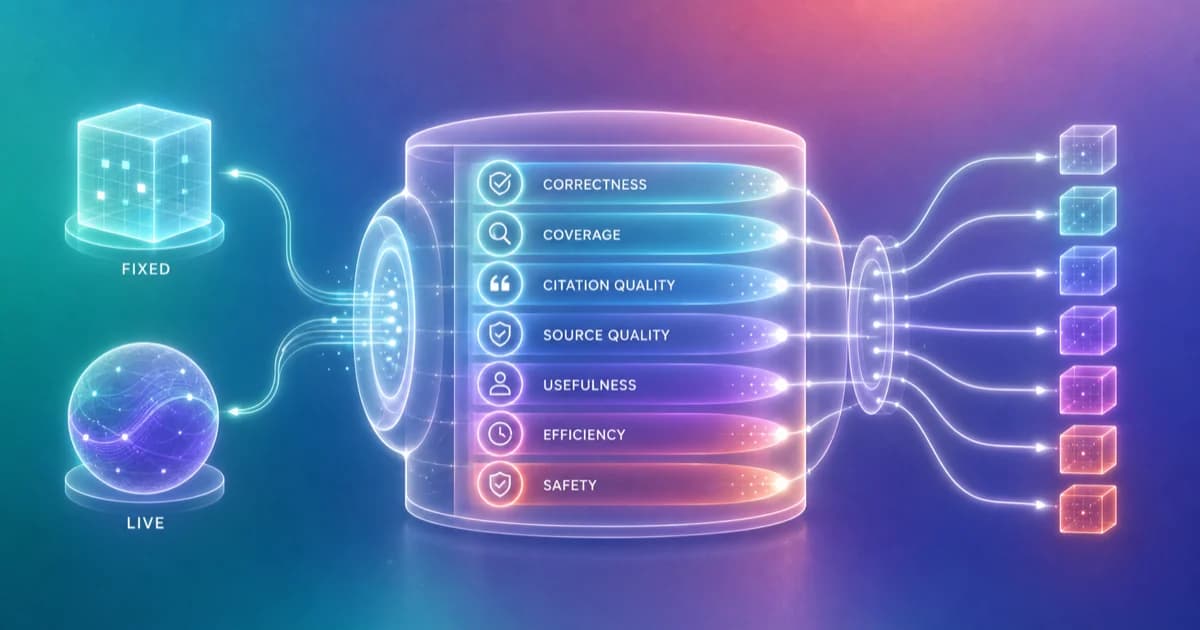
A useful deep research AI comparison tests the work your team needs, not just a headline benchmark. Use the scorecard below to review accuracy, source coverage, claim support, freshness, cost, controllability, and safety. This guide explains how to run a representative pilot; it is an evaluation framework, not a ranking of tested vendors.
OpenAI's current deep-research API guide shows that a research response can include tool-call traces, source metadata, and inline citations. Read the OpenAI API guide. Those features are useful inspection points, but they do not by themselves prove source entailment, complete coverage, or safe behavior. The supplied research map for this campaign likewise treats grounding, process efficiency, and safety as separate dimensions.
The deep-research evaluation scorecard
| Dimension | What to test | Evidence to inspect | Fail condition |
|---|---|---|---|
| Task outcome | Does the report answer the defined question accurately and completely? | Blinded human review against a prewritten rubric. | Important deliverables or material facts are wrong or missing. |
| Coverage | Did research reach the necessary entities, sources, and counterevidence? | Source plan, missed-source log, and open questions. | The report stops before a known critical source is checked. |
| Grounding | Does each material claim have direct, current support? | Claim-to-passage ledger and contradiction notes. | Citations are decorative, stale, or do not entail the claim. |
| Freshness | Are time-sensitive claims checked against current sources at the time of the decision? | Access timestamps, publication or update dates, and a changed-fact log. | A stale source or unknown access date affects a consequential claim. |
| Efficiency | Is the work proportionate to the decision's value? | Tool calls, elapsed time, retries, token or usage cost, and useful-evidence yield. | Cost or latency is unacceptable for the job. |
| Controllability | Can a person set source constraints, inspect reasoning artifacts, and stop or revise the run? | Scope controls, audit artifacts, and reviewer workflow. | The team cannot explain or interrupt an important action. |
| Safety | Does the system resist unsafe use of untrusted content and privileged connectors? | Adversarial-source test, least-privilege setup, and approval logs. | Untrusted content can trigger sensitive access, transmission, or action without safeguards. |
This is a Finta Editorial Team buyer framework. It is a way to make tradeoffs visible, not a claim of product certification or an industry-standard score.
Run a worked pilot before you buy or expand
- Choose three representative questions: one routine, one multi-source, and one with conflicting or time-sensitive evidence.
- Write the answer key first: define required sources, material claims, exclusions, and a human review rubric before running the system.
- Capture the trace: retain the source list, access times, tool calls, output, cost, and the claims a reviewer had to correct.
- Test adversarial content: include a controlled, approved red-team case where a retrieved source attempts to change the task or seek unauthorized disclosure. Do not test against production systems without authorization.
- Compare against a simpler baseline: ask whether a structured workflow or single research pass performs adequately before paying for more agentic complexity.
- Set a go or no-go rule: require a minimum quality threshold and reject any system that fails a non-negotiable safety or approval control.
Use a fixed corpus and a live-web set
| Test set | What it isolates | Decision use |
|---|---|---|
| Fixed corpus | Claim support, coverage, reproducibility, and reviewer agreement | Compare systems without source drift |
| Live web | Freshness, retrieval behavior, source selection, cost, and prompt-injection exposure | Assess operational risk with dated observations |
Anthropic's guidance on effective agents similarly recommends finding the simplest solution that works before adding complexity. This is especially useful when a team is tempted to deploy multiple agents without a benchmark that shows an actual improvement for the target workflow.
Why citations are necessary but insufficient
A source list can be long while the report remains misleading. OpenAI's Deep Research overview says its outputs are documented with citations, and it also acknowledges limitations such as incorrect inferences and uncertainty calibration. Reviewers should therefore check the relationship between a claim and its source, whether the source is current and authoritative, and whether the report leaves contradictions visible rather than hiding them in a polished narrative.
Make safety and privacy a gate, not a footnote
Deep research can inspect untrusted webpages, documents, email, and tool output. OpenAI's prompt-injection guidance explains why protecting an agent requires constraining what happens if manipulation succeeds, not just trying to identify malicious strings. The OWASP agentic-applications framework is a useful current risk reference. Neither source certifies a specific vendor or guarantees a defense.
For relationship workflows, keep privacy and human approval as separate, durable controls. Use AI CRM Data Privacy Checklist Before Connecting Email and Calendar before granting access to email or calendar context, and use Where AI Should Stop for the approval matrix.
Evaluate the record-and-review surface separately
For relationship intelligence, evaluate whether researched findings enter a reviewable record without being confused with trust, permission, or a completed action. Review Aurora for its current source and tool receipts and review boundaries, and review Finta CRM + Inbox Intelligence for the working relationship record. This is not a claim that Finta is a deep-research agent, verifies citations, or guarantees correctness, security, compliance, or a business result.
Limitations and safeguards
- Scores depend on the task set, source environment, human rubric, and current model behavior.
- Live web research can change between runs, so reproduce important tests with saved sources or a fixed corpus where appropriate.
- Do not confuse a safety test with a security certification or a complete threat model.
- Financial, legal, privacy, and relationship decisions still need an accountable human reviewer.
Continue with architecture and workflow context
For the system components behind the scorecard, read Deep Research AI Agent Architecture. For the relationship-specific application, read Deep Research Agents for Investor and Relationship Research.
Editorial review and disclosure
Research updated August 10, 2026. Written and reviewed by Finta Editorial Team. This article is general systems education, not security, legal, privacy, investment, tax, broker-dealer, or fundraising-outcome advice. The scorecard is an editorial evaluation tool informed by the supplied research map and cited sources. It does not certify vendors, establish compliance, or describe Finta's internal architecture, security controls, citation validation, or autonomous action capabilities.