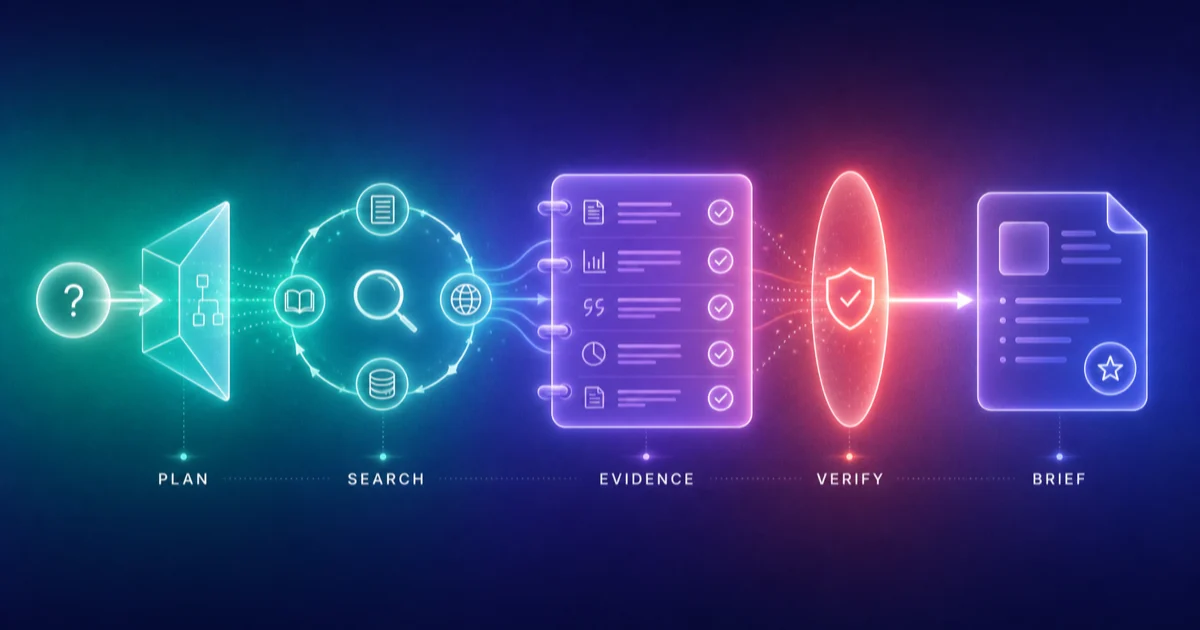
Deep research agent architecture starts with a repeatable evidence loop: define the question, plan the work, retrieve sources, record support, challenge claims, and review the report. This guide provides an architecture card and worked workflow for evaluating those steps. It is an editorial framework, not a description of Finta's internal system.
OpenAI's current API guide says deep-research models can use web search, file search, remote MCP servers, and optionally Code Interpreter. A response can expose web, file, code, and MCP call items plus a final answer with inline citations. Read the OpenAI deep research API guide. That is an API example, not a blueprint Finta follows.
The minimum architecture card
| Layer | Job | Evidence of healthy behavior | Failure to test |
|---|---|---|---|
| Research brief | State the question, constraints, source preferences, and output needed. | The task is specific enough to review. | The agent starts from an underspecified goal. |
| Planner | Break the question into researchable subquestions and set a stopping rule. | Each search has a purpose. | Endless searching or premature stopping. |
| Retrieval | Find, open, and compare relevant sources. | Sources are timely, appropriate, and diverse. | One weak source becomes the entire answer. |
| Evidence ledger | Map claims to passages, dates, transformations, conflicts, and unknowns. | A reviewer can trace an important conclusion. | Citations are added after prose without direct support. |
| Verifier | Challenge factual support, freshness, calculations, and contradictions. | Unsupported claims return to research. | Polished language hides a gap. |
| Policy boundary | Constrain tool access, data flow, and consequential actions. | Untrusted content cannot directly trigger a sensitive tool. | A retrieved page or email changes the agent's goal. |
This architecture card is a Finta Editorial Team framework. It describes what a team should be able to inspect, not an assertion that Finta or any particular vendor implements these layers in exactly this way.
Why a single evidence loop is the right starting point
Start with one capable agent and a structured evidence ledger before adding a multi-agent design. Anthropic's implementation guidance recommends the simplest solution that solves the task, and its separate research-system write-up shows both the usefulness and coordination cost of parallel workers. Parallelism is useful when a question has genuinely independent branches. It is not a substitute for source quality, verification, or a clear stopping rule.
A worked evidence-first loop
- Define: turn a vague request into a bounded question with a date range, audience, and source constraints.
- Plan: list the entities, concepts, and unknowns that need separate investigation.
- Retrieve: gather primary or authoritative sources first, then record the exact section that supports each material claim.
- Challenge: identify missing evidence, contradictions, stale sources, and calculations that need independent checking.
- Write: draft only the claims supported by the evidence ledger, clearly labeling inference and uncertainty.
- Review: approve the report, any external sharing, and any downstream action separately.
For relationship research, preserve provenance at the claim level: source URL or record ID, access date, supporting passage, transformation, contradiction, and reviewer disposition. A citation is not sufficient if a reviewer cannot tell which assertion it supports.
For the applied source-to-decision pattern, continue to Deep Research Agents for Investor and Relationship Research.
Keep external content untrusted
Research systems read webpages, documents, emails, and tool output. That content can contain instructions meant to redirect the agent. OpenAI's prompt-injection guidance explains why protecting an agent cannot rely only on classifying malicious strings: the system also needs safeguards around data transmission and tool use. Use the architecture boundary as a review question: can untrusted content influence a sensitive action without deterministic policy checks and human approval?
This is adjacent to, but does not replace, the existing AI CRM Data Privacy Checklist and Human Approval Rules for Relationship Workflows. Those articles remain the canonical owners for privacy controls and approval rules.
Use the architecture to improve relationship research
Relationship intelligence turns research output into a reviewed brief or next task tied to a relationship record. Aurora describes current source and tool receipts and review boundaries, while Finta CRM keeps available relationship context attached to the working record. These public pages do not claim that Finta uses the architecture above, performs deep research, or validates every cited claim.
Limitations and safeguards
- A citation can be present without directly supporting the adjacent claim.
- Live web research changes over time, so source access and freshness need a visible date.
- Multiple agents can duplicate work or amplify weak evidence if their outputs are not structured and reviewed.
- Do not give a research agent broad connector or write access merely because it can produce a well-formed report.
Continue with the memory and evaluation guides
For the state that supports a long-running workflow, read AI Agent Memory for Relationship Workflows. For the buyer scorecard that tests the resulting system, read How to Evaluate Deep Research AI Agents.
Editorial review and disclosure
Research updated August 10, 2026. Written and reviewed by Finta Editorial Team. This article is general systems education, not security, legal, privacy, investment, tax, broker-dealer, or fundraising-outcome advice. The architecture card is an editorial synthesis informed by the supplied research map and cited materials. It does not describe Finta's internal agent architecture, security controls, prompt-injection defenses, or autonomous action capabilities.