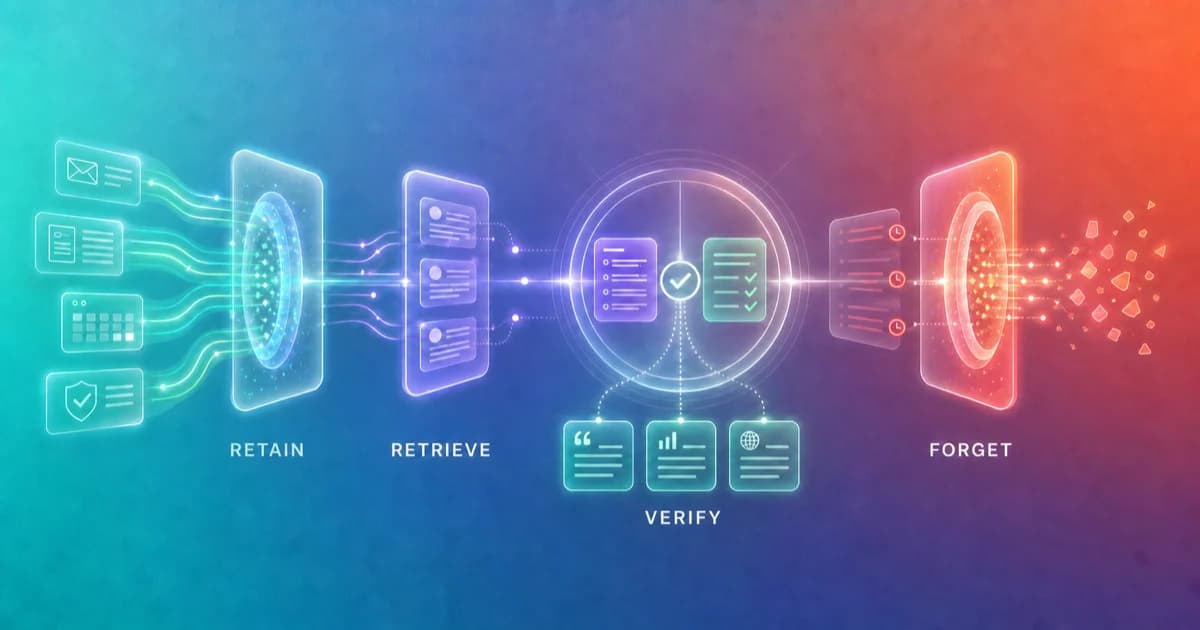
AI agent memory should help a team use the right context without turning a chat history into unquestioned facts. This guide separates working context, execution state, relationship facts, and source evidence, then shows what to retain, retrieve, verify, and forget. The framework is for designing relationship workflows, not a claim about Finta's internal memory architecture.
More context is not automatically better context. Anthropic describes context as a finite resource that must be curated. The four buckets below are a practical editorial model for relationship workflows, not a description of Finta's internal memory architecture.
The four memory buckets
| Memory bucket | What belongs there | What must accompany it | What should not happen |
|---|---|---|---|
| Working context | The current task, selected sources, active plan, and immediate constraints. | Task scope and a short expiry. | Turning a temporary prompt into a permanent relationship fact. |
| Execution state | Completed tasks, pending review, retries, and approved handoffs. | Owner, status, and timestamp. | Leaving an unreviewed draft looking like a completed action. |
| Persistent relationship facts | Approved contact details, preferences, relationship history, and decisions that belong in the system of record. | Source, owner, and revalidation point. | Promoting a model inference or third-party claim to fact without review. |
| Evidence memory | Source passage, retrieval time, factual claim, contradiction, and uncertainty. | Traceable source and access context. | Replacing evidence with a confidence score or summary alone. |
This table is a Finta Editorial Team memory charter. Its purpose is to prevent an agent from accumulating ambiguous relationship information that nobody can later explain, correct, or remove.
Use the retain, retrieve, verify, forget checklist
- Retain: keep only information that has a defined relationship-workflow use, a source authorized under your team's policy and the relevant user's permissions, and an accountable owner.
- Retrieve: bring the smallest useful set of evidence into a task. Do not load every email, meeting, and note just because it is available.
- Verify: distinguish a source-backed fact from an inference, a stale summary, or a missing data point. Recheck time-sensitive facts before outreach or a recommendation.
- Forget: remove or correct data that is no longer relevant, permitted, accurate, or needed for the workflow. Preserve a controlled correction trail where policy requires it.
Finta's current CRM page says a relationship record can combine a pipeline stage, available research, mutual connections, and supported inbox context. See Finta CRM. That is a product-level description of a working record, not evidence that Finta stores the four memory buckets above or retains every connected item indefinitely.
Worked example: a connector preference
Suppose a founder learns that an advisor prefers to review any introduction request before their name is mentioned. The relationship workflow should record the source and date of that preference, the person responsible for keeping it current, and a review point before an introduction draft is prepared. The workflow should not store an unqualified assumption such as this advisor always introduces founders. The difference protects the advisor's agency and makes the next action explainable.
Keep interaction evidence separate from inferred relationship strength. Finta Networks describes strength as available interaction evidence, not likelihood of an introduction. Relationship intelligence should preserve that distinction through retention, retrieval, and any later draft.
Memory is also a security and privacy surface. The OWASP Top 10 for Agentic Applications is a current risk framework for systems that plan and act across complex workflows. Treat that as a reason to design explicit access, correction, and approval boundaries, not as a claim that a particular product is compliant or attack-proof.
Keep existing owners in the loop
Use AI CRM Data Privacy Checklist Before Connecting Email and Calendar for the pre-connection privacy and retention questions. Use How Relationship Intelligence Works for the separate process of turning permitted signals into a reviewable next action. Memory should support those workflows, not become a second, opaque CRM.
Limitations and safeguards
- Incomplete data can look authoritative when it is summarized cleanly.
- Past interaction volume is not proof of trust, permission, investor fit, or a desired next step.
- Retention, deletion, access, and correction obligations depend on the team, source, and applicable policies.
- Do not allow untrusted external text to become durable memory without review and provenance.
Build on a record, not an opaque transcript
For the durable relationship record, review Finta CRM + Inbox Intelligence. Review Aurora separately for its current source and tool receipts and review boundaries. Neither public page establishes the four-part memory model above. Use the memory charter to define what your team must verify before a summary or suggestion becomes durable relationship context.
Editorial review and disclosure
Research updated August 10, 2026. Written and reviewed by Finta Editorial Team. This article is general operational education, not legal, privacy, security, investment, tax, broker-dealer, or fundraising-outcome advice. The memory model is an editorial framework informed by the supplied research map and cited sources. It does not describe Finta's internal architecture, data-retention practices, or security controls. Verify current product behavior and your own policy obligations before implementation.
Sources
- Anthropic: Effective Context Engineering for AI Agents
- Finta CRM + Inbox Intelligence
- OWASP Top 10 for Agentic Applications for 2026
- Anthropic: Building Effective AI Agents
Related guide: Personal intelligence hub vs. second brain.
Related guide: How Aurora Agents share workspace context.