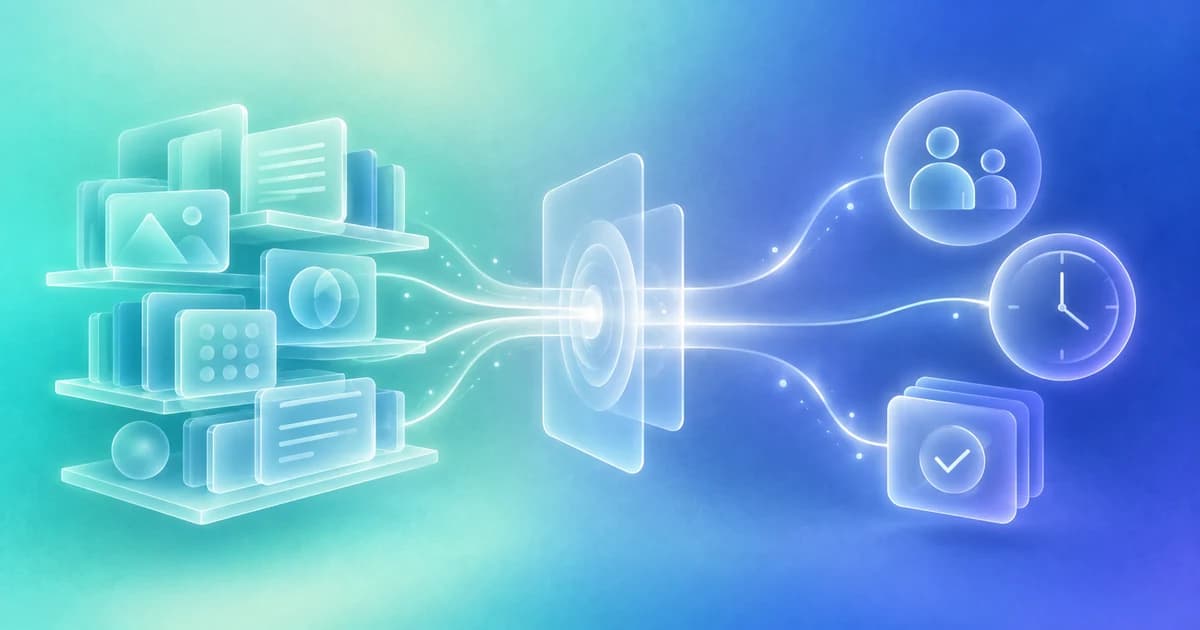
An AI second brain helps organize and retrieve useful knowledge; a personal intelligence hub connects relevant knowledge to relationships, timing and active commitments. These capabilities can coexist in the same system. This guide compares the library, working context and follow-through jobs, then shows how to bridge a few trusted sources into one active responsibility without migrating everything or treating every note as a task.
You do not need to abandon an organized library of notes to benefit from personal intelligence. You need to decide what should happen when a piece of knowledge becomes relevant to an active responsibility.
A saved insight is valuable. A saved insight that arrives before the right conversation can be more useful still.
Start with the question you are trying to answer
In this comparison, “second brain” refers to a personal knowledge system for capturing, organizing, and retrieving information. We are not evaluating a specific author’s method or claiming that knowledge-management tools cannot support actions.
The contrast is between two questions:
What have I learned or saved about this?
What does the current situation require me to do?
The first question asks for recall and synthesis. The second also needs a goal, current evidence, an owner, and a way to track the result.
Imagine you collected excellent material about enterprise procurement. Months later, a prospective customer introduces a procurement lead into your deal. The saved research becomes useful when connected to the account, the current proposal, and the questions that person actually asked.
Without that connection, your second brain may contain the answer while your working day still feels disconnected.
Three layers worth keeping distinct
Think of your information in three layers: a library, working context, and active commitments.
| Layer | What belongs there | What makes it useful |
|---|---|---|
| Library | Research, notes, source documents, reusable knowledge. | Clear organization, retrieval, ownership, and appropriate access. |
| Working context | The relevant subset for a conversation or decision. | Selection based on the current goal rather than everything ever saved. |
| Active commitments | Agreed next steps, responsible people, and completion evidence. | A reliable way to revisit unfinished work and recognize when it is done. |
A single application may support several layers. Several applications may also work together effectively. The failure to avoid is having three conflicting copies of the same promise with no clear owner.
Our personal intelligence hub guide describes the connected experience. The implementation can remain modest: a well-maintained document library, a relationship record, and a source-linked task may be enough to start.
Do not turn every note into a task
Knowledge systems need room for ideas that are not obligations. An interesting article is not a commitment. A speculative comment is not a deadline. A brainstorming note should not automatically enter the same queue as something you promised a customer.
Before promoting a note into active work, ask what event made it actionable. Was there a direct request? Did someone accept responsibility? Has the user chosen to pursue the idea? Is there a date that actually matters?
In a fictional product meeting, “We could explore a partner program” is an idea. “I will send a partner-program outline before our next meeting” is a commitment. Preserving that distinction keeps the system useful instead of turning curiosity into an endless backlog.
Keep the original source authoritative
Summaries are useful working aids, but they are not always substitutes for the underlying evidence.
Keep a way to reopen the source and check the date, author, and context. When a source changes, decide whether the summary or task needs to change with it. A proposal from last quarter may still be useful background without being the approved proposal today.
This also helps with contradictory information. Rather than silently blending two documents, record which version governs the current decision and why. When the answer is unclear, preserve the conflict for review.
Finta Documents describes an organized library where Aurora can retrieve supported files and create deliverables from available context. That is a useful connection between stored material and work, but readers should still verify source versions and sharing permissions.
Build a small bridge instead of migrating everything
Choose one active project or relationship. Identify the few notes and documents that actually inform its next decision. Link those sources to the working record and write down the next step, responsible person, and review date.
At the next review, ask whether the connected context helped. Did it prevent repeated explanation? Did it surface the right material? Did a person complete something that otherwise might have been forgotten?
Add more information only when it solves a demonstrated gap. A hub filled with irrelevant context can become another crowded library rather than a better operating system.
For the practical sequence, use our guide to building a personal intelligence hub.
Keep the library; improve the handoff
The strongest combination is not “notes versus AI.” It is a dependable handoff from knowledge to the moment when that knowledge matters.
A second brain can help you remember what you know. Personal intelligence can help you use the right part of that knowledge in the relationship, decision, or commitment in front of you.
Do not replace a working system simply to adopt a new category label. Connect one useful piece of knowledge to one meaningful next step, then build from what proves valuable.