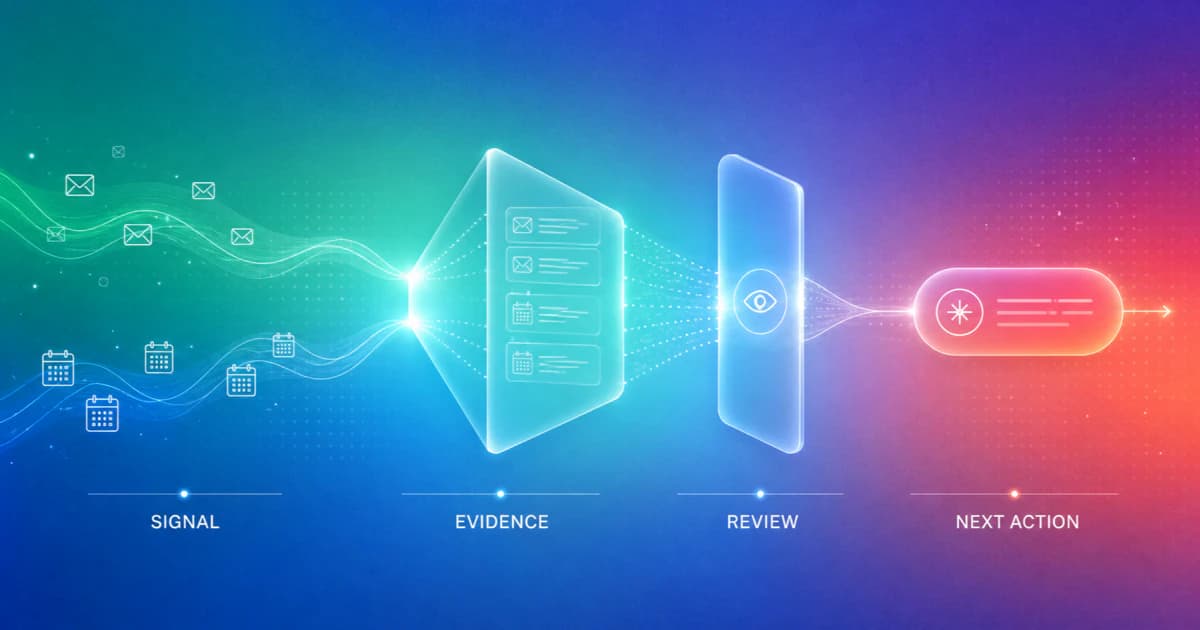
Relationship intelligence works when it preserves the difference between a signal and a decision. An email, a calendar event, a mutual connection, or a CRM stage can be useful context. None of those inputs alone establishes interest, trust, or permission to act.
Finta's product documentation describes a bounded version of this loop. Its CRM can bring supported inbox context and mutual connections into a relationship record; it can prepare drafts, but it says nothing sends automatically. Its Fundraise OS describes using selected context to help rank investors, identify warm paths, draft outreach, and prepare meetings, with the user in control. Finta CRM + Inbox Intelligence and Finta Fundraise OS are the canonical pages for those product details.
The five layers of a responsible workflow
| Layer | Input | Useful output | Required check |
|---|---|---|---|
| Capture | Permitted inbox, calendar, CRM, and network data | Source-linked signals | Was the source connected and authorized? |
| Normalize | Names, emails, companies, dates, records | One reviewable relationship record | Are identities and duplicates resolved? |
| Map | Known interactions and mutual paths | Context around a possible route | Is the evidence current and relevant? |
| Prioritize | Stage, timing, fit criteria, available signals | A proposed next action | Does the recommendation explain itself? |
| Execute | Human-reviewed draft or task | A sent message, request, or deferred action | Did a person approve the consequential step? |
The table is a Finta Editorial Team framework. It is deliberately stricter than a generic flowchart because the risks appear at the boundaries: an incomplete source can look like a complete record, and a useful suggestion can turn into an unwanted message if approval is missing.
Worked example: from a meeting signal to a next action
- Capture: an upcoming meeting appears for a target investor, and the CRM record shows the relationship has a defined owner.
- Normalize: confirm that the calendar participant, CRM contact, and company are the same person. Do not merge records on a guess.
- Map: inspect the source-supported history and any available mutual connection. Write down what is known, such as a prior conversation or a connector with relevant context.
- Prioritize: choose one proposed action: prepare meeting notes, draft a direct follow-up, or ask the connector whether an introduction would be appropriate.
- Execute: review the draft, check tone and facts, then send, edit, or decline. Record the decision and resulting stage change.
This example does not presume the meeting will occur, that the target is a fit, or that a connector will agree to help. It turns ambiguous signals into a smaller, auditable decision.
What product claims should be checked before adoption
Ask any provider to demonstrate source coverage, permissions, refresh timing, identity resolution, explanations for relationship strength, and the precise point where a human takes control. On Finta's current CRM page, inbox triage is described as working with eligible unread messages from CRM contacts, and draft replies remain reviewable. The page also states that a warm introduction request needs a usable connector email and remains a user-reviewed action. Review those current CRM details rather than assuming they apply to every inbox or integration.
Teams evaluating AI CRM agents for relationship-led teams can use the same source, permission, and approval checks before putting an agent into a workflow.
For a broader category perspective, Carta's relationship-intelligence overview describes capture, analysis, and activation as related steps. The gap to close in any actual workflow is governance: who can see which data, what counts as sufficient evidence, and who is accountable for the next move.
Limitations and safeguards
- Disconnected or unshared accounts create blind spots. Absence of a signal is not evidence that no relationship exists.
- Calendar attendance does not reveal meeting quality, intent, or consent to follow up.
- Relationship scores should route attention, not substitute for evidence or judgment.
- Drafts, requests, and stage changes need a clear owner and a review point.
Use a controlled next-action loop
Build one small workflow first: choose a permitted signal, tie it to a reviewed record, require an explanation for the recommendation, and keep sending under human approval. To inspect Finta's related product surfaces, see Finta Networks for relationship paths and Finta CRM for the relationship record and inbox workflow.
Continue the relationship intelligence playbook
- Relationship Intelligence vs. CRM: What Each System Knows and Does
- Relationship Strength Is Not Trust: How to Read Relationship Signals Responsibly
Editorial review and disclosure
Research updated August 8, 2026. Written and reviewed by Finta Editorial Team. This is general operational education, not investment, legal, tax, broker-dealer, or fundraising-outcome advice. Finta product references reflect the linked product pages on the research date. Verify current availability, permissions, integrations, and your own policies before relying on a workflow.
Sources
- Finta CRM + Inbox Intelligence
- Finta Networks
- Finta Fundraise OS
- Carta: Relationship Intelligence and Deal Flow
Related guide: Personal intelligence vs. relationship intelligence.