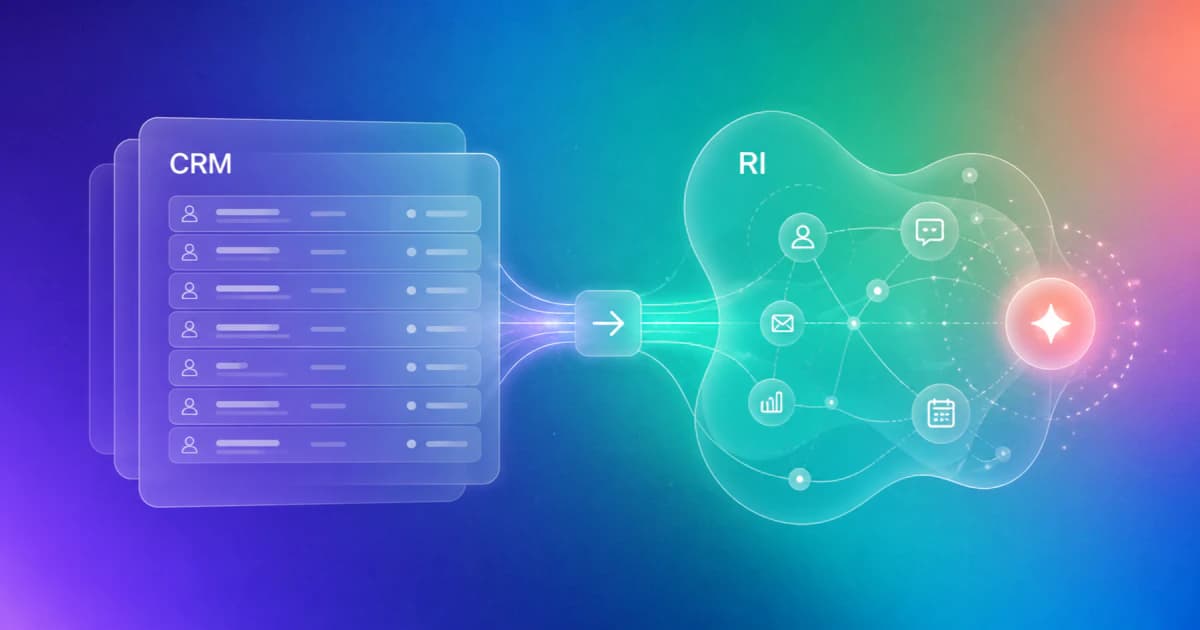
Short answer: a CRM should give a team a reliable operating record. Relationship intelligence should help the team inspect available relationship evidence and decide what to do next. They overlap, but they are not interchangeable.
That distinction matters most when a fundraising or relationship-led team has a clean pipeline but still asks, who knows this person, what has happened recently, and is an introduction appropriate? Finta describes its CRM as bringing a relationship's stage, research, mutual connections, and supported inbox context into one record. Its Networks product is the canonical product destination for relationship strength and warm paths. Finta CRM + Inbox Intelligence and Finta Networks therefore belong in the same operating loop, rather than being treated as duplicate databases.
The label relationship intelligence is used differently across vendors. For example, Carta's current category overview describes relationship intelligence in the private-capital context as capturing, analyzing, and activating relationship data. That is useful category language, not a universal product specification. A team's real test is whether it can trace a recommendation back to evidence and preserve human judgment before outreach.
What each system should know
| Operating question | CRM should own | Relationship intelligence should add | Human decision |
|---|---|---|---|
| Who is this? | Contact, company, role, owner, stage, notes | Available interaction and mutual-path evidence | Is this the correct person and record? |
| Where are we in the process? | Pipeline stage, next task, meeting history, outcome | Recent signal that may change priority | Should the stage or next task change? |
| How could we reach them? | Approved contact channel and communication history | Possible connector and path context | Is a warm request appropriate and welcome? |
| What should happen next? | Assigned task and accountable owner | Evidence-backed prompt or draft | Approve, edit, defer, or decline the action |
This table is an editorial operating framework, not a claim that every CRM or relationship-intelligence product has the same fields. It prevents a common failure mode: treating a connection score as if it replaces a source of truth, a contact owner, or a person's judgment.
A worked record, evidence, decision framework
- Record: put the investor or partner in the CRM with the stage, owner, and agreed next step.
- Evidence: attach only the available and permitted history that explains the relationship, such as a relevant thread, a recent meeting, or a mutual path.
- Interpretation: ask what the evidence actually supports. A connector may know the target, but the record may not establish current context or willingness to introduce.
- Decision: create a reviewable task, direct message, or introduction request. Keep the decision and outcome on the record.
Finta's CRM product page makes the control boundary explicit: a warm-introduction request can be prepared from a relationship record, but the user reviews and sends it, and no introduction or outcome is guaranteed. Read the Finta CRM product details. This is the design principle to preserve even if a team uses a different stack.
What changes in practice
If the team only has a CRM, the next move can depend on memory or manual research. If it only has a relationship graph, its operating history can become disconnected from stages, tasks, and ownership. The useful design is an evidence-to-action loop: CRM holds the accountable workflow, relationship intelligence makes relevant context easier to inspect, and a human makes the consequential choice.
For a current market comparison perspective, Rolodex's CRM versus relationship-intelligence article similarly treats the categories as related but different. Treat that as a vendor's market framing, then verify each tool's actual data source, permissions, and handoff behavior in your own trial.
Limitations and safeguards
- A visible mutual connection is not consent to ask for an introduction.
- A relationship signal is not proof of investor fit, trust, or likely response.
- Available data is bounded by the systems connected, their permissions, and data quality.
- Do not let a relationship layer silently overwrite the CRM record or send messages without approval.
Put the distinction to work
Start by choosing one recent target. Confirm the CRM record, inspect the available relationship context, then document why the next step is a direct message, a warm request, or more research. If you want the product destinations for that workflow, review Finta CRM for the working relationship record and Finta Networks for relationship paths and evidence.
Continue the relationship intelligence playbook
- How Relationship Intelligence Works: From Inbox and Calendar Signals to Next Actions
- How to Evaluate Relationship Intelligence Software: A Buyer’s Scorecard
Editorial review and disclosure
Research updated August 8, 2026. Written and reviewed by Finta Editorial Team. This is general operational education, not investment, legal, tax, broker-dealer, or fundraising-outcome advice. Finta product references reflect the linked product pages on the research date. Verify current availability, permissions, integrations, and your own policies before relying on a workflow.
Sources
- Finta CRM + Inbox Intelligence
- Finta Networks
- Carta: Relationship Intelligence and Deal Flow
- Rolodex: CRM vs. Relationship Intelligence
Related guide: Compare personal and relationship intelligence.