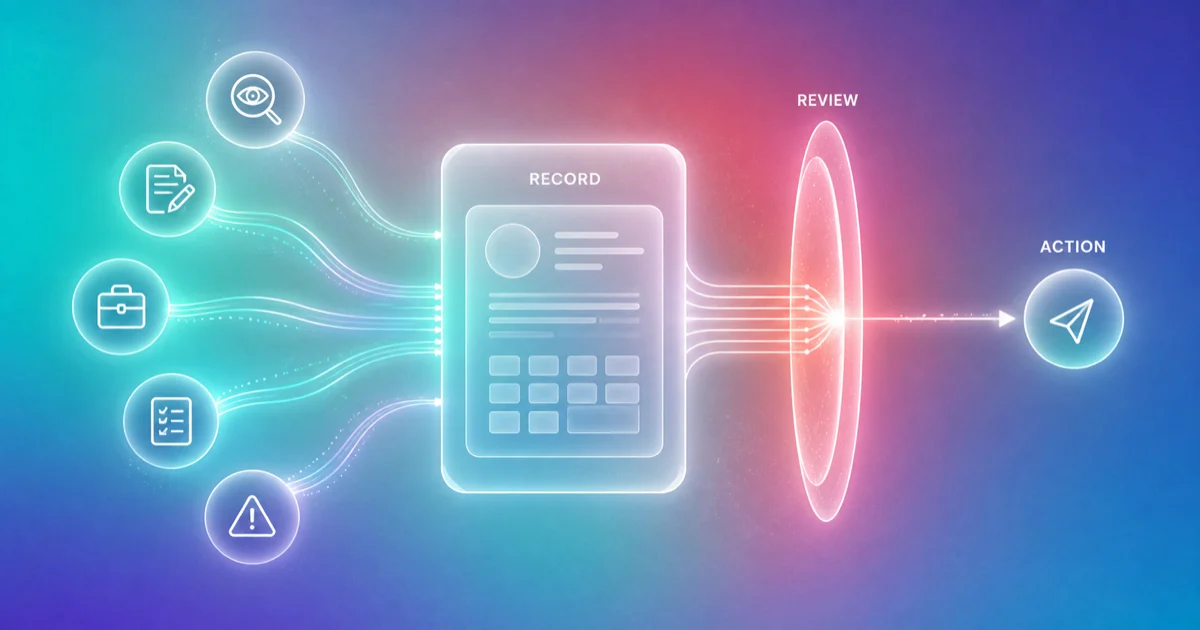
CRM AI automation is most useful when one clear job produces a record your team can trust. Start with a permitted signal, ask an agent to prepare a source-linked summary or proposal, and have a named person review the next step. This guide maps agent responsibilities, approval boundaries, and pilot measures for relationship-led teams.
The category can be confusing because an agent that reads a CRM and an agent that acts inside a CRM are different designs. Salesforce's CRM-agent guide frames this as a connected-versus-native architecture distinction. Treat that as a vendor's category framing, not a universal standard or a claim about Finta. The operational test for any team is simpler: what information can the agent see, what can it change, where is the action recorded, and who owns the result?
Start with a relationship-agent job map
| Job | Bounded agent contribution | Required record | Human responsibility | Useful measure |
|---|---|---|---|---|
| Observe | Surface a permitted, relevant signal. | Source and observed time. | Decide whether the signal matters. | Relevant signals reviewed. |
| Prepare | Summarize a thread, meeting, or open ask. | Source links and uncertainty. | Correct missing context or framing. | Briefs accepted with material edits tracked. |
| Propose | Suggest a task, stage update, or draft. | Reason and proposed action. | Approve, revise, defer, or reject. | Proposals with an accountable disposition. |
| Record | Place approved facts and outcomes in the relationship record. | Owner, date, and source. | Confirm the update is accurate. | Duplicate or stale records found in review. |
| Execute | Prepare a communication or workflow handoff. | Approval state and final content. | Choose whether to send or take the consequential action. | Actions with a documented reviewer. |
This is a Finta Editorial Team operating framework. It does not claim that every CRM agent supports every job, or that a high score on one task makes the system safe for another.
An AI CRM agent executes bounded jobs. Relationship intelligence supplies the permitted evidence, relationship ownership, and decision context those jobs should respect. The useful output is a reviewable next action, not a prediction that someone will respond or permission to contact them. See how relationship intelligence works for the broader record, evidence, and next-action model.
A practical pilot: observe, prepare, propose, record, review
- Observe: choose one permitted event, such as a new reply from an existing CRM contact.
- Prepare: ask the agent to create a short source-linked summary, not an unsourced judgment about intent.
- Propose: ask for one next task or draft, including the evidence it used and the information it could not verify.
- Record: store only approved facts and the reviewer decision on the CRM record.
- Review: compare the proposal with the source and decide whether to act, edit, defer, or discard it.
Finta's current CRM page describes a relationship record that can keep pipeline stage, available research, mutual connections, and supported inbox context together. It also says provider-backed drafts remain reviewable and nothing sends until a person chooses Send. Review the current Finta CRM details. Those statements describe the linked product page, not a claim that Finta autonomously makes consequential relationship decisions.
What to measure before expanding scope
A useful pilot has a small scorecard. Track source availability, record accuracy after review, proposal acceptance or rejection reasons, elapsed review time, and the percentage of suggested actions that had a named owner. Do not treat sent volume, number of drafts, or the mere presence of AI as success. A CRM agent that creates more messages while making the record less trustworthy has failed the relationship workflow.
For the approval rules themselves, use the existing canonical guide, Where AI Should Stop: Human Approval Rules for Relationship Workflows. For the broader sales cadence that follows a reviewed record, see Relationship-Led Sales: A Practical Playbook for Founder-Led Teams.
Limitations and safeguards
- A CRM record may be incomplete, stale, or inconsistent across connected systems.
- A draft is not evidence of intent, consent, investor fit, or likelihood of reply.
- Permissions, provider availability, and policy constraints can limit what a workflow can see or do.
- Do not broaden an agent from preparation into outreach or sensitive record changes without a separate, evidence-based review.
Use Finta for a reviewable relationship record
Finta CRM keeps pipeline stage, available research, mutual connections, and supported inbox context on a relationship record. Aurora can prepare next steps from available workspace and supported-connection context and show current source or tool receipts. For supported one-off messages, a person remains responsible for review and Send. These product details describe a review surface, not an autonomous relationship agent.
Editorial review and disclosure
Research updated August 10, 2026. Written and reviewed by Finta Editorial Team. This article is general operational education, not investment, legal, tax, broker-dealer, security, or fundraising-outcome advice. Architecture descriptions from other vendors are cited as category context. Finta references reflect only the linked product pages on the research date and do not describe Finta's internal agent architecture, security controls, or autonomous action capabilities.