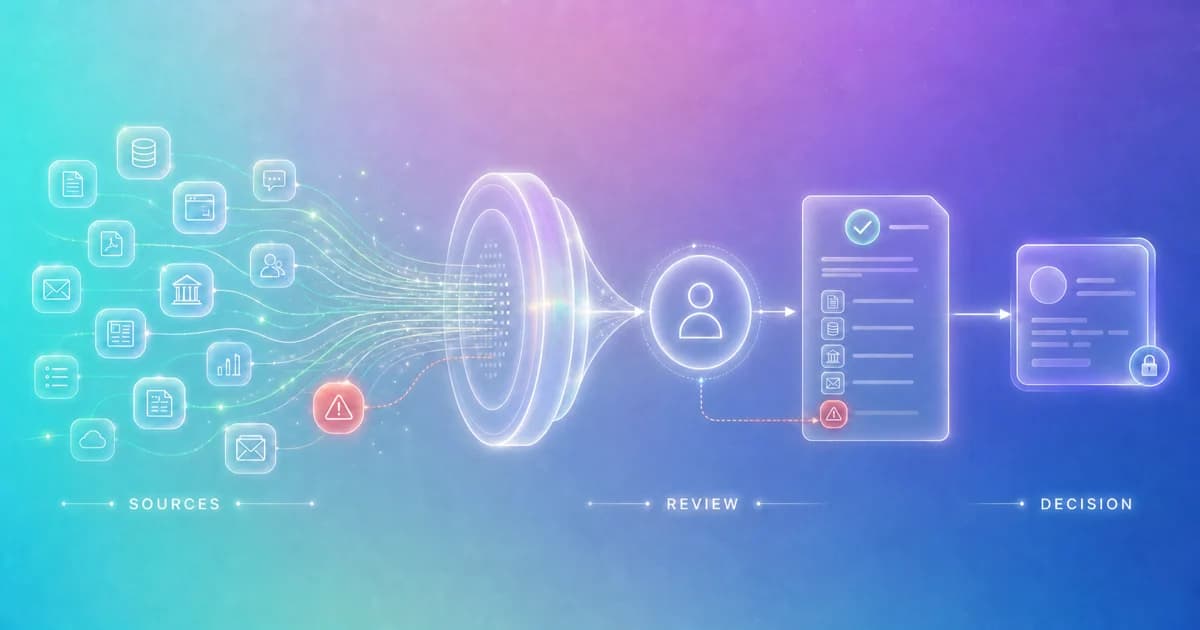
Direct answer: Use deep research to prepare a source-to-decision memo, not an autonomous investor-selection or outreach system. A good memo separates factual evidence, open questions, relationship context, the decision owner, and the next action that still needs human review.
OpenAI describes Deep Research as producing documented reports with citations, while also acknowledging that the system can make incorrect inferences and may not convey uncertainty accurately. Read OpenAI's Deep Research overview and limitations. That is why a long, cited report should be an input to a founder or investor-relations workflow, not the final authority on fit, timing, or a sensitive relationship decision.
The source-to-decision memo
| Memo element | What to capture | What it does not establish | Owner before action |
|---|---|---|---|
| Research question | The decision to inform, date range, geography, and known constraints. | That the question has a single objective answer. | Founder or relationship owner. |
| Source plan | Primary company, fund, regulatory, and directly relevant sources to inspect. | That all public information is current or complete. | Research reviewer. |
| Evidence ledger | Claim, source, access date, supporting section, conflict, and uncertainty. | That a citation alone entails the claim. | Research reviewer. |
| Relationship context | Permitted history, possible connector, recency, and known permission status. | Trust, endorsement, or willingness to introduce. | Relationship owner. |
| Decision | Research further, request permission, prepare direct outreach, or defer. | Investor interest, a meeting, or capital. | Founder or designated approver. |
| Record and follow-through | Decision, rationale, next task, reviewer, and outcome. | That the next action will be completed automatically. | Accountable task owner. |
This is an editorial framework. It is intentionally cautious because investor research and relationship work can affect reputation, time, confidential information, and fundraising decisions.
A worked workflow for a prospective investor
- Scope the question: define what needs to be learned, such as whether a firm's stated focus appears relevant to a company's current stage and sector.
- Collect primary evidence: inspect the firm's current site, relevant partner pages, portfolio information, announcements, and any other sources that directly bear on the question.
- Log uncertainty: record gaps, conflicting sources, and facts that require confirmation. Do not fill gaps with assumptions about check size, lead behavior, or willingness to meet.
- Separate relationship evidence: note any permitted direct history or possible connector, but do not convert a connection into an implied endorsement.
- Choose the next action: assign a person to research further, seek the connector's permission, prepare a direct note, or defer.
- Review before contact: compare the intended message with the memo and approve the final claim, recipient, and timing.
Finta Fundraise OS is presented as a workflow for investor pipelines, research, warm paths, outreach drafts, and meeting preparation. Aurora describes source and tool receipts and review boundaries, while CRM keeps the reviewed next task attached to the relationship record. These product statements do not mean Finta performs deep research, validates every source, chooses investors, or sends consequential communications autonomously.
Why relationship context has its own column
Research about an investor and evidence about a relationship answer different questions. A firm's public materials may help establish relevance. A real thread, meeting, or connector may inform whether a particular outreach path is appropriate. Combining them without labels can make a weak path look stronger than it is. That separation is the relationship intelligence layer: fit, access, timing, owner, and permission remain distinct.
Finta Networks exposes relationship-strength bands with source and evidence, and states that strength is not the likelihood of an introduction. Treat a possible connector as a path to ask about, then keep permission, review, and the final send decision with the named relationship owner. Use How to Build an Investor Relationship Map Before You Raise to keep target fit and path evidence distinct, and use Warm Introductions vs. Cold Investor Outreach for the motion decision.
Limitations and safeguards
- Public information may be stale, incomplete, promotional, or not applicable to a current fundraising context.
- Do not treat a researched profile as investment advice, a fundraising forecast, or evidence that an investor will meet.
- Protect confidential internal information and use only permitted relationship context in a memo or outreach draft.
- Keep human review before making claims about a firm, asking a connector for help, or contacting a prospective investor.
Move the reviewed memo into a working raise
After review, move only the approved decision, cited notes, named owner, and next task into the raise. Fundraise OS can organize the investor pipeline and warm-path workflow, with the user in control. It does not establish source verification, investor selection, or autonomous outreach. See Deep Research AI Agent Architecture for the evidence and verification pattern behind the memo.
Editorial review and disclosure
Research updated August 10, 2026. Written and reviewed by Finta Editorial Team. This article is general educational material, not investment, legal, tax, broker-dealer, security, or fundraising-outcome advice. It does not recommend investors or assert that a researched person, firm, connector, or route is appropriate. Finta product references reflect the linked product pages on the research date and do not claim that Finta provides autonomous investor selection, source verification, or consequential outreach.
Sources
- OpenAI: Introducing Deep Research
- OpenAI: Deep Research API Guide
- Finta Fundraise OS
- Finta CRM + Inbox Intelligence
Related guide: Meet an AI research teammate.