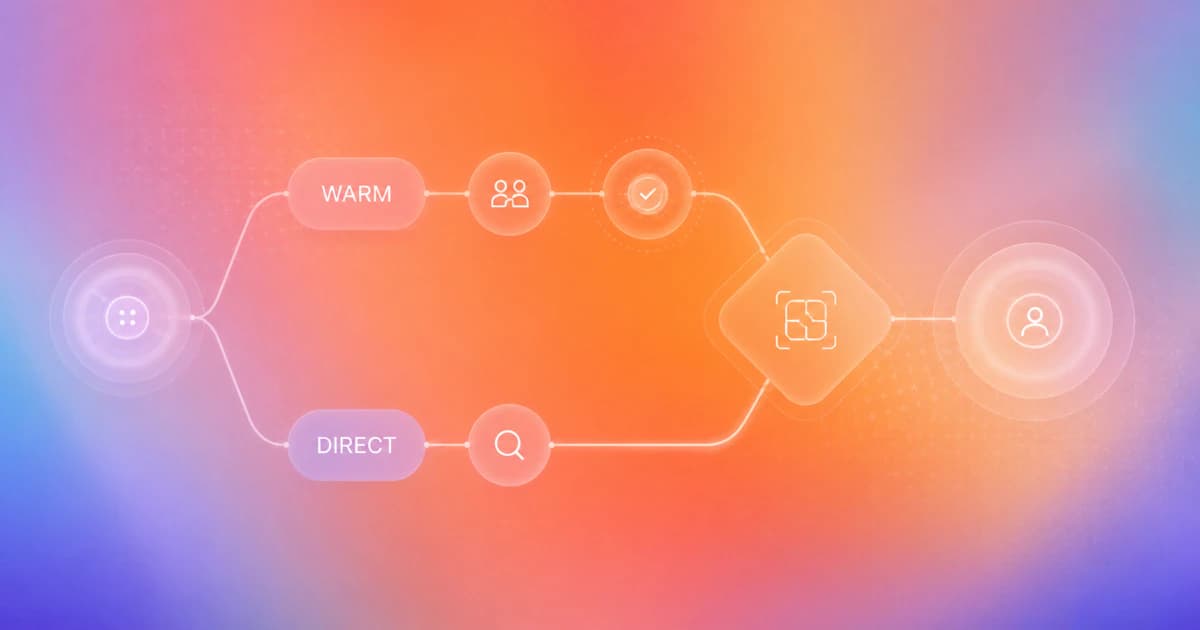
Choose a warm introduction when there is relevant context and a willing connector. Choose direct outreach when the target is a strong fit but no credible, permissioned route exists. Neither path guarantees a meeting or capital. The right choice is the one that respects the people involved and gives the founder a clear, reviewable next action.
This is not a claim that warm outreach universally outperforms cold outreach. It is a decision framework for avoiding two common mistakes: asking every visible connection for an introduction, or waiting indefinitely for a perfect warm path before contacting a well-matched investor directly.
The fit, context, consent, timing framework
| Situation | Fit | Context and consent | Recommended next step |
|---|---|---|---|
| Strong target fit and a connector with current, specific context | Clear | Connector is likely able and willing to assess a request | Ask the connector whether a brief introduction would be welcome |
| Strong target fit but no known warm route | Clear | No connector to burden | Prepare concise, researched direct outreach |
| Visible mutual connection with stale or unclear context | Uncertain | Permission not established | Refresh context or ask permission before requesting an introduction |
| Low target fit and a possible connector | Weak | Even a willing connector may not change the mismatch | Research further or defer the request |
| Time-sensitive event with incomplete information | Potentially clear | Consent or context still missing | Use a low-pressure direct note or wait, rather than forcing an intro |
This table is a Finta Editorial Team decision framework. It is intentionally not a conversion model. It helps a founder document why a path is appropriate before an outreach action is made.
Worked decisions
- Warm request: You have a strong target fit, a connector who recently discussed the investor's thesis with you, and enough context to make the ask easy to decline. Write a short request that includes the reason for fit, a lightweight forwardable blurb, and explicit permission to say no.
- Direct outreach: You have a strong target fit but no consented connector. Research the target's current focus, keep the message concise, and state why the company is relevant. Do not imply a relationship that does not exist.
- Wait and research: A mutual connection exists but the evidence is old or unclear. Confirm the relationship and timing before you put the connector in the middle. A delayed, respectful decision is often safer than a speculative request.
Finta's CRM documentation describes a related control boundary: it can surface available mutual connections and prepare a prefilled introduction request, but the connector needs a usable email, the user reviews and sends the request, and no introduction or outcome is guaranteed. Review the Finta CRM warm-introduction details.
Do not blur pathway discovery with introduction orchestration
Finding a possible path and managing an introduction are different jobs. A potential route may appear in a relationship graph. A true warm introduction requires a connector's choice, appropriate context, and follow-through by several people. Vendor category language reflects that difference: Boomerang's warm-introduction software page describes a dedicated introduction workflow. Treat that as a reminder to confirm what a given tool actually manages before assuming it will handle every step.
For founder fundraising, Finta's Fundraise OS page describes an investor pipeline, a warm-intro system, outreach templates, and human review of sensitive outreach. See the current Fundraise OS workflow. Use this article to choose the motion, then use the product workflow to organize the work and record the result.
Simple scripts that preserve agency
Permission check: I am considering reaching out to this investor because of a specific fit. Do you know them well enough to say whether a brief introduction request would be appropriate? No pressure if not.
Forwardable request: If you are comfortable introducing us, here is a short note you can edit or ignore. It explains the company, why the investor may be relevant, and gives them an easy way to decline.
Direct outreach posture: I am reaching out directly because the firm's stated focus appears relevant. If this is not the right person or timing, I would appreciate a quick redirect rather than an introduction you do not want to make.
Limitations and safeguards
- A warm path is not an endorsement and should not be presented as one.
- Direct outreach still requires accurate claims, thoughtful targeting, and respect for preferences.
- Do not use private context in a message unless you have permission to do so.
- Neither route establishes investor suitability, interest, or a fundraising result.
Choose a motion, then track the outcome
For each target, record fit, available context, permission status, chosen motion, owner, and outcome. If you need an integrated founder workflow, start with Finta Fundraise OS; for the canonical product view of available relationship paths, see Finta Networks.
Continue the relationship intelligence playbook
- How to Build an Investor Relationship Map Before You Raise
- How to Track Warm Intro Requests Without Burning Out Your Network
Editorial review and disclosure
Research updated August 8, 2026. Written and reviewed by Finta Editorial Team. This is general operational education, not investment, legal, tax, broker-dealer, or fundraising-outcome advice. Finta product references reflect the linked product pages on the research date. Verify current availability, permissions, integrations, and your own policies before relying on a workflow.