Fundraising Operations
What Not to Delegate to an AI Agent
Decide which AI work can remain preparation, which actions need specific authority and which decisions stay with people.
What you will learn
- Separate preparation, action authority and accountable human judgment.
- Set source and disclosure boundaries for a real task.
- Review the exact action and inspect the resulting state.
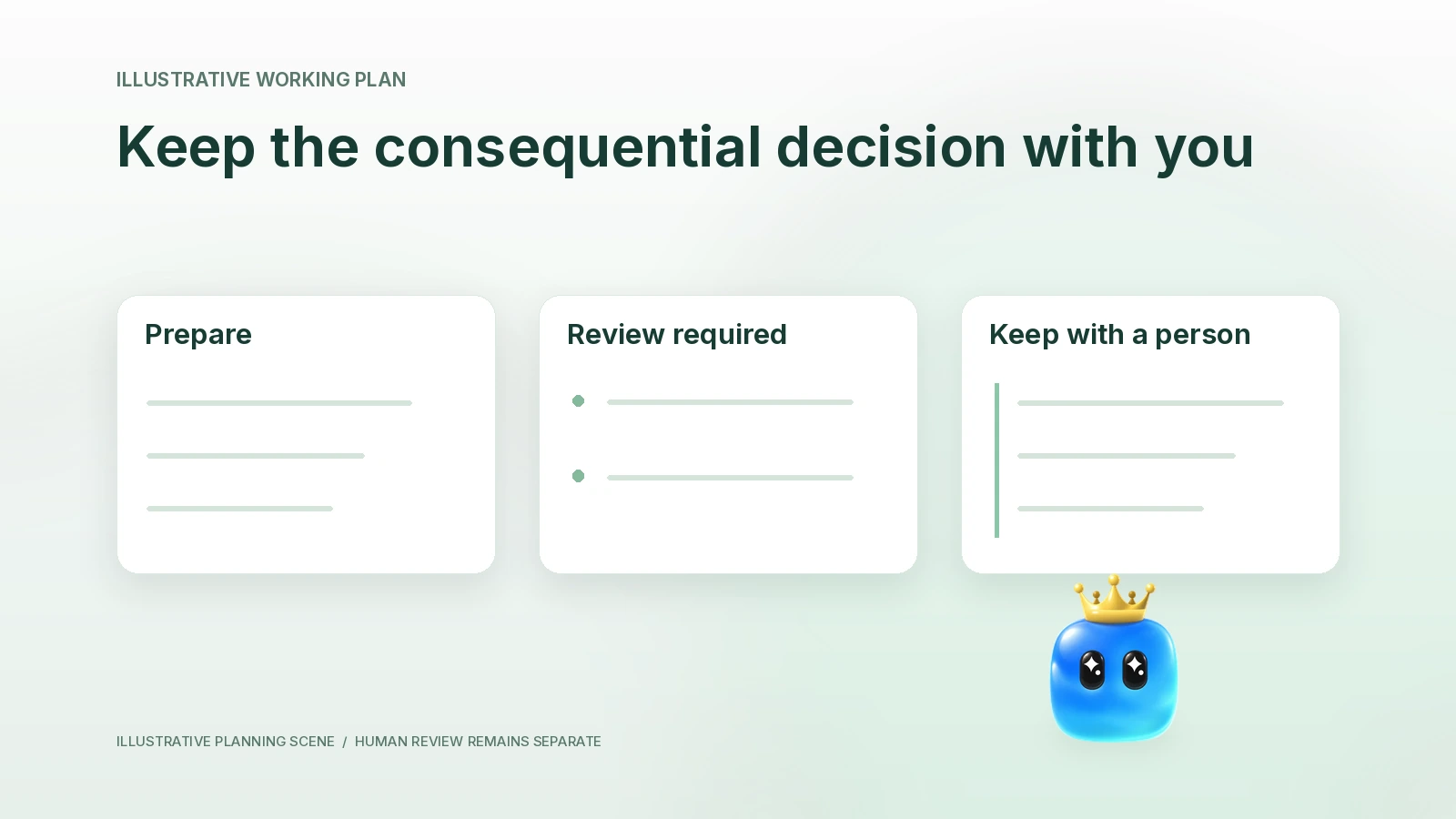
Delegate preparation more readily than authority. An AI agent can help gather permitted evidence, organize questions and draft a proposal, but a source connection or a confident answer does not authorize disclosure, a commitment or a consequential decision. Define the action boundary for the actual task and account before work begins.
Source check: October 22, 2026. This is an operating worksheet based on current Aurora concepts and documented tool boundaries. It does not claim that every write has the same approval mechanism or that any product guarantees safe outcomes.
Use an authority card for the task
Write the audience, permitted information, allowed output and action owner. “Help with fundraising” is too broad. “Prepare a private evidence review from this approved packet; do not contact investors or update records” is inspectable.
| Lane | Reasonable bounded work | Boundary to preserve |
|---|---|---|
| Read and prepare | Summarize permitted sources, identify uncertainty and draft internal questions. | Stay within the actual account, source scope and intended audience. |
| Review required | Propose a record change, external message, task assignment or disclosure. | Inspect exact target, content, owner, timing and expected result before an authorized action. |
| Keep with accountable people | Resolve legal interpretation, investment judgment, hiring decisions or an uncertain external commitment. | Use AI for evidence and alternatives; retain appropriate human judgment and specialist review. |
| Do not delegate in this task | Expose credentials, bypass access controls, invent missing evidence or act outside the owner's authority. | Stop, reduce scope or obtain the proper decision through normal channels. |
These are operating boundaries, not a claim that all contexts carry identical risks. A public source summary and a confidential financing disclosure require different review. Connected tools can make an action possible without making it appropriate.
Keep confidential material tied to its audience
Ask which people may see the source and the derived output. A private note can reveal more than its headline: names, negotiation positions, health detail or an internal estimate may be inappropriate in an external message even when the summary is accurate.
A shared role definition does not share a user's private App account. Conversely, naming a role “public research” is not a technical partition that limits all its available tools. Check the actual source access, provide only needed material and state disclosure limits in the task.
Do not turn missing evidence into authority
Require the output to distinguish facts, estimates, requests, accepted commitments and unknowns. A positive meeting is not an investment commitment. A calendar invitation does not prove attendance. A proposed deadline is not an accepted promise. A tool call queued for later is not a completed action.
If the task involves a financial figure, legal statement or material product claim, inspect the primary source and its date. Use the source verification worksheet before the statement travels into an investor-facing draft.
Fictional worked example: a tempting introduction
The invented founder Robin has an internal note saying that a prospective investor “may be interested after another review.” Robin asks for an introduction email. A careless draft says the investor has committed and attaches a confidential appendix.
The reviewer rejects both moves. The evidence supports an ongoing discussion, not a commitment. The appendix is not approved for this audience. A useful revised output prepares a private question list, a narrower draft using the cleared overview and an explicit decision about whether to contact the recipient. Nothing is sent in this exercise.
Review the exact consequential step
| Check | Ask before action | Receipt afterward |
|---|---|---|
| Identity | Is this the intended account, organization, person and record? | Actual target identity matches the reviewed one. |
| Authority | Does this person control this action and disclosure? | Action stayed within the specific authorization. |
| Content | Is the complete payload accurate and permitted? | Saved/sent content matches the reviewed version. |
| State | Is the source current and the action still needed? | Readback shows what changed, failed or remains pending. |
| Follow-through | Who handles an error or unresolved result? | Owner and next decision are recorded without claiming reversal. |
Do not rely on a general “be safe” instruction or an approval expectation from another tool. Finta documents action-specific confirmations for selected MCP operations. Other actions can have different controls. Inspect the actual tool and requested payload.
Scheduling is a separate authority decision
A recurring responsibility can prepare drafts for review. A routine does not inherit unlimited permission from its existence. Aurora also has a separate owner-authorized routine email recipient setting; that exception makes broad claims that every email always needs fresh approval inaccurate.
For this worksheet, keep external messages in draft. Changing a recipient allowlist, enabling a routine or granting access is outside the exercise. If recurring action is later authorized, record the exact scope and owner, inspect the real state and decide how errors will be noticed.
Review the delegation boundary for this task in Aurora AI in Finta, Claude or Codex.
Task and intended audience: [details]. Permitted sources and dates: [references]. My actual authority: [details]. Allowed output: [read/summarize/draft]. Explicitly forbidden actions and disclosures: [details].
Classify each requested step as preparation, a specific action requiring review, an accountable human decision, or outside this task's authority. Explain uncertainty and missing evidence. Distinguish documented capability from currently available tools and a completed action.
Return a small authority card, a safe preparation output and the exact unresolved decisions. Do not send, save, assign, disclose, connect accounts, change permissions or enable routines from this request. Do not invent facts, legal conclusions, commitments or a claim that universal approval controls protect the task.
Common questions
Does a connected account mean I approved every action?
No. Account authorization makes specific tools available. The task, disclosure and action still need appropriate authority and review.
Can I ask AI to help with a consequential decision?
Yes, as preparation: organize evidence, assumptions, alternatives and questions for the accountable reviewer. Do not substitute a fluent answer for the judgment or specialist review the decision requires.
What if the source or authority is unclear?
Hold the affected step. Prepare the question that would resolve it, or reduce the task to a permitted internal draft.
Put these limits into a responsibility plan and practice them with one small reviewed task.