Fundraising Operations
Your First Seven Days with an Aurora Agent
Practice one Aurora responsibility through seven checkpoints before adding sources, roles or scheduling.
What you will learn
- Define a small useful first responsibility.
- Review source coverage, correct an error and repeat the task.
- Decide whether to keep, narrow or expand without enabling actions by default.
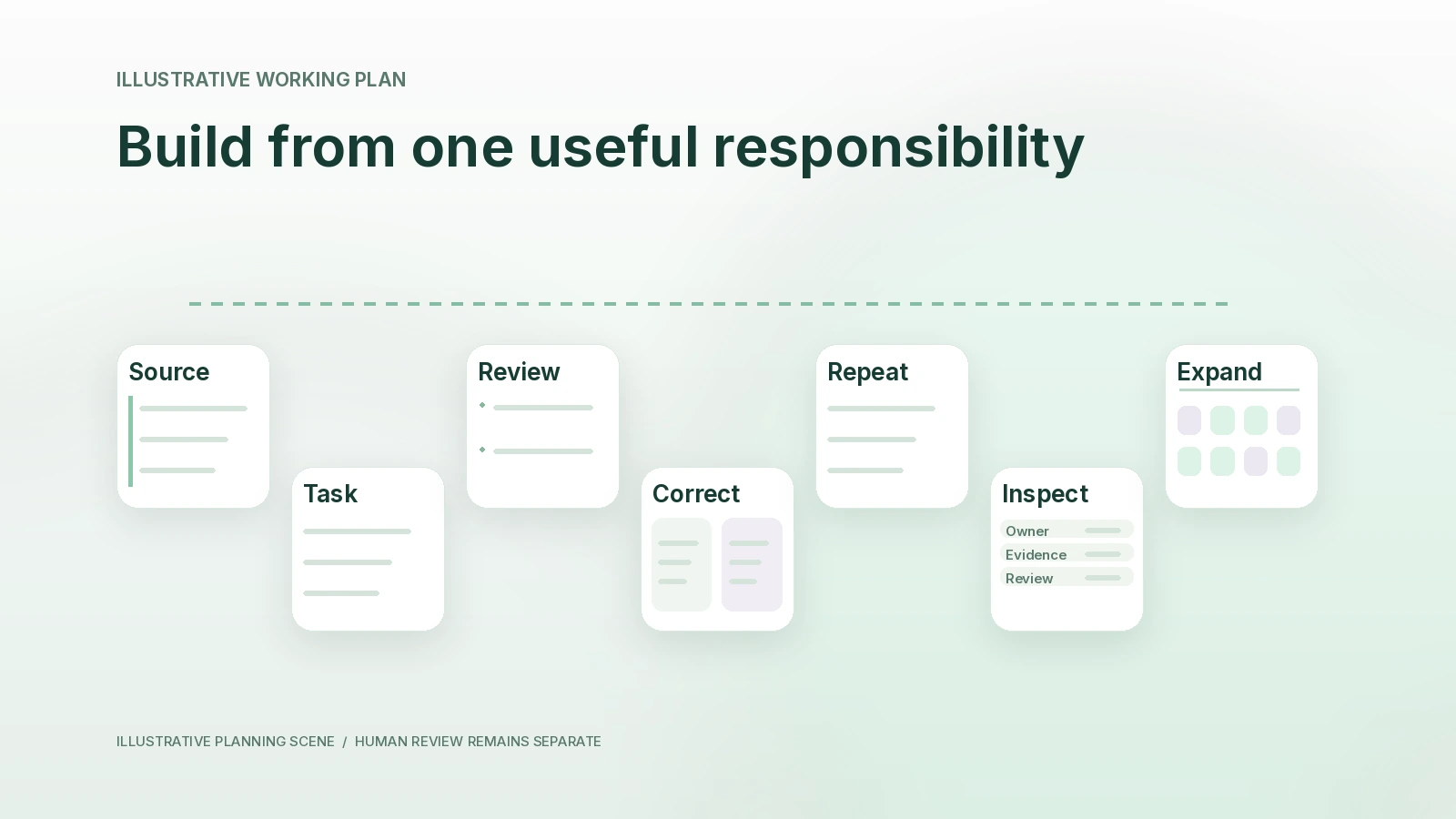
Start an Aurora responsibility with one useful task, one permitted source and a reviewed output. Repeat the task after correcting an error before adding more sources, roles or scheduling. The seven checkpoints below can take seven days or a different pace; they are a practice sequence, not an automatic onboarding program or a promise of saved time.
Source check: October 22, 2026. This plan uses current Aurora concepts and actual Skill identities. It is a teaching exercise, not a newly recorded product run. Feature and organization access must be available in your account; use ordinary Aurora with a bounded request if a named responsibility is unavailable.
Choose a small first job
Pick work you can inspect: summarize one permitted relationship note, prepare questions for one meeting or identify open questions in a company brief. Avoid starting with an entire inbox, a broad research mandate or external sending. A clear output makes it possible to notice whether the source was misunderstood.
Write one sentence: “For [reader], use [permitted source] to prepare [artifact], leaving [action] for review.” If you cannot name the reader or source, reduce the task before setting up more.
The seven-checkpoint practice log
| Checkpoint | Practice | Keep this artifact | Advance only when |
|---|---|---|---|
| 1. Define | Choose one recurring reader need and a bounded output. | Responsibility sentence and read/draft boundary. | The reviewer can explain a useful result. |
| 2. Scope | Supply one permitted dated source or check one known connected item. | Source identity and coverage receipt. | The source and account are correct. |
| 3. Review | Request the first artifact with sources and unknowns. | Accepted passages, corrections and rejected claims. | Material claims can be traced. |
| 4. Correct | Resolve one error and decide where the correction belongs. | Correction record and revised artifact. | The same error no longer appears in the repeat task. |
| 5. Challenge | Supply an incomplete or conflicting source case. | Escalation or explicit unknown. | The output does not invent the missing fact. |
| 6. Repeat | Try another comparable packet manually. | Side-by-side quality review. | The job remains useful and the review burden is acceptable. |
| 7. Decide | Keep, narrow, stop or propose one addition. | Next-step decision and owner. | The addition solves a demonstrated gap. |
Each checkpoint is user-triggered or manual in this plan. The worksheet does not enable a routine, create a team or authorize an external action.
Correct the right layer
A wrong answer can come from different places. A typo in the supplied note needs a source correction. An unclear output format needs an instruction correction. An outdated remembered fact needs the available memory controls and source review. A temporary exception may belong only in this task.
Do not assume that editing one answer updates every conversation, saved memory or downstream draft. Inspect the context used for the repeat task. Remembered context follows the authorized user and organization with its settings and limitations; it is not an unlimited, guaranteed record of everything.
Fictional worked example: one meeting brief
At the invented company Cedar Bench, a founder chooses to prepare questions for an upcoming supplier meeting. She supplies a permitted company description and a dated email excerpt. Her first output incorrectly treats a request for pricing as a purchase commitment. She marks the sentence rejected and changes the instruction to preserve the difference between interest, request and agreement.
For the challenge checkpoint she removes the delivery date. A useful response says the date is unknown and prepares a question; it does not manufacture a deadline. For the repeat checkpoint she supplies another permitted supplier note and checks whether the same distinction is preserved.
Her final decision is to keep one meeting-preparation responsibility. She does not add an outreach role because the evidence shows no need for it. This is a fictional review log, not a claim about observed Aurora performance.
Use real playbooks where they fit
The Daily Meeting Prep template is a relevant playbook for preparing a meeting overview. The Post Meeting template serves a different job after reviewed notes exist. Choosing a Skill does not connect a source, transfer a private App account or approve an update.
A portrait or role name helps organize the responsibility. Actual tools still follow account authorization and organization resources. Begin with the available, supported setup; do not change access, plan or billing to force an unavailable exercise.
Scheduling comes after a useful repeat
If a repeated task truly needs a schedule, first write a proposal: exact source coverage, output, cadence, owner, review destination and stop condition. Aurora routines are separate scheduled configurations and begin disabled. A persistent role is not continuously working merely because it exists.
This practice plan remains draft/review. Any owner-authorized routine email recipient setting is a separate explicit decision. Do not treat a schedule, article or template as permission to send or disclose information.
Guide me through one practice checkpoint in Aurora AI in Finta, Claude or Codex.
Checkpoint: [1–7]. Reader and task: [details]. Permitted source/date and account scope: [details]. Review boundary: [read or draft only].
Prepare the checkpoint artifact, not the whole week at once. Show source references, assumptions and unknowns. Preserve the difference between a request, discussion and accepted commitment.
If I provide a correction, identify whether it belongs to source text, task instructions, available memory controls or this one task; do not claim it changed elsewhere without checking. Do not connect accounts, save records, send, schedule, install or add roles. Ask me to review the evidence before the next checkpoint.
Common questions
Do I have to finish in seven calendar days?
No. Advance when the review criteria are met. An unresolved source or identity issue is a reason to pause the exercise.
What counts as success?
A useful, source-traceable output with manageable corrections and explicit limits. Record your own review; this guide supplies no measured accuracy or time-saving claim.
When is another agent justified?
When the practice reveals a distinct responsibility with its own output and owner. First see whether clearer instructions or a smaller task solves the issue.
Use the responsibility-plan library for the next choice and the memory and context guide for correction controls.