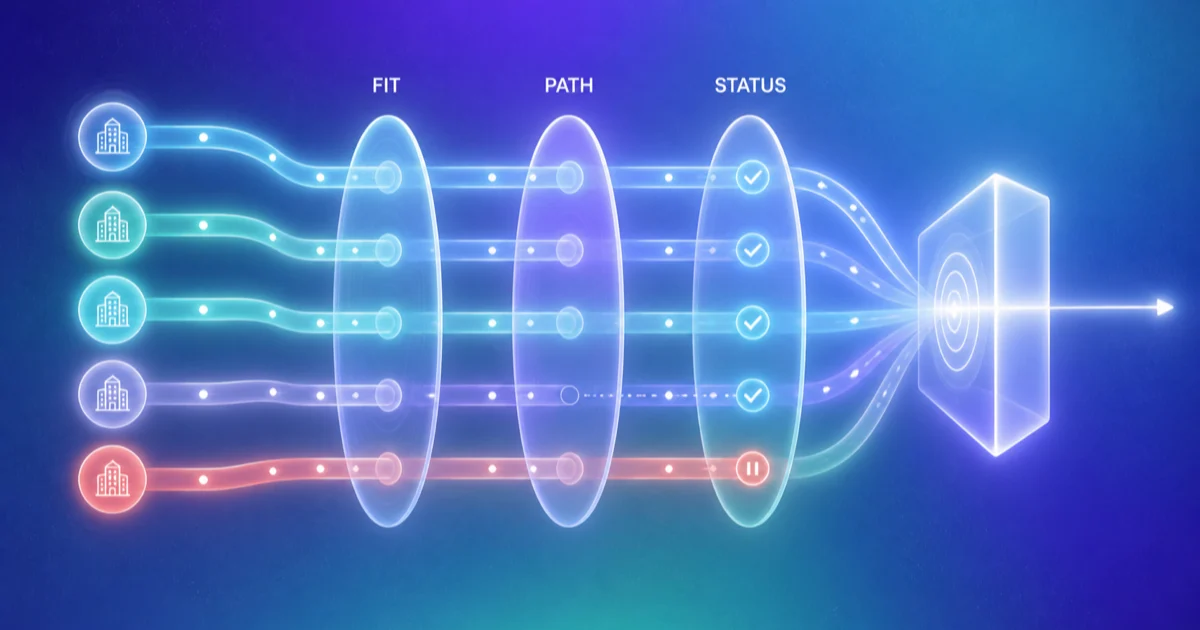
Short answer: An M&A buyer coverage matrix is a mandate-specific working view that keeps buyer fit, a sponsor-appetite hypothesis, relationship path, and process readiness separate. A buyer can be strategically relevant but not ready for contact. A strong relationship path can be inappropriate for the mandate. The matrix should make those differences visible before duplicate, premature, or permissionless outreach.
Scope: This page owns a sell-side buyer universe after mandate-specific research begins. It does not decide whether a single relationship path is credible or whether to pursue advisory work.
BuyerList's public buyer-tracking page is one example of a market category that combines firms, contacts, relationship context, and process stages. Treat its feature list as evidence that buyer-tracking workflows exist, not as a universal schema or a claim that Finta offers the same functionality. The matrix below is a decision framework a team can adapt to its own approved process.
Build the matrix around the mandate, not the contact list
| Matrix field | What to capture | What it prevents |
|---|---|---|
| Buyer or sponsor | Organization, buyer type, sector relevance, mandate-specific rationale, and any sponsor-appetite hypothesis with its source | A generic list that ignores the transaction context |
| Fit hypothesis | Why the buyer may be relevant, plus what is still unverified | Confusing research with a confirmed mandate fit |
| Relationship path | Direct owner, mutual path, source, recency, and confidence | Assuming access from a weak connection |
| Permission and restrictions | Whether a contact or introduction request is appropriate under the team's process | Uncoordinated or permissionless outreach |
| Process state | Researching, approved for outreach, contacted, response received, paused, or closed | Duplicated work and lost handoffs |
| Next decision | Named owner, due date, evidence needed, and a reason to advance or pause | A stage label with no accountable action |
This is not an NDA tracker, a data-room record, or a substitute for the legal and process controls that an M&A engagement may require. Keep those records in the systems approved by the firm.
Use three separate questions before outreach
- Is this a plausible buyer for this mandate? Record the hypothesis and source. Do not inflate a thin market observation into verified appetite.
- Is there a credible way to reach the right person? Identify the direct owner or possible path, then ask whether it is current and appropriate.
- Is the team ready to contact them? Confirm process timing, the owner's approval, and any restrictions before a message, introduction request, or material is prepared.
That separation helps a team distinguish relationship intelligence from a simple buyer list. It also protects connector trust: a mutual path is an invitation to seek context, not a license to activate someone without their awareness.
How relationship context improves the buyer universe
For a relationship-led team evaluating Finta, CRM brings stage, research, mutual connections, and supported inbox context into a relationship record. Networks groups supported email activity into relationship-strength bands and shows the supporting source and evidence. That can help a human review an access path, but it does not establish buyer interest, introduction likelihood, NDA status, or process approval.
Start the map by reading the sibling investment-banking relationship-mapping guide, then use the sibling deal origination workflow to decide when the buyer matrix should become active. For a different artifact aimed at a complex customer account rather than a sell-side buyer universe, see Finta's account relationship map template.
Run a short buyer-coverage review
Before a meeting or buyer-list update, review the matrix with the people who own the relationships and the mandate process:
- Which buyers are present only because of a broad market assumption?
- Which paths need the owner's context before anyone asks for an introduction?
- Which entries have no named next decision and should be paused?
- Which facts are confidential, restricted, or belong in an approved engagement system rather than this working view?
Close each review by recording why the team is advancing, pausing, or removing a buyer. The decision trail is more useful than a larger list.
Limitations and safeguards
Do not use this framework to state or imply that a buyer has interest, approval, capacity, or transaction intent. Do not share confidential details, client information, or materials through unapproved channels. If the firm is subject to broker-dealer requirements, its communications, records, supervision, and vendor processes may have specific obligations. FINRA's current books-and-records guidance explains why that assessment is firm-specific.
Use the matrix as a decision aid
Choose one live or illustrative sell-side mandate, define no more than ten initial buyers, and require a source and a named next decision for each row. If Finta fits your relationship-led workflow, start with CRM and Networks for relationship context, while keeping deal-process and compliance controls in the approved systems at your firm.
Editorial review and disclosure
Research updated August 10, 2026. Written and reviewed by Finta Editorial Team. This is general operational education, not legal, regulatory, investment, broker-dealer, underwriting, valuation, or transaction advice. Finta product references reflect the linked public pages on the research date. Verify current product availability, permissions, integrations, and firm policies before relying on any workflow.