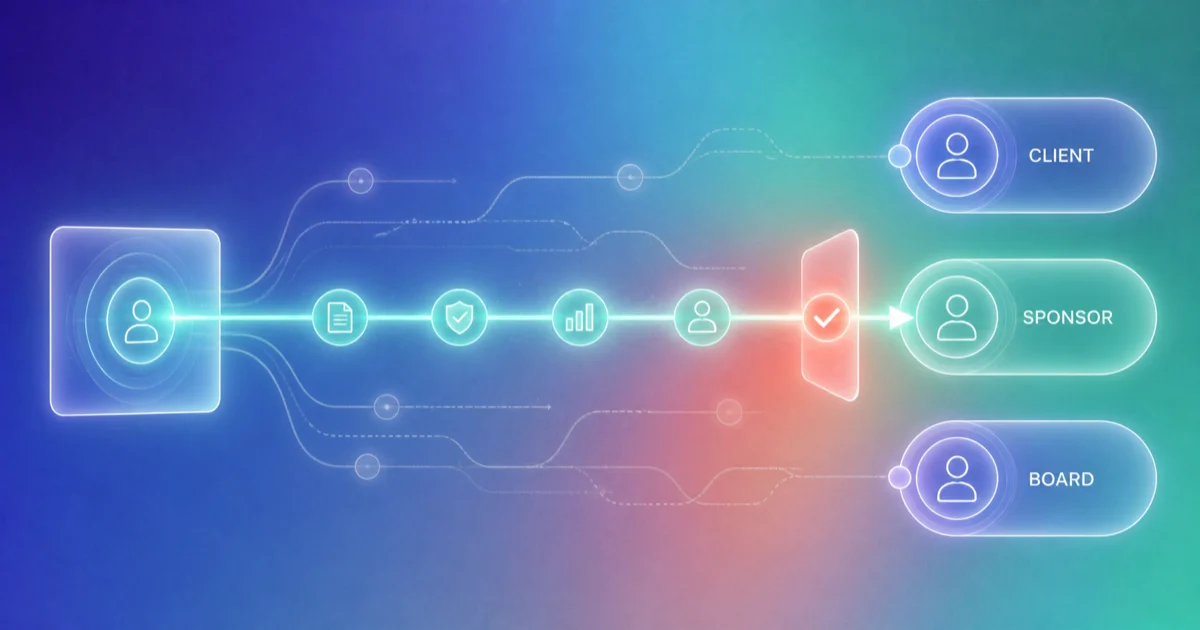
Client relationship mapping helps an investment banking team evaluate a credible path to one person, such as a client executive, sponsor partner, or board member. Record the source, recency, relationship owner, and consent state before choosing a direct approach or introduction request. This guide provides a path record and workflow, not a promise of access.
For investment banking, relationship mapping is usually discussed as finding connections among bankers, clients, target companies, executives, and board members. Altrata's investment-banking overview is one current vendor example. Treat that as category context, not as a universal definition or proof that an inferred connection is current. The operating question is narrower: what evidence supports a credible next path to this specific decision-maker?
Scope: This article owns the access-path decision for one named person. It is not a mandate-level buyer universe or a recurring client-coverage cadence.
Build a path record, not just a relationship graph
Start with the target and work backward. The target could be a CEO, CFO, sponsor partner, board member, or corporate-development leader. Then separate what is known from what is assumed. A former employer overlap can be useful research context, for example, but it is not the same as a direct relationship or a willing connector.
| Field | What to record | Decision it supports |
|---|---|---|
| Target and role | Person, organization, role, and the reason the target matters | Are we mapping the right decision-maker? |
| Path type | Direct relationship, mutual contact, shared board, former colleague, or unverified lead | How strong is the access evidence? |
| Evidence and recency | Source link, last meaningful interaction, and date checked | Is the path still relevant? |
| Relationship owner | The banker or teammate who can explain the context | Who should confirm or decline the request? |
| Consent state | Not asked, permission requested, approved, declined, or not appropriate | May the team make an introduction request? |
| Next decision | Research, direct outreach, intro request, defer, or close | What should happen now? |
This is an editorial framework, not a claim that every relationship-intelligence system contains these fields. Its value is the separation of source evidence from judgment. It also gives a team a place to record a polite no, rather than repeatedly reviving an unsuitable path.
A five-step relationship-mapping workflow
- Name the access goal. Write the specific person, decision, and reason for engagement. Avoid a broad instruction such as find a warm path into the company.
- Collect available evidence. Review internal relationship history, known mutual contacts, meeting notes, and approved firm information. Label any inferred connection as inferred.
- Ask the relationship owner for context. The owner may know that a connection is stale, personal, restricted, or not appropriate for a business request.
- Choose one action. A direct note may be more appropriate than asking a weak connector. If an introduction is appropriate, explain the context and make it easy for the connector to decline.
- Close the loop. Record the outcome, including a decline, no response, or a request to revisit later. The next banker should not have to rediscover that decision.
Relationship-intelligence test: Treat relationship intelligence as evidence for a human decision, not inferred entitlement to an introduction. A usable path combines a known source, recency, relationship-owner context, and an explicit decision to ask, approach directly, research, or stop.
For a relationship-led team evaluating Finta, CRM brings a relationship's stage, research, mutual connections, and supported inbox context together. Networks can show relationship-strength evidence from supported connected-email history or explicit imports. That evidence does not establish likelihood of an introduction; the relationship owner still decides whether a request is appropriate.
Use source quality as a gate
A path should become weaker, not stronger, when its evidence is thin. Ask four questions before moving forward:
- Can someone explain how the relationship exists, rather than merely point to a profile overlap?
- Is the evidence recent enough for the current situation?
- Does the relationship owner know about the proposed request and have a chance to decline?
- Would the request respect the firm's engagement terms, client expectations, and any relevant restrictions?
For a broader relationship-record model, read Finta's account relationship map template. For the investment-banking-specific follow-on, use the sibling client coverage plan to coordinate the people and next actions around a strategic account. When the question is which organizations belong in a sell-side buyer universe, use the M&A buyer coverage matrix.
Limitations and safeguards
Relationship mapping is not diligence, a client-conflict check, an information-barrier control, or a permission to share confidential information. If a firm is subject to broker-dealer rules, it should use its own approved tools and procedures. FINRA's books-and-records guidance shows why recordkeeping, supervision, and vendor handling are firm-specific regulatory questions.
Put the map to work
Choose one target from a current coverage list. Create the path record, mark every inference as an inference, and ask the relationship owner for a decision. If you want a relationship-first workflow, start with Finta CRM and Finta Networks, then keep the team's approved banking and compliance systems in control.
Editorial review and disclosure
Research updated August 10, 2026. Written and reviewed by Finta Editorial Team. This is general operational education, not legal, regulatory, investment, broker-dealer, underwriting, valuation, or transaction advice. Finta product references reflect the linked public pages on the research date. Verify current product availability, permissions, integrations, and firm policies before relying on any workflow.