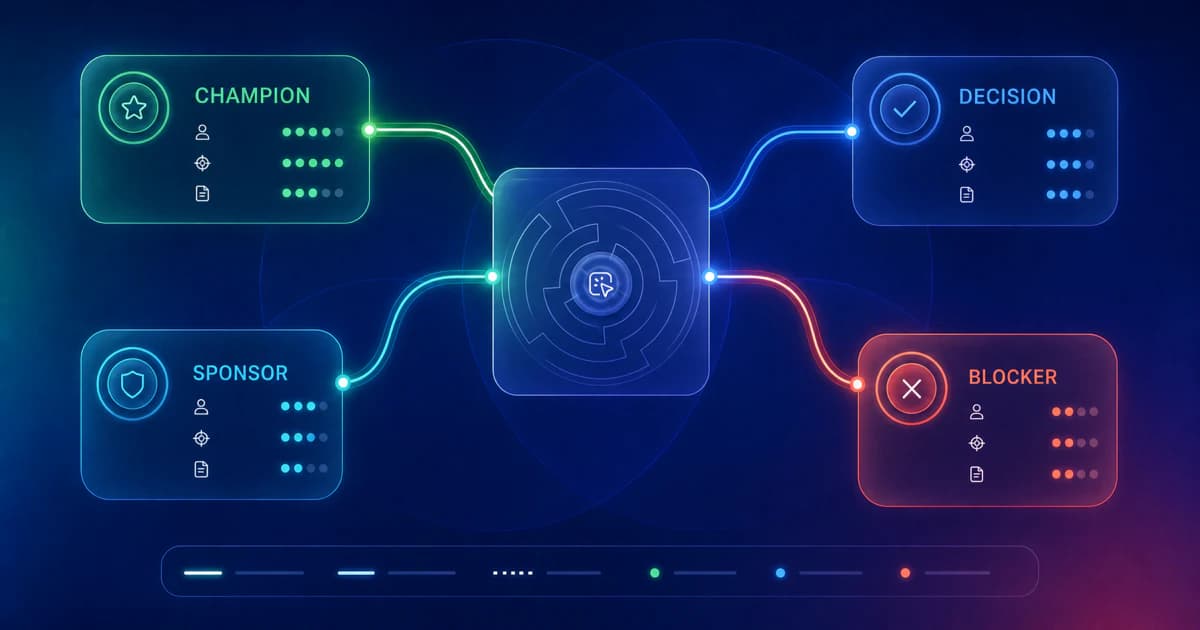
Direct answer: A useful account relationship map is not an org chart. It is a shared decision tool that shows who matters, why they matter, what relationship evidence exists, what remains unknown, and who owns the next action.
Research update: This article was initially published on June 30, 2026 and was reviewed against current sources on August 8, 2026.
Map the buying situation, not just job titles
Complex B2B opportunities often have more stakeholders than the first conversation reveals. LinkedIn's Sales Navigator Relationship Maps documentation offers a current example of a role-based approach: teams can view and manage leads in an account, distinguish decision maker, champion, evaluator, procurement, and influencer roles, and identify stale leads or gaps. Use those labels as a starting point, then tailor the map to the actual account.
The goal is not to claim certainty about who controls the deal. The goal is to make assumptions visible before the team spends time on the wrong relationship or misses a critical stakeholder.
For a capital-markets adaptation of this method, see investment-banking relationship mapping.
Account relationship map template
| Field | What to record | Why it matters |
|---|---|---|
| Stakeholder or role | Name when known, otherwise a clearly labeled placeholder role. | Shows which part of the account is represented and which roles are still unknown. |
| Decision role | Decision maker, champion, evaluator, procurement, influencer, blocker, user, or another role defined by the team. | Prevents one contact from being treated as the entire buying committee. |
| Influence and stance | A qualified estimate of influence and current posture, each linked to evidence. | Separates observed facts from unsupported optimism. |
| Relationship evidence | Last conversation, mutual connection, meeting, shared context, or stated need. | Gives the next person a reason for the relationship assessment. |
| Owner | The person responsible for the next interaction or internal question. | Prevents relationship work from becoming everyone's and no one's job. |
| Open question | The one thing the team needs to learn next. | Turns the map into a conversation plan instead of a static diagram. |
| Next action and date | A concrete, respectful follow-up, introduction request, research task, or decision to pause. | Preserves momentum without inventing urgency. |
Build the first map in 45 minutes
- State the account objective. Define the decision the team wants to enable, not just the product it wants to sell.
- List known people and unknown roles. Add placeholders for functions that may matter, such as finance, security, operations, legal, procurement, and end users.
- Separate evidence from inference. Record what was actually said or observed. Label assumptions as questions.
- Assign one owner per next action. An introduction request, meeting follow-up, research task, and internal escalation should each have a responsible person.
- Review after material events. Update the map when someone changes role, a new stakeholder appears, or the account gives evidence that the original hypothesis was wrong.
Worked example: an illustrative buying committee
The account below is fictional. It shows how the template reveals relationship gaps without treating an estimate as fact.
| Role | Current evidence | Open question | Next action |
|---|---|---|---|
| Operations champion | Attended discovery and described a manual reporting process. | Can this person sponsor a cross-functional evaluation? | Send a factual recap and ask whether a security reviewer should join the next conversation. |
| Economic decision maker | Role identified, no direct interaction yet. | What outcome and budget process matters to this person? | Ask the champion for context before requesting an introduction. |
| Security evaluator | Role assumed from the account's buying process, person not identified. | Which security and data questions must be resolved? | Add a placeholder and prepare a concise information request. |
| Procurement owner | No evidence yet that procurement is involved. | When, if at all, does commercial review begin? | Do not contact speculatively. Revisit after the technical evaluation is clearer. |
A blank role is valuable data. It tells the team where not to overstate relationship coverage and what it needs to learn next.
Keep the map current enough to be useful
Maps decay when they are updated only during forecast calls. Make a lightweight review part of meeting preparation and post-meeting follow-through. LinkedIn's documentation notes that account maps can surface stale leads and relationship gaps. Your process should do the same even if the map lives in a different system.
Use Finta to connect the map to the work
Finta's public product page describes warm pathways, meeting briefs, and next steps across connected relationship context. Use Finta to keep account notes, relationship history, and the next question together, then verify current functionality and permissions before adopting it as the team workflow. The template itself remains valuable whether it lives in Finta, a CRM, or a shared planning document.
Limitations
This template does not reveal an account's actual authority structure, budget, or intent. It should not be used to collect unnecessary personal data, infer sensitive information, or bypass a stakeholder's preferences. Adapt the fields to your privacy policy, sales motion, and account complexity.
Continue the relationship intelligence playbook
- Relationship-Led Sales: A Practical Playbook for Founder-Led Teams
- Where AI Should Stop: Human Approval Rules for Relationship Workflows
Editorial review and disclosure
Written and reviewed by Finta Editorial Team. The template and worked example are original editorial materials. LinkedIn documentation is cited as a current example of role-based relationship mapping, not as evidence that the template produces a revenue outcome. Finta is the publisher and is linked as a relevant workflow option.
Sources
- LinkedIn Sales Navigator, Relationship Maps in Account Pages, reviewed August 8, 2026.
- Finta product page, reviewed August 8, 2026.