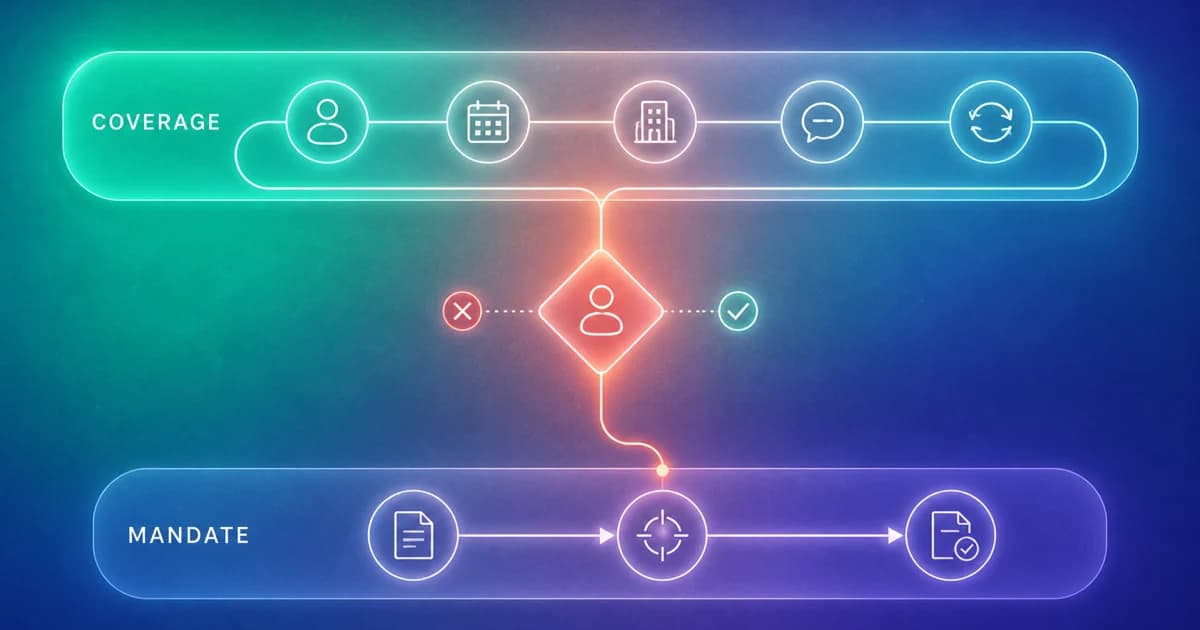
Investment banking deal sourcing turns a relationship or market signal into a decision about whether an advisory opportunity deserves work. This M&A origination guide separates coverage, qualification, access, early mandate preparation, and the mandate decision. Use its two-lane workflow to keep evidence and ownership connected without treating a meeting or warm path as an engagement.
Scope: This article owns the path from signal to an internal mandate decision. Use the client coverage plan for recurring account care and the buyer coverage matrix only when a sell-side buyer universe needs its own working artifact.
Intralinks' current investment-bank sourcing guide describes existing-relationship outreach, intermediary flow, and inbound approaches as different sources of opportunity. Use that channel taxonomy as a planning prompt, not a universal formula. The essential operating question is whether a signal is ready for a named human owner to investigate.
Use a dual-lane coverage-to-mandate workflow
| Stage | Evidence needed to enter | Human decision | Exit condition |
|---|---|---|---|
| Coverage signal | Relevant relationship, market observation, client conversation, intermediary context, or inbound approach | Is this worth structured research? | Research, defer, or close |
| Qualified opportunity | Known organization, potential advisory question, source, and accountable owner | Does it fit the team's mandate, sector, and timing? | Advance to access plan or return to coverage |
| Access plan | Direct path or appropriate introduction path, with consent and context | Who may contact whom, and how? | Meeting secured, declined, or paused |
| Early mandate work | Documented client need, working team, and agreed next conversation | Should the firm commit more preparation? | Pitch, no pursuit, or return to coverage |
| Mandate decision | Client decision and the firm's approved internal process | What is signed, pending, or not proceeding? | Active engagement, closed, or future follow-up |
The table is an illustrative workflow, not a bank's formal approval process. It is intentionally explicit about evidence because a stage name by itself does not tell the next owner why a potential mandate advanced.
How to keep the lanes connected
- Attach the signal to the relationship record. Preserve the source, relevant conversation, and person who surfaced it. Do not turn private memory into an unsupported fact.
- Create an opportunity only after a human owner accepts it. Capture the target, potential client question, source, uncertainty, and next research task.
- Plan access separately from fit. A good relationship path does not prove that the opportunity is suitable. A strong fit does not create permission to contact someone.
- Use a reviewed next action. The action might be research, a direct message, a request for an introduction, or a decision not to pursue. Keep the reasoning with the record.
- Return paused opportunities to coverage. A deferred opportunity can remain strategically relevant without being treated as an active mandate.
Relationship intelligence is the bridge between the two lanes: it carries source, recency, relationship owner, access-path evidence, consent state, and the reviewed next decision without turning a signal into a mandate.
For a relationship-led team evaluating Finta, Networks can surface supported relationship-strength evidence, CRM keeps the relationship record and supported inbox context together, and Automations can schedule Aurora context review or enroll contacts in multi-step workflows with exit rules. Templates must be reviewed before activation, and no workflow stage substitutes for the firm's approvals.
Give every stage an evidence question
Before an opportunity advances, ask the question that the next stage actually needs answered:
- Signal: What happened, and where can the next owner verify it?
- Qualification: What is known about fit and timing, and what is still an assumption?
- Access: Is a relationship path current, appropriate, and consented to?
- Pitch: What client question is the team prepared to address, and which facts still require validation?
- Mandate: Which formal decisions belong in the firm's approved process rather than the relationship workflow?
This approach complements the generic How Relationship Intelligence Works guide by defining a banking-specific decision boundary. It also prepares the team for the sibling M&A buyer coverage matrix once a sell-side process needs a structured buyer universe.
Limitations and safeguards
Do not interpret a relationship signal as a recommendation, a mandate probability, a conflict clearance, or approval to share client information. Do not use a workflow stage as proof that a client has engaged the firm or that a transaction will occur. Firms subject to broker-dealer requirements should use their own approved communication, retention, and supervisory procedures. FINRA's books-and-records guidance is a reminder that those obligations depend on the firm and activity.
Start with one active coverage theme
Choose a sector, sponsor group, or client segment where the team already has relevant relationship history. Create the two lanes, write entry evidence for each stage, and decide who has authority to advance or pause an opportunity. If you use Finta for relationship-led work, explore Finta CRM and Finta Automations for a reviewable relationship workflow. For a broader account rhythm, link the work to the sibling client coverage plan.
Editorial review and disclosure
Research updated August 10, 2026. Written and reviewed by Finta Editorial Team. This is general operational education, not legal, regulatory, investment, broker-dealer, underwriting, valuation, or transaction advice. Finta product references reflect the linked public pages on the research date. Verify current product availability, permissions, integrations, and firm policies before relying on any workflow.