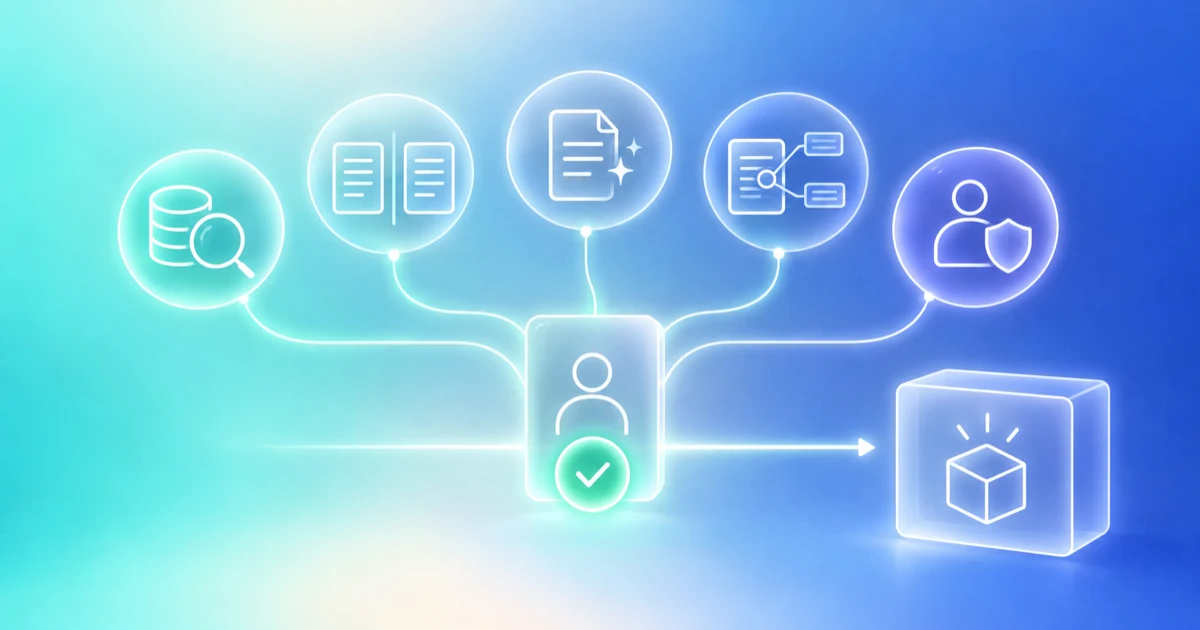
What makes a data room AI-enabled
An AI data room uses machine learning or generative AI to help people find, understand, prepare, or control information inside a document-sharing workflow. The label alone says very little. A useful evaluation starts with the exact task the system performs, the sources and permissions it uses, the output it produces, and the review required before anything changes.
Search, summaries, generation, and action are different capabilities. A provider can be strong at one and offer none of the others. Run the same test pack through each product before treating "AI data room" as a meaningful comparison category.
Five AI jobs that buyers often confuse
| Job | What a useful result looks like | Main question to verify |
|---|---|---|
| Find | Retrieves relevant passages, not just matching filenames | Does the answer respect document and viewer permissions? |
| Explain | Summarizes or clarifies a document with source references | Can a reviewer trace the answer back to the original? |
| Transform | Classifies, translates, compares, or suggests redactions | Is the output reviewable before it replaces or exposes anything? |
| Create | Produces a memo, update, index, or recipient-facing page | Which sources and assumptions entered the output? |
| Act | Uses tools to update a room, permission, record, or follow-up | What authority, confirmation, stop condition, and receipt apply? |
This distinction prevents a common buying mistake: assuming that a document chatbot, an AI redaction tool, and an action-capable agent solve the same problem.
Run a five-task evaluation with the same documents
Use a synthetic or appropriately sanitized test pack. A practical pack might contain:
- a current pitch deck;
- an older deck with a conflicting metric;
- a financial model with assumptions on a separate tab;
- a customer summary containing a disclosure restriction;
- a corporate document with an important exception in an appendix.
Then run these tests.
1. Retrieval test
Ask a question whose answer appears in more than one file and has changed over time. Record which source the system selected, whether it surfaced the conflict, and whether the citation opens the supporting passage.
2. Summary test
Ask for a summary that must preserve a material limitation. Compare the output with the source. Score omissions separately from factual errors.
3. Creation test
Ask the system to prepare a short diligence response or investor update from the approved sources. Check whether it distinguishes source facts, calculations, management assumptions, and missing evidence.
4. Permission test
Run the same question from two roles with different access. A useful result must not rely on a prompt instruction to enforce permissions. The product should apply access at the data or tool boundary.
5. Action test
Ask for a change that affects a recipient, such as preparing a new room section or a follow-up. Record whether the system only recommends, prepares a draft, asks for confirmation, changes state, or sends something externally. Require a visible receipt for what happened.
Use a scorecard like this:
| Test | Pass condition | Evidence to save | Failure that matters |
|---|---|---|---|
| Retrieval | Correct current source and conflict shown | Openable source references | Confident answer from an obsolete file |
| Summary | Material exceptions preserved | Source-to-summary comparison | Omitted limitation |
| Creation | Claims grounded and unknowns marked | Draft plus source list | Invented fact or silent assumption |
| Permission | Results match the viewer's entitlement | Two-role test record | Cross-role disclosure |
| Action | Authority and result are explicit | Approval state and receipt | Hidden or irreversible external action |
What current products demonstrate
Current provider documentation shows that the category already contains distinct approaches:
- Datasite documents semantic search, source-linked answers, summaries, document comparison, translation, and AI-assisted redaction in Datasite Diligence. Its AI capabilities FAQ says outputs are scoped to buyer permissions inside its controlled environment.
- Ansarada documents AI-assisted sorting in AI-Sort, along with separate translation, redaction, prediction, and question-answering capabilities. Its AI governance explanation says AiDA is read-only and cannot edit, move, share, publish, delete, change permissions, or invite users.
- Papermark describes a data-room copilot for chatting with rooms and documents. Its broader data-room documentation lists separate AI redaction, Q&A, analytics, permissions, and programmatic interfaces.
- Finta combines a supported document library, Aurora, Share Pages, CRM context, and reviewed follow-through. That is a fundraising and relationship workflow, not a claim of feature parity with an enterprise M&A VDR.
These are vendor-documented capabilities checked on September 14, 2026. They are not independent performance rankings, and no hands-on benchmark is claimed here.
Permissions and sources matter more than fluent answers
An AI answer can be readable and still be wrong, stale, or unauthorized. Before adoption, ask:
- Which files can the model retrieve?
- Does it honor the viewer's existing permissions?
- Can it cite the exact supporting source?
- How does it handle conflicting versions?
- Can an administrator control or disable AI access?
- Does content leave the provider's controlled environment?
- Which actions are possible, and which require a human decision?
- What log or receipt shows the actual result?
NIST notes that agentic systems can plan multi-step tasks and use tools, which makes visibility into tool usage and evidence important for evaluation. NIST also highlights identity and authorization as core controls when agents receive access to data and applications. See the NIST agent evaluation project and its software-agent identity and authority work.
Where Finta fits
Finta Documents stores uploaded files and folders, indexes supported formats for Aurora search, and can save PDF, DOCX, CSV, or Markdown work created from available context. Other allowed files can remain stored without becoming searchable source context. A connected Google Drive source does not continuously copy an entire Drive into the Documents library.
Inside the Finta Share Page builder, Aurora can prepare a custom HTML page from instructions, attached files, and supported document-library search. The user reviews the page and chooses supported access and download settings before publishing. Identified activity can become CRM context; public sessions remain anonymous. Aurora shows sources and approval state for supported work and only completes actions available through the current tools and permissions.
Finta does not claim automated redaction, autonomous legal diligence, universal visitor identification, or automatic external follow-up by default. A specialist VDR may be a better fit when a process requires enterprise M&A controls, large-scale redaction, formal Q&A administration, data-residency commitments, or transaction governance beyond Finta's documented product.
AI data room versus agentic data room
An AI data room can stop at retrieval, explanation, or transformation. An agentic data room adds a goal-directed, multi-step use of tools that can prepare or perform permitted work. The practical test is not whether the interface has a chatbot. It is whether the system can show the source, authority, approval state, action, and result.
For a startup fundraising use case, continue with the AI-assisted room-creation workflow or compare a specialist provider with Finta in the Papermark alternative guide.
Research checked September 14, 2026. AI capabilities, controls, and availability change quickly. Re-run the test pack and verify current provider documentation before making a purchasing decision.