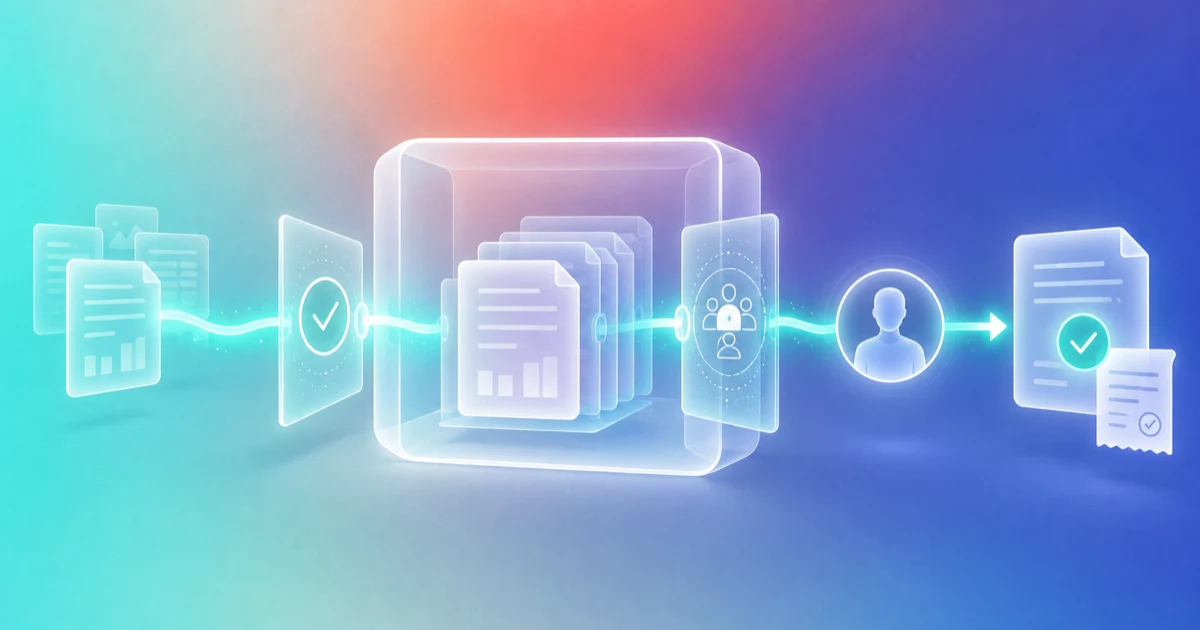
What an agentic data room is
An agentic data room is a permissioned document environment in which an AI agent can use approved sources and tools to pursue a defined information-management goal, complete more than one step, and return a verifiable result. It goes beyond document chat only when the system can prepare or perform a supported action.
For fundraising, the information boundary should stay explicit. The agent may help find a source, reconcile versions, prepare a room section, or propose a controlled change. It should not infer permission from file access, invent missing diligence, or publish sensitive material without the authority required by the workflow.
The practical test is:
source -> permission -> approval -> action -> receipt
If a provider cannot show those five states, "agentic" may be describing an interface rather than a controlled workflow.
Agentic data room versus document chat
An AI chat experience can answer questions or summarize files without changing anything. Agentic work uses tools to advance a goal through multiple steps. Google Cloud's architecture guidance makes a useful distinction: summarizing, translating, or classifying a document may not require an agentic workflow, while an agent uses available tools to plan and execute a multi-step task. NIST similarly describes current agents as systems that can plan, use tools, search databases, and take actions beyond text output. See Google Cloud's agentic architecture guidance and NIST's tool-use overview.
| Capability | Typical result | Agentic by itself? |
|---|---|---|
| Keyword or semantic search | Relevant files or passages | No |
| Summary or explanation | A shorter account of source material | No |
| Classification or translation | A transformed version or label | No |
| Suggested room plan | A proposed structure for review | Not necessarily |
| Multi-step tool use | A supported room or document action with state change | Potentially, when authority and results are explicit |
The label matters less than the operating contract. Buyers need to know which tools are available, what each tool can change, and where a person remains accountable.
The five-part action contract
1. Source
The system should identify the files, records, instructions, or connected sources used. A filename is not enough when several versions exist. Useful evidence includes source links, modified dates, owners, and a clear indication of missing or conflicting material.
2. Permission
Access to a tool or file must follow the user's and recipient's actual entitlements. A prompt such as "do not reveal confidential files" is not a substitute for technical authorization. NIST's current work on software-agent identity warns that access to diverse data and applications creates distinct identification and authorization risks.
3. Approval
The workflow should distinguish recommendations, drafts, internal changes, room publication, permission changes, and external communication. These do not carry equal consequence. The product should show what requires confirmation before the action occurs.
4. Action
The result should name the actual supported operation: prepare a page, create a document, update a room, change a record, or send a message. "The agent handled the data room" is too vague to evaluate.
5. Receipt
The system should return what changed, what did not change, which sources were used, and whether anything reached another person. A receipt can also show a stop condition, such as missing authority, unavailable source, or failed tool.
A worked fundraising-room example
Consider an illustrative startup preparing for a partner meeting. An investor has asked for the current ownership model, customer-retention evidence, and a concise explanation of a recent forecast revision.
- Goal: Prepare an investor-facing room update for founder review.
- Sources: The founder selects the current ownership model, retention analysis, approved forecast, and the investor's open request.
- Conflict: The system finds an older forecast with a different revenue figure and marks it as superseded rather than silently combining the two.
- Prepared action: The agent creates a proposed room section and a short explanation grounded in the selected sources.
- Human review: The founder checks the numbers, wording, recipient access, and download settings.
- Controlled result: The approved room update is published through the supported product flow.
- Receipt: The system records which sources informed the update, which settings were selected, and whether anything was sent.
The agent did not decide which investor deserved access. It did not determine legal sufficiency. It did not infer that a room view meant investment intent. Those remain separate decisions.
What agents should not decide on their own
For sensitive fundraising material, keep these decisions under named human control unless a verified policy and product workflow explicitly establish otherwise:
- granting a new person access to confidential information;
- expanding a recipient's permissions;
- publishing or replacing approved material;
- representing that diligence is legally complete;
- redacting or disclosing privileged or regulated information;
- sending consequential investor communication;
- interpreting engagement as a commitment or investment decision;
- accepting terms, signing documents, or changing a transaction state.
The right automation boundary depends on the organization, transaction, and law. This article is an operating framework, not legal, compliance, or security advice.
How MCP can expose supported actions
Model Context Protocol, or MCP, is one way an AI client can discover and call tools exposed by another system. It does not make every possible action available, and it does not establish permission by itself.
Datasite's April 28, 2026 MCP announcement says supported assistants can create, permission, and organize rooms and access live VDR content without moving the documents out of Datasite. That is a vendor-reported example of tools extending beyond chat. The exact operations, entitlements, and confirmation model still need to be tested in the buyer's environment.
Finta MCP makes supported Finta relationship and workflow tools available to compatible AI clients under the connected user's authorization. For the data-room use case, current Finta product evidence should still come from the specific tool and surface being used. An MCP connection is not proof of room-wide permission changes, autonomous publication, or unrestricted document access.
How Finta approaches the information boundary
Finta Documents provides uploaded and generated material, with supported formats indexed for Aurora search. Finta Share Pages provides the recipient-facing workspace and supported access settings. Inside the Share Page builder, Aurora can prepare a custom HTML page from instructions, attached files, and supported document-library search.
The user reviews the page and controls publication and access. Public sessions remain anonymous. Supported identified activity can return to the CRM relationship record, where it becomes context for the next decision. Aurora can prepare supported work from available context and shows when confirmation is required.
This supports an agentic pattern because Aurora can work across sources and tools toward a defined result. The claim is bounded to demonstrated operations. Finta does not claim autonomous diligence, AI redaction, universal visitor identification, automatic permission changes, legal completeness, or automatic investor follow-up by default.
Agentic data room versus agentic deal room
The distinction in this cluster is operational, not a universal market taxonomy:
- The agentic data room manages work inside the information boundary: sources, organization, preparation, access controls, and document-facing actions.
- The agentic deal room manages work around the fundraising process: people, open questions, relationship context, ownership, activity signals, and reviewed next steps.
Some providers use data room and deal room as synonyms. Use this distinction only when it makes the workflow clearer.
A buyer checklist for testing the claim
Ask a provider to demonstrate, not merely describe:
- A multi-step task using a fixed synthetic document pack.
- The source and version used for each material claim.
- Two users receiving different results because of actual permissions.
- The confirmation step before a consequential action.
- A failed or unavailable-tool state.
- The final action receipt.
- The boundary between document activity and inferred investor intent.
- The process for correcting an incorrect output or action.
For a practical implementation, follow Create an Investor Data Room with AI. Teams still comparing reactive AI capabilities can begin with the AI data-room evaluation scorecard.
Research checked September 14, 2026. Agentic terminology and provider capabilities are evolving. Verify current tools, permissions, and product behavior in the intended account before relying on them.