Institutional networks
Finta for Referral Partner Management
Organize trusted connectors, introduction pathways, permission, follow-through, and outcomes without treating relationships as automated distribution.
- Best for
- Referral partnership leaders, Founders, Relationship-driven operators
- Relationship value
- A referral depends on trust among the requester, connector, and recipient, plus a respectful close-the-loop outcome.
- Recurring workflows
- Verify a referral path, Request connector permission, Track the handoff, Coordinate follow-up, Close the loop
- Information sources
- CRM contacts, Network evidence, Messages, Meetings, Tasks
- Network scale
- A growing referral network becomes difficult to operate when connector context, consent, handoffs, and outcomes live in separate tools.
- Works with
- Gmail, Outlook, Google Calendar
Finta helps referral-led teams remember partner relationships, evaluate possible introduction paths, prepare permission-aware requests, and track follow-through. It is designed for the human coordination around a referral, not for affiliate tracking, commission calculation, deal registration, or channel-revenue attribution.
The core unit is a three-sided relationship: the person seeking a connection, the connector deciding whether to help, and the recipient deciding whether to engage. Good software preserves control for all three.
What a referral relationship workspace should answer
| Question | Record to maintain | Boundary |
|---|---|---|
| Who is the target? | Verified person, role, and organization | Current identity must be checked |
| Why might the connection be useful? | Specific fit and reason for the conversation | Fit is a hypothesis until confirmed |
| Who may have an appropriate path? | Relationship owner and source evidence | A path is not consent |
| What may be shared? | Approved forwardable context | Private notes remain private |
| What is the permission state? | Not asked, request prepared, connector approved, or declined | Silence is not approval |
| What happened next? | Introduction, response, meeting, pass, or next action | Do not infer outcomes from activity alone |
| Was the loop closed? | Appropriate update or thanks | Respect recipient and connector privacy |
Finta connects these fields to the broader relationship history so a request does not arrive without context.
From possible path to reviewed action
- Qualify the reason: Identify the target and a specific reason the conversation could be relevant.
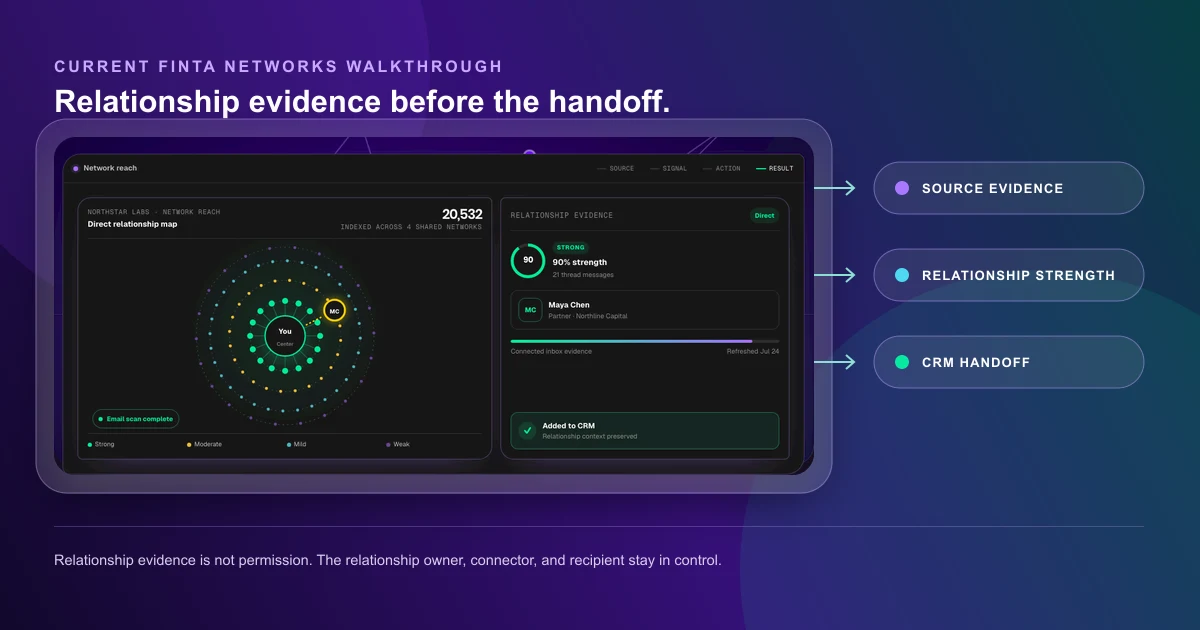
- Inspect relationship evidence: Use Networks and permitted records to find possible paths.
- Choose the relationship owner: Do not route around the person who owns the context.
- Prepare the request: Give the connector enough information to decide, include an easy decline, and separate internal notes from forwardable wording.
- Record explicit permission: Only mark the connector approved when they have agreed.
- Track the outcome: Record the introduction, response, meeting, pass, or next step based on evidence.
- Close the loop: Thank or update the connector appropriately without exposing confidential details.
What Aurora can do
Aurora can use supported Finta tools and available sources to research the target, inspect authorized relationship context, summarize prior interactions, prepare the connector ask, draft forwardable context, propose tasks, and help update the workflow after review. It can complete eligible workspace actions when the relevant tools and permissions are available.
Aurora does not get to convert a network edge into consent. It should not choose to disclose private context, promise an introduction, or send a consequential message without approval. A person confirms the target, connector, relationship evidence, wording, and timing.
Worked example: a professional-services referral
A consultant wants an introduction to the operations leader at a prospective client. A former customer appears to know another executive at the company.
Aurora researches the current organizational roles, gathers the permitted customer history, and prepares a short brief. Networks shows the possible path, including the source available to the user. The consultant reviews whether the former customer is an appropriate connector and records why the conversation could help the prospect.
Aurora drafts a request that makes the purpose clear and gives the connector an easy way to decline or suggest a different person. The consultant approves and sends it through the supported channel. If the connector agrees, the introduction is tracked separately from the initial request. After the conversation, the consultant records the outcome and gives the connector an appropriate update.
No step assumes that a visible connection is an invitation to use it.
A focused weekly review
Ask Aurora to prepare a candidate list of:
- Qualified referrals with no chosen connector
- Requests prepared but waiting for internal approval
- Connector approvals with no introduction recorded
- Introductions with no owner or next action
- Requests whose target role or company context may have changed
- Completed loops that still need a respectful update
The relationship owner confirms the source evidence and decides what to do. Declined and not-appropriate requests should close cleanly.
What Finta supports
- Contact and organization records
- Network evidence and possible relationship paths
- Introduction-pathway tracking
- Relationship ownership, notes, tasks, and next actions
- Aurora research, briefing, drafting, and eligible workspace actions
- Permitted inbox, calendar, meeting, and document context
- Configured reminders and Automations with stop conditions
What Finta does not replace
- Affiliate links and conversion tracking
- Partner portals or external partner logins
- Commission, rebate, or incentive calculation
- Deal registration and channel conflict management
- Formal partner-sourced revenue attribution
- Contracting, billing, or payment systems
- Consent, legal, or compliance review
Limitations and safe stops
Networks can be incomplete or stale. AI can match the wrong person, misread a role, or summarize a relationship inaccurately. The connector may not know the recipient well enough to help. The recipient may decline even after a valid introduction. Some relationships involve confidentiality or regulated communication.
Stop when the identity, purpose, fit, permission, or shareable context is unclear. Never escalate a request because the software found a second path.
Sources
- Finta Networks
- Finta Aurora
- Finta CRM
- Finta warm-introduction workflow
- Salesforce referral data model
- Microsoft referral resource
Turn a possible connection into a respectful process
Start with one qualified request, preserve the evidence, and keep every permission decision visible. Start free with Finta to coordinate referral relationships with a human in control.