Fundraising Operations
Personal AI Agents for Work: A Practical Guide for Founders
Choose a personal AI agent by the work, permitted sources and review you can provide. Compare six current product descriptions and plan a small, honest trial.
What you will learn
- Separate personal errands, knowledge work and relationship operations.
- Read current access qualifiers without treating documentation as tested performance.
- Design a small source-backed responsibility trial and review its actual result.
A personal AI agent is useful for work when it can carry a defined responsibility from permitted sources to an inspectable result. Choose by the job, the context it needs, the actions you are willing to authorize and the review you can provide. A familiar product name or an impressive demonstration is not enough to establish fit.
Source review: October 22, 2026. This landscape compares official descriptions of Meta Muse, Grok Bot, ChatGPT dots, Claude Duet, Instinct and Aurora by Finta. It is desk research, not a same-task benchmark or a report of using six authenticated accounts. Access and controls can change. The worksheet and scenario are original educational examples.
What you will learn
- Separate personal errands, knowledge work and relationship operations.
- Compare six products using current access and evidence limits.
- Write a small responsibility brief and decide what to test before relying on it.
Start with the responsibility you want to hand over
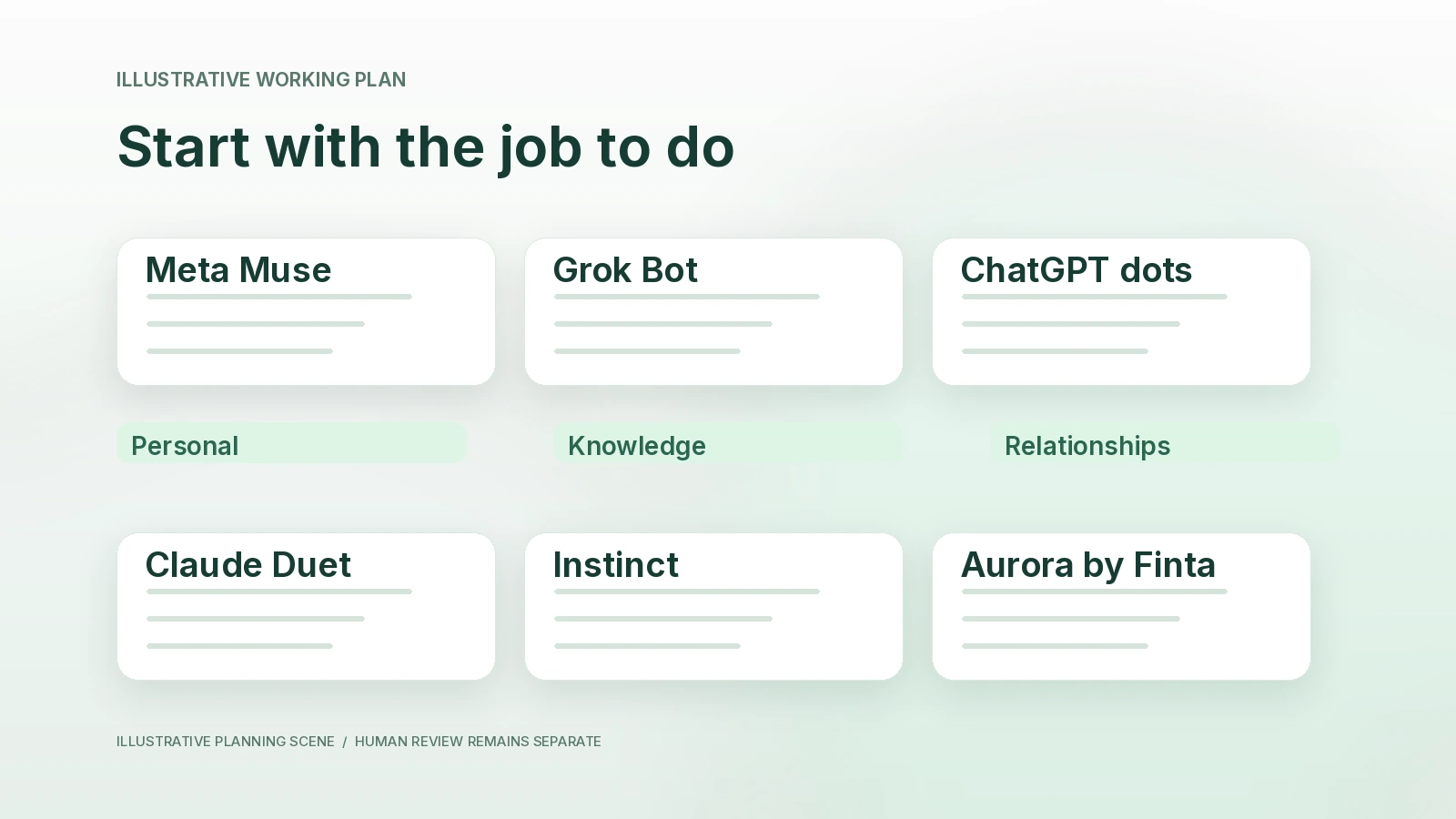
Three jobs that sound like “help me stay on top of things” require different evidence. Ordering groceries needs a personal account and a purchase decision. Revising a presentation needs the current source files and an editing standard. Preparing an investor meeting needs accurate identity, relationship history, confidential materials and a person who owns the next conversation.
Write one sentence before choosing software: “Use these sources to prepare this artifact for this person by this time, and stop before these actions.” If you cannot name the artifact, begin with a conversation or a simple checklist. An ongoing agent responsibility adds maintenance as well as capability.
| Work category | Example responsibility | Useful evidence | Review boundary |
|---|---|---|---|
| Personal errands | Prepare options for a weekend trip. | Dates, preferences, availability and actual quoted terms. | A person checks and authorizes bookings or purchases. |
| Knowledge work | Revise a product presentation when approved inputs change. | Current files, source dates, requested format and changes. | The author checks accuracy and the final version. |
| Relationship operations | Prepare a brief and a possible follow-up for one investor call. | Identity, authorized conversation history, current materials and unresolved questions. | The relationship owner reviews facts, recipients, commitments and permitted actions. |
A source-dated view of six products
The products below overlap in some tasks but are not interchangeable. Their official pages establish what the providers describe. They do not establish comparative reliability, your account's access or a connection to Finta.
| Product | Documented orientation | Access or evidence qualifier | A useful first question |
|---|---|---|---|
| Meta Muse | Meta describes a personal agent for everyday goals and tasks, working through connected services and its own cloud computer. | The launch describes a US rollout on iOS, Android and muse.ai. Check the actual account and current service terms. | Does the permitted personal task match the sources and action controls available to me? |
| Grok Bot | xAI describes named Bots, computer-based work and reusable routines, with examples of coordinating work. | The current site displays plan-linked access and a macOS download. A published workflow is not our tested result. | Which computer, signed-in accounts, routine and review policy would this specific job use? |
| ChatGPT dots | OpenAI describes ongoing responsibilities using ChatGPT memory, connected apps and a cloud computer. | Help lists gradual Pro rollout for adults outside the EEA, Switzerland and UK, eligible Business Premium workspaces, and an Enterprise beta enabled by an admin. | Is the intended workspace eligible, and what can this dot do under its current rules? |
| Claude Duet | Anthropic describes proactive briefs, connected-app work and tasks returned for review. | A US research preview with a waitlist for Pro and Max; Team and Enterprise are not included in the checked FAQ. | Can I access this preview, and which tasks and mistakes will I need to supervise? |
| Instinct | Its homepage describes a personal assistant reached by text or call, using a phone and computer for everyday work. | The short homepage does not establish detailed plan limits, organization sharing or exact review controls. | What account, permissions and action receipt would support my intended task? |
| Aurora by Finta | Finta describes relationship work informed by available workspace context and supported connections. | Tools, connected accounts, organization access and working mode affect what is available. Optional agent features need to be enabled for the intended workspace. | Can the current environment prepare a source-backed relationship artifact for my review? |
Read the primary descriptions: Meta Muse, Grok Bot, ChatGPT dots access and controls, Claude Duet, Instinct and Aurora by Finta. Meta Muse is a different entity from Finta's character named Muse. Claude Duet is distinct from Claude Code, and ChatGPT dots is distinct from a regular ChatGPT conversation.
Fill in a task-fit worksheet before connecting more sources
Complete this table for one real responsibility. Keep the first trial small enough to inspect every factual claim. “Not verified” belongs in an evidence cell when the source is silent or access has not been tested; it is not a negative feature verdict.
| Decision | Your record | What would change the decision? |
|---|---|---|
| Outcome | [One artifact and the decision it supports] | [A clearer or simpler manual method] |
| Sources | [Exact files/accounts, owner and allowed use] | [Missing context or an unauthorized source] |
| Continuity | [One task, recurring check or ongoing responsibility] | [The work does not repeat enough to justify upkeep] |
| Actions | [Read, draft, proposed record change, external action] | [An action exceeds the agreed authority] |
| Review | [Reviewer, factual checks and stop conditions] | [The reviewer cannot verify a consequential claim] |
| Observed result | [Actual output, corrections, failures and date] | [A repeated error or unusable output] |
| Cost and attention | [Setup, usage, review and correction effort] | [Review costs more than the useful work returned] |
A product with broader access is not automatically the better choice. A narrow read-and-draft job may need only approved excerpts. A computer session may help with an interface-based task but also introduces login state and additional steps to inspect. Keep account connection, read access, permission to change a record and authorization to contact someone separate.
Worked example: choose a first responsibility for an investor meeting
Fictional planning exercise, not a product test. Lena runs a small startup. She wants help preparing tomorrow's investor call. She has an approved company brief, the investor's public biography and her own notes from an earlier conversation. She does not have permission to share a customer's confidential contract.
Her first request is “Handle my investor relationships.” That gives no clear output or stopping point. She rewrites it as: “Prepare a one-page brief for tomorrow's call from these three authorized sources. List changed facts, unresolved questions and two topics to discuss. Do not contact the investor, edit CRM records or share files.”
Lena can evaluate a small candidate set using that same packet. In each environment she records which inputs were actually available, whether the brief cites them, which statements need correction and whether any unrequested action was attempted. If she has access to only one product, she records a single-product trial. She does not fill the other columns with imagined performance.
For Aurora, the meeting-preparation workflow provides a relevant operating recipe. Lena checks the current account and source availability first. A helpful draft is the result of this trial; a sent follow-up, a booked meeting and an investment remain separate events.
Keep the first test useful and easy to stop
- Choose a low-consequence artifact with an identifiable reviewer.
- Use a small, authorized source packet with dates.
- Write what may happen and what must stop for a decision.
- Inspect the actual output and any action receipts.
- Record corrections before repeating the task.
- Add a recurring trigger only when the first result is worth reviewing again.
In Finta, a team plan is not a provisioned team, and creating a named responsibility does not create new source permissions. Use the team-design lesson after one responsibility works. Use the action-boundary lesson to decide how a proposed action should be reviewed.
Copyable AI practice prompt
Try this with Aurora AI in Finta, Claude or Codex using only information you are authorized to share. Capabilities and connections differ. This exercise returns a draft for your review.
Help me choose one practical AI-agent responsibility.
Job and intended artifact: [details]
Authorized sources and allowed use: [list]
Products I can actually access: [accounts, current source pages and dates]
Allowed actions and stop conditions: [boundaries]
Return a task-fit worksheet and a small trial plan. Separate documented capabilities from observed results and unknowns. Keep personal errands, knowledge work and relationship operations distinct. Do not invent product access, performance, integration, prices or a winner. Do not connect accounts, change records, contact anyone or schedule work. I will review the plan and any later output.
Your next step
Choose the smallest responsibility whose result you can verify. Complete the worksheet before adding more tools or teammates. The right first outcome is an accurate, useful artifact and a clear decision about what to repeat.
Sources reviewed October 22, 2026. Product descriptions are provider-reported, and account access was not tested. This guide is independent editorial education from Finta, not an affiliation with the other providers or a comparative performance claim.