Fundraising Operations
What AI Agents Should Ask Before Acting for You
Make the action, account, evidence and authority explicit before an agent acts. Use a practical authorization card and check the resulting state.
What you will learn
- Distinguish access from action authority.
- Write a specific authorization and review record.
- Verify outcomes without universal approval or security claims.
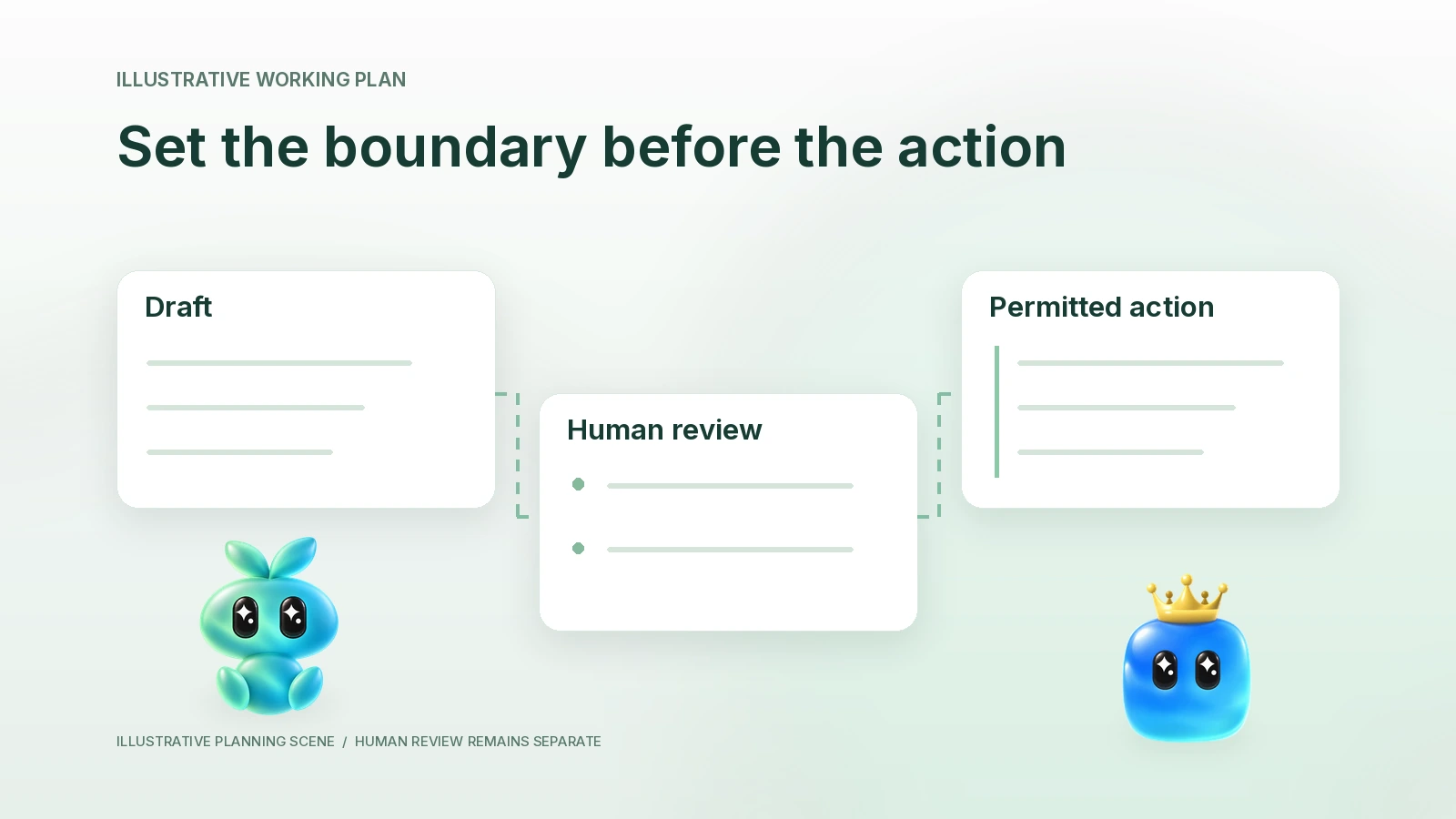
Before an AI agent acts for you, establish the exact action, account, information, recipient or record, and authority that covers it. Permission to read a source is not permission to change it. Permission to prepare a draft is not permission to send it. A recurring schedule does not settle either question.
Reviewed October 22, 2026. This lesson helps you write and inspect an action-specific review record. Its matrix is an editorial planning tool, not a promise that every product enforces the same approval interface. It does not grant authority or activate a routine.
What you will learn
- Separate source access, drafting, record changes and external commitments.
- Write an authorization record a person can meaningfully review.
- Check the resulting state instead of treating a request or approval as completion.
Ask six questions about the proposed action
- What will change? Name the object, fields, recipients, file access or calendar commitment.
- Which identity will do it? Confirm the intended account and organization.
- What evidence supports it? Link the approved source and distinguish inference.
- Who has authority? Identify the relationship owner, document owner or other accountable person.
- What is the boundary? State whether authority is one-time, narrowly recurring or unresolved.
- How will we know? Define the action receipt and any readback needed.
A useful request is concrete enough for someone to say yes, revise or stop. “Can I handle this?” is weaker than “May I send this reviewed note from your work account to this confirmed recipient with this approved attachment?”
Use an action and review matrix
| Proposed work | Check first | Meaningful decision | Result to verify |
|---|---|---|---|
| Read authorized material. | Correct account, purpose and source scope. | Resolve any unclear or newly requested access. | Which sources were actually retrieved. |
| Prepare a draft. | Facts, evidence, intended audience and omissions. | Accept or revise the proposed content. | Draft exists; nothing implied about sending. |
| Change a CRM record. | Exact record, fields, current values and evidence. | Authorize the specific change under the actual policy. | Read back the changed fields and unresolved errors. |
| Send a message. | Identity, recipient, text, attachments and timing. | Apply the actual one-time or narrowly recurring authorization. | Provider result and actual sent state. |
| Share a private document. | Owner's authority, recipient, scope and permission level. | Approve access for this purpose or keep private. | Recipient access and shared version. |
| Make a calendar commitment. | Participants, time zone, availability and invitation contents. | Confirm the specific commitment or leave a proposal. | Correct event and attendee state. |
The matrix describes what should be reviewed, not a universal claim about which operations must show a fresh confirmation card. Products and workflows differ. Check their real settings and enforcement before relying on a standing rule.
Worked example: a draft is not authority to share a deck
Fictional example. A founder asks for a follow-up draft after an investor meeting. The notes say the investor asked for a product overview. The folder also contains a confidential customer contract and two versions of the deck.
The useful preparation result is a draft plus a question about which product overview is approved. It is not permission to attach the newest-looking file, expose the folder or send the message. The founder selects the approved file and checks whether the recipient can view it without gaining broader access.
| Action record | Fictional entry |
|---|---|
| Requested outcome | Prepare a follow-up draft from approved meeting notes. |
| Current authority | Read supplied notes and draft only. |
| Proposed extra action | Send the final note with the selected product overview. |
| Open decision | Confirm recipient identity, exact file, access and wording. |
| Excluded material | Customer contract and unrelated folder contents. |
| Receipt after a later authorized action | Actual send/access outcome, or clear failure/uncertainty. |
If a send request times out, the founder checks whether it was sent before retrying. If the draft was merely copied, the record should say that. A useful receipt preserves the distinction between prepared, approved, requested and completed.
What to check in Aurora
Finta's boundary overview explains that available data and actions depend on account, organization, connected provider, granted permissions and supported workflow. AI output can be wrong or incomplete; an important decision still needs review.
Keep this exercise in draft-and-review mode. Current source includes a separate narrow owner-authorized setting for routine email recipients. That means it would be inaccurate to say every email in every configuration always needs a new approval. It also means a role, schedule or article CTA must not be treated as permission to enable that setting.
Check the actual policy covering the intended action. Do not assume every record edit uses the same approval mechanism as an email. Named agents organize responsibilities; their names and source assignments do not create new access rights or separate data partitions.
Write an authorization card for the next permitted step
| Field | Your record |
|---|---|
| Action and object | [Exact change, message, file or commitment] |
| Account and owner | [Intended identity and accountable person, no credentials] |
| Evidence | [Approved sources and relevant dates] |
| Recipients or affected people | [Confirmed identities and purpose] |
| Authority | [Actual approval, bounded standing rule or unresolved question] |
| Limits | [Scope, duration, exclusions and stop conditions] |
| Receipt | [What happened, what did not and how it was verified] |
Use the card at a transition, not as a blanket permission slip. A changed recipient, different file, expanded purpose or new account can require a new decision even when the earlier draft was approved.
For categories of work that should remain with a person or qualified adviser, use the delegation-limits lesson. This guide owns the narrower question of how a specific supported action becomes authorized and verified.
Copyable AI practice prompt
Try this with Aurora AI in Finta, Claude or Codex using only information you are authorized to share. Capabilities and connections differ. This exercise returns a draft for your review.
Review the boundary before a proposed agent action.
Original request and permitted scope: [details]
Proposed action, object, account and recipient: [facts]
Approved evidence and actual authorization: [sources or unknown]
Return an authorization card. Separate reading, drafting, record changes, sharing, sending and commitments. Identify any expansion beyond the original request. State the review decision still needed and the receipt/readback to check afterward. Do not grant permission, infer a standing rule, enable auto-send, execute, contact or change records. Mark uncertainty explicitly.
Your next step
Choose one upcoming transition and fill in its authorization card. Resolve unclear authority before acting, then inspect the real result. The goal is a specific permitted action with a truthful receipt, not a broad promise of autonomy.