Fundraising Operations
How to Build an AI Agent Team with Finta
Design a small agent team with distinct responsibilities, permitted sources, reviewed handoffs and one bounded first task.
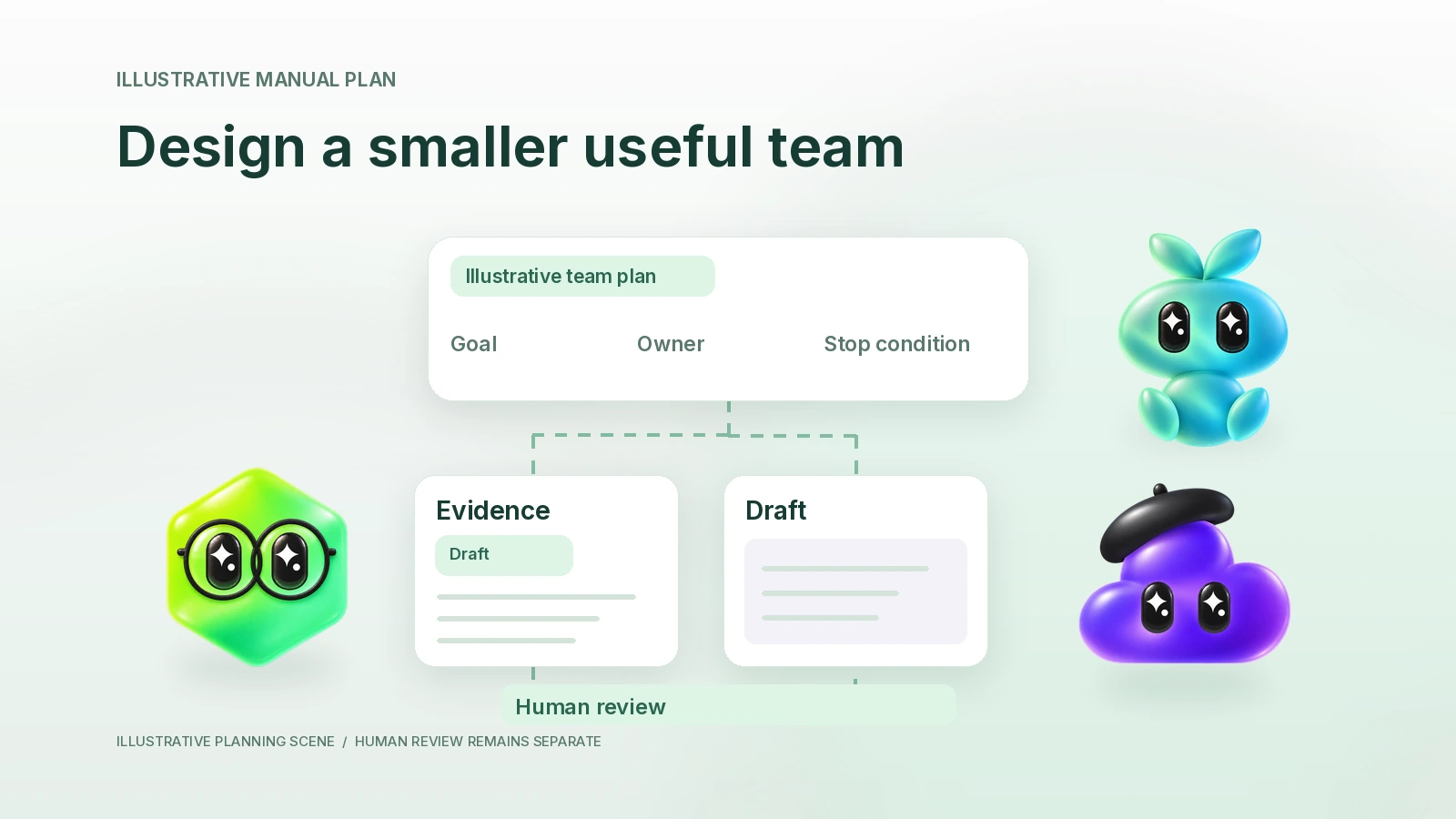
What you will learn
- Choose the smallest sufficient role roster.
- Define distinct artifacts, handoffs and stop conditions.
- Separate a team plan from access and product activation.
Build an AI agent team by dividing one useful outcome into a few bounded responsibilities, naming the evidence each responsibility needs and deciding who reviews the result. Start with one agent if it can do the job clearly. Add a second responsibility when it produces a genuinely different artifact.
In Finta, Aurora is the primary agent. Optional named agents use the Aurora runtime with their own instructions and persistent conversation. Availability depends on the workspace and current release. A team plan does not itself create agents, connect accounts, enable routines or authorize messages.
Choose an outcome you can inspect
“Run fundraising” is too broad to evaluate. “Prepare the three pieces I need before Thursday’s investor call” gives you a concrete result: a current investor brief, a meeting agenda and a list of unresolved commitments. Those pieces can share evidence without repeating the same job.
Define the smallest success condition before naming teammates. For this task, success means that the founder can see what is known about the investor, what to ask and which promised materials still need an owner. It does not mean that the investor takes a meeting or invests.
Use an existing manual process as the starting point. Write down where the facts currently live, who checks them and what a usable output looks like. If you cannot describe the manual decision, adding agent roles will make the ambiguity harder to see.
Complete the team-design worksheet
The following plan is a fictional example for a startup called Cedar Signal. Role names describe the work in this exercise; they are not built-in specialist identities or separate permission zones.
| Responsibility | Permitted evidence | Distinct output | Reviewer and stop condition |
|---|---|---|---|
| Investor research | Founder-approved investor record and current official strategy page | One-page brief with source dates and unresolved fit questions | Founder; stop when identity or strategy sources conflict |
| Meeting preparation | Approved research brief and founder-supplied meeting purpose | Five-question agenda with confirmed facts separate from hypotheses | Founder; ask for the purpose if it is missing |
| Commitment review | Supplied notes from the prior conversation | Owner, promised material and confirmed-date table | Founder; leave unowned or ambiguous commitments unresolved |
The research responsibility identifies evidence. Meeting preparation decides which questions that evidence makes useful. Commitment review preserves obligations already made. If two roles return the same investor summary, combine them or change their output contracts.
Add a named human owner to the plan. The person owns the relationship and decides whether to use the result. Giving an agent a responsibility does not transfer disclosure, investment or client obligations to software.
Check sources and access before assigning work
Confirm the signed-in account, selected workspace and the actual sources available to that user. A connected App account belongs to the user who authorized it. Organization Skills are a different resource. Neither an agent’s name nor its instructions creates new access or isolates one client’s information from another.
For a first exercise, a small user-supplied evidence packet is often sufficient. Include only material you may share, with its source and date. Mark missing items as missing. Do not ask an agent to infer private email history, a connector’s account identity or permission to request an introduction.
If Agents is unavailable in your workspace, complete the same plan with Aurora and manually pass the reviewed artifacts between assignments. That is a useful single-agent workflow. Describe it accurately rather than pretending that several agents were provisioned.
Make the handoff a document, not a guess
A handoff should say what is ready, what remains uncertain and what the next responsibility may do. In Cedar Signal’s fictional plan, the founder approves the source-backed investor brief before using it to prepare questions. The meeting-preparation task receives that brief, not an unrestricted instruction to read everything the research role can reach.
| Transition | Mode in this example | Evidence of completion |
|---|---|---|
| Founder supplies the company and investor packet | Manual | The packet lists its sources and observation dates |
| Founder starts research | User-triggered | A returned brief, not merely a queued assignment |
| Founder reviews the brief and assigns meeting preparation | Manual review, then user-triggered task | Approved facts and explicit unresolved questions travel together |
| Founder decides what to say in the meeting | Manual | A final agenda; no message or calendar change is implied |
Current source code includes asking another agent for judgment and delegating bounded work. Those are different actions. Delegation is limited rather than an unlimited recursive team, and a queued receipt is not a finished artifact. Where those tools are available, inspect the actual returned state before advancing the plan.
Test one responsibility before adding a schedule
Run the research job once on a normal packet. Then remove a required source and try a conflict case. A useful result should identify the missing input, preserve the conflict and stop short of inventing an answer. Keep the original input and the founder’s corrections so you can see whether the role needs better instructions or a better source.
Only consider recurring work after the output is useful. A persistent conversation is not continuous execution. New routine bindings start disabled, and the application must confirm activation of a supported schedule. A role description or article CTA does not enable it.
Use this first-assignment prompt
Help me design the smallest useful team for [one outcome]. Use only [permitted evidence packet]. Return a responsibility table with distinct outputs, source requirements, reviewer and stop condition. Identify duplicated work and prefer one agent when sufficient. Mark unknowns and access assumptions. Draft one bounded first assignment. Do not create agents, connect accounts, enable routines, send messages or change records. I will review the plan and choose any product actions separately.Review the plan for unnecessary coordination. Each added role should have a reason, an output and an owner. If the first agent already produces the complete reviewed artifact, you may not need a team yet.
Common questions
Does a team template create a working team?
A planning template is a design aid. Current playbooks can provide starting instructions, but connections, source access, routines and task execution remain separate steps.
Do different agents have separate private data?
A role is not a permission partition. Check the underlying user, workspace and source controls rather than relying on names or portraits.
What should I do next?
Use the delegation brief to write the first assignment, then the context-handoff guide to define its receipt. Explore Aurora by Finta for the current product.
Product sources checked October 22, 2026. The Cedar Signal plan is fictional educational material, not a recorded runtime test or a customer result.