Fundraising Operations
Agents, Skills, Routines, and Teams: How the Pieces Fit
Map the responsibility, reusable method, recurring trigger and handoff separately. A plan, an installed Skill and an active routine are different states.
What you will learn
- Assign each component a specific operating role.
- Verify configuration and permissions separately.
- Distinguish planned coordination from an observed run and reviewed result.
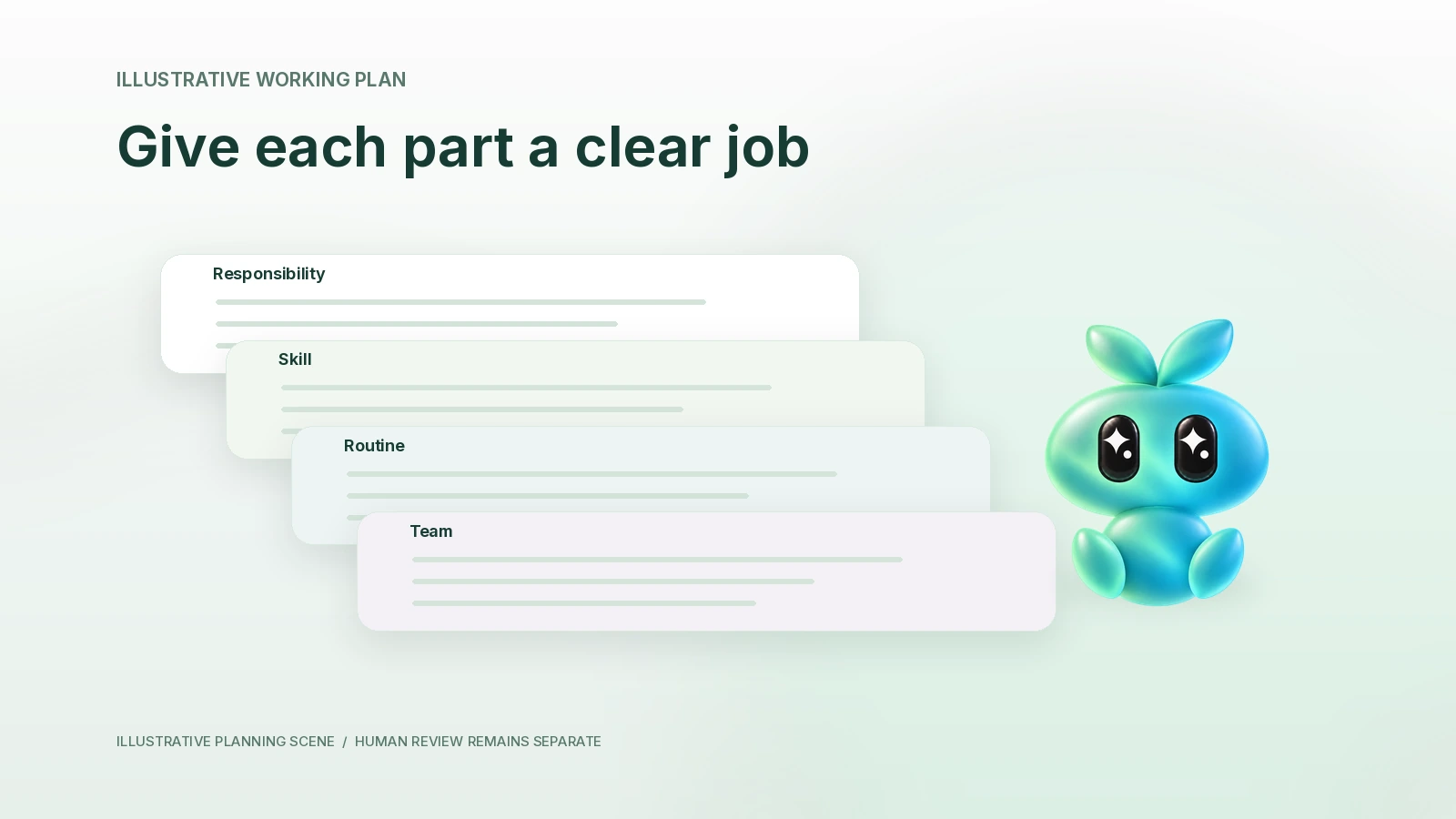
An agent owns a responsibility, a Skill describes a reusable way to perform work, a routine starts supported recurring work and a team coordinates distinct responsibilities. Keep those four decisions separate. Naming an agent does not install a Skill, connect an account, activate a schedule or prove that several agents worked together.
Reviewed October 22, 2026. This is an operating map for founders using Aurora by Finta. The filled example is fictional, and the product explanation is based on current documentation and source review rather than an authenticated setup demonstration.
What you will learn
- Map a recurring job to responsibility, method, trigger and handoff.
- Recognize which setup decisions are still required.
- Distinguish a planned team from actual coordinated runs and useful outputs.
Give each component one job
| Component | Question it answers | Useful record | It does not grant |
|---|---|---|---|
| Agent | Who owns this continuing responsibility? | Outcome, instructions, expected result and conversation. | New data access or a separate permission silo. |
| Skill | How should this kind of work be performed? | Reusable method, input requirements and checks. | A connected account or automatic execution. |
| Routine | When should a supported check run again? | Trigger, timezone, effective state and expected output. | Permission to contact someone or ignore an exception. |
| Team | How do distinct responsibilities contribute to the result? | Outputs, dependencies, receipts and human reviewer. | A completed task simply because roles were listed. |
Finta's Automations page distinguishes scheduled Aurora work, contact sequences and reusable organization-level Skills. Optional agents, where enabled, organize continuing work with instructions and a primary conversation. They still depend on actual available tools and the owner's authorized context.
Connected App accounts belong to the individual user; a role name does not turn those accounts into shared team data. Assigning a Skill or source in an operating plan is different from enforcing access restrictions. Review the actual organization and account boundaries separately.
Fill in one four-part work map
| Decision | Your answer | Check before use |
|---|---|---|
| Responsibility | [One outcome, owner and final reviewer] | Does the job remain useful beyond one conversation? |
| Method | [Existing Skill or reviewed instructions] | Does it cover this task, and what inputs are missing? |
| Trigger | [Manual start or supported recurring configuration] | Is it actually enabled, with the right timezone and next occurrence? |
| Sources | [Exact authorized accounts or supplied packet] | Can the intended user access them for this purpose? |
| Output | [Artifact and factual acceptance checks] | Can the reviewer verify the supporting evidence? |
| Handoff | [Recipient responsibility and fields passed] | Is this a manual transfer, a question or a delegated run? |
| Authority | [Allowed actions and stop conditions] | Do saved settings match the instruction? |
A gap in one row is not repaired by filling another. Adding a schedule does not fix missing evidence. Installing a writing method does not authorize sending. Choosing a specialist does not establish that it received the final approved file.
Worked example: a recurring investor follow-up review
Fictional example. A founder wants to review open investor questions every Friday. She has a permitted question ledger and approved company materials. The first useful output is a draft list of questions that need a reply, a file or a founder decision.
- Responsibility: identify unresolved investor requests and prepare an evidence-backed next-step list.
- Method: use a reviewed follow-up procedure that separates source facts, draft wording, timing and stop decisions.
- Trigger: begin manually. Consider a supported weekly routine after the first output is worth repeating.
- Team: keep one responsibility unless a separate factual research task earns its own output and review.
The founder can inspect the existing Email Follow-up Skill template for its actual writing job. That preview is a starting method, not an installed agent team or a promise of account access. A recurring routine is also separate from any contact sequence that sends messages.
In a later trial, a research responsibility might return an updated public-source table to the follow-up responsibility. The receipt should state the source version, changed fact, uncertainty and permitted next use. Merely asking one conversation to use headings called “Research” and “Follow-up” is not evidence that two agents coordinated.
Keep the setup states visible
Use a small checklist rather than a single “configured” label:
- The plan describes the job and has a reviewer.
- The intended workspace exposes the supported feature.
- The responsibility exists with reviewed instructions.
- The required sources are available to the correct user.
- The relevant Skill is available and appropriate.
- Any routine has its own reviewed effective state.
- A real run returned an inspectable artifact.
- The person reviewed the result and authorized any separate next action.
New routine bindings are disabled in the reviewed source path. Do not describe saving a plan or creating a responsibility as enabling background work. Check the current application before relying on a recurring configuration.
Current coordination is bounded. A question to another responsibility and a delegated work item have different purposes, and a queued work item is not a completed artifact. Inspect what actually ran and returned rather than infer behavior from the roster.
Resolve the common configuration confusions
Can one Skill serve several responsibilities?
A reusable method can be relevant to more than one job. Keep the role-specific inputs and expected output clear, and do not use reuse as an excuse to duplicate work.
Does each agent need a different connected account?
Not simply because it has a different name. Verify the actual owner, organization and available connections. Instructions and visual assignments do not create privacy partitions.
When should a routine be added?
After the task has a useful repeatable artifact and the current product supports the intended cadence. Define how missing sources, no change and conflicting evidence should appear.
Copyable AI practice prompt
Try this with Aurora AI in Finta, Claude or Codex using only information you are authorized to share. Capabilities and connections differ. This exercise returns a draft for your review.
Map one recurring job into responsibility, method, trigger and handoff.
Job and reviewer: [details]
Available approved sources: [list]
Current supported features and existing Skill: [facts or unknown]
Return a filled work map with separate planned, configured, enabled, run and reviewed states. Identify missing permissions or evidence without assuming access. Keep a manual first trial unless I supply verified recurring configuration. Do not install a team, create agents, activate routines, send or change records.
Your next step
Complete the work map for one responsibility. Use the team-design lesson only when distinct outputs justify a team, and the existing routine guide when you are ready to review a supported recurring trigger.