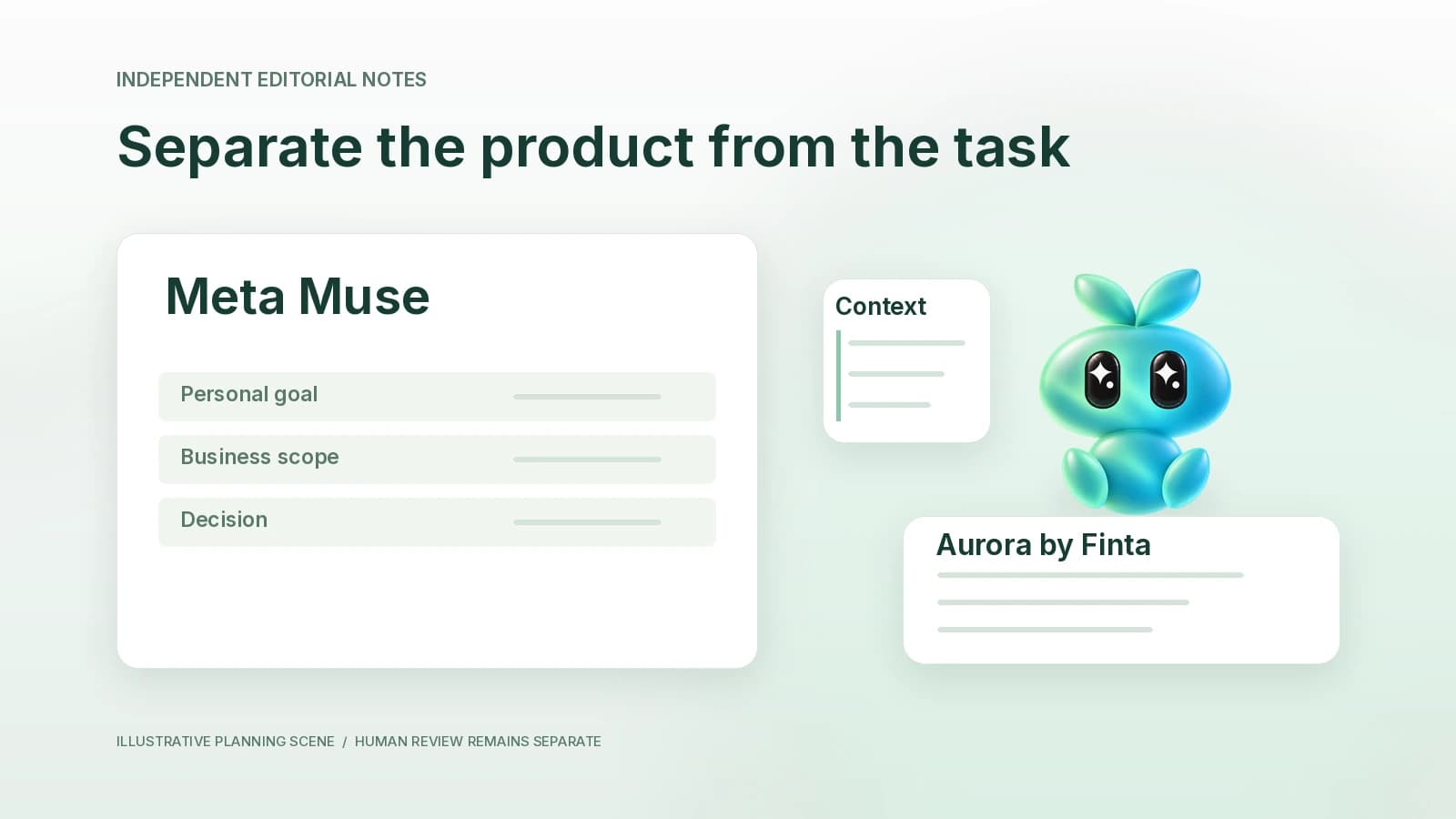
Meta Muse is Meta's personal AI agent for carrying goals and tasks beyond a single conversation. For a founder, the important distinction is between help with a personal goal and responsibility for a professional relationship. An agent's ability to do work does not decide which information it should receive or which commitments it should make.
Evidence checked October 22, 2026. This guide separates official product statements from an original planning exercise. We did not run the product or verify account-specific access.
What Meta says Muse is built to do
Meta's launch announcement describes personal goals, app and browser work, and user-controlled access. It describes a US rollout on iOS, Android and the web, with glasses support coming later. Check the live access route before assuming availability for a particular person or country.
The design explanation describes continuing work through schedules and events and maintaining conversational context. Meta's technical safety article describes a dedicated cloud computer and a separate permission authority, while acknowledging that mistakes remain possible. These are Meta's descriptions, not our security audit.
Meta Muse is separate from the character named Muse in Finta's artwork. Neither shared naming nor this independent article implies an integration, partnership or endorsement.
Turn a broad goal into a bounded assignment
“Keep my week under control” mixes discovery, prioritization and external action. Break it into a proposed plan, the sources it may inspect and the decisions that remain yours. A plan can be useful even if you never give an agent permission to make a booking or send a message.
For professional work, add the relationship owner. A founder may know a person personally while the company owns the deal record. That does not make every private conversation appropriate input for a business brief. Decide which context belongs in the assignment before judging the resulting prose.
A goal-to-action worksheet
Use this worksheet to decide whether a candidate task belongs in personal assistance, a relationship workflow or a manual decision. The examples describe desired boundaries, not verified Meta Muse settings.
| Candidate task | Permitted input | Useful draft output | Decision you retain |
|---|---|---|---|
| Coordinate a personal obligation | A calendar excerpt you choose to share | Options and conflicts | Which event to move or book |
| Prepare a professional conversation | Approved business notes and current source links | A brief with unanswered questions | What to disclose and which objective matters |
| Reconnect with a former colleague | An appropriate, dated conversation summary | A proposed reason to reconnect | Whether the relationship supports contacting them |
| Make a purchase or external commitment | Exact scope and constraints | A reviewable proposal with recipient or merchant | Approval under the actual account policy |
| Keep a goal current | Specified sources and refresh rule | A change summary with source dates | Whether to repeat, pause or change direction |
A row is ready for a first trial when you can identify both the output and the boundary. If “handle it” is the only completion rule, the reviewer will struggle to distinguish initiative from a misunderstanding. Keep the first assignment small enough that you can inspect the evidence yourself.
Fictional worked example: one founder, two kinds of context
Fictional planning example, not a Meta Muse result. Imani is arranging a family visit while preparing a meeting with Juniper Vale Capital, a fictional investor. Her personal calendar explains a travel conflict. The company packet contains the meeting invitation and an approved product summary. A private message from a friend mentions an investor's family situation.
The personal task can ask for a set of travel options without booking. The business task should use the approved packet to prepare the meeting and note the calendar conflict. It should not turn the friend's message into an outreach angle. The relevance of private information does not make its reuse appropriate.
Imani's completion receipt would name the sources supplied, list the unresolved scheduling choice and label the meeting brief as a draft. There is no claimed booking, contact or product-generated output here. If she later tests an agent, she can compare the actual artifact against this plan.
What to check before relying on it
Ask what the account can access now, what happens when access is removed and how sensitive actions are presented. Try a harmless task first. Introduce one missing fact deliberately and see whether the actual response asks a useful question. Save the result so your confidence comes from observed behavior rather than a general impression.
Separate scope from correctness. A product may be able to use a browser while still misunderstanding a date or sending context to the wrong recipient. Review the exact target, content and action, especially when another person's reputation or private information is involved.
Prepare your first assignment
This manual briefing prompt organizes a reviewable artifact. It does not connect accounts, schedule work or authorize external actions.
Help me turn one goal into a bounded assignment. Use only the facts and excerpts I deliberately provide. Separate personal context from business context. Return: goal, permitted sources, draft artifact, decisions I retain, unresolved questions and stop condition. Do not connect accounts, contact people, make purchases or create recurring work. If a private fact seems relevant, flag it for my decision rather than inserting it into an external message.When a relationship workflow is the better evaluation
Meta Muse may be worth evaluating when the recurring problem spans personal plans and everyday tasks. If the job is carrying investor context into a credible next step, inspect the permissioned introduction recipe and Aurora by Finta. They address a different starting point, not a promise that Meta Muse cannot help with business work.
The Aurora versus Meta Muse comparison keeps the professional task constant. The agent landscape and approval-boundary guide explain the broader decisions.
Questions to resolve
Is Meta Muse the Muse shown in Finta artwork?
No. They are different entities. This article consistently uses Meta Muse for Meta's product.
Does a connection mean permission for any action?
Do not assume that. Inspect the actual access and action controls and define the assignment's scope. The worksheet is a planning aid, not an enforcement mechanism.
Does this establish professional team support?
No account-specific team, sharing or professional-record behavior was tested here. Treat those as explicit evaluation questions rather than features proved or disproved by omission.
Disclosure: Finta publishes this independent guide. The product discussed is not presented as a Finta partner or integration. Product access, documentation and account controls can change.