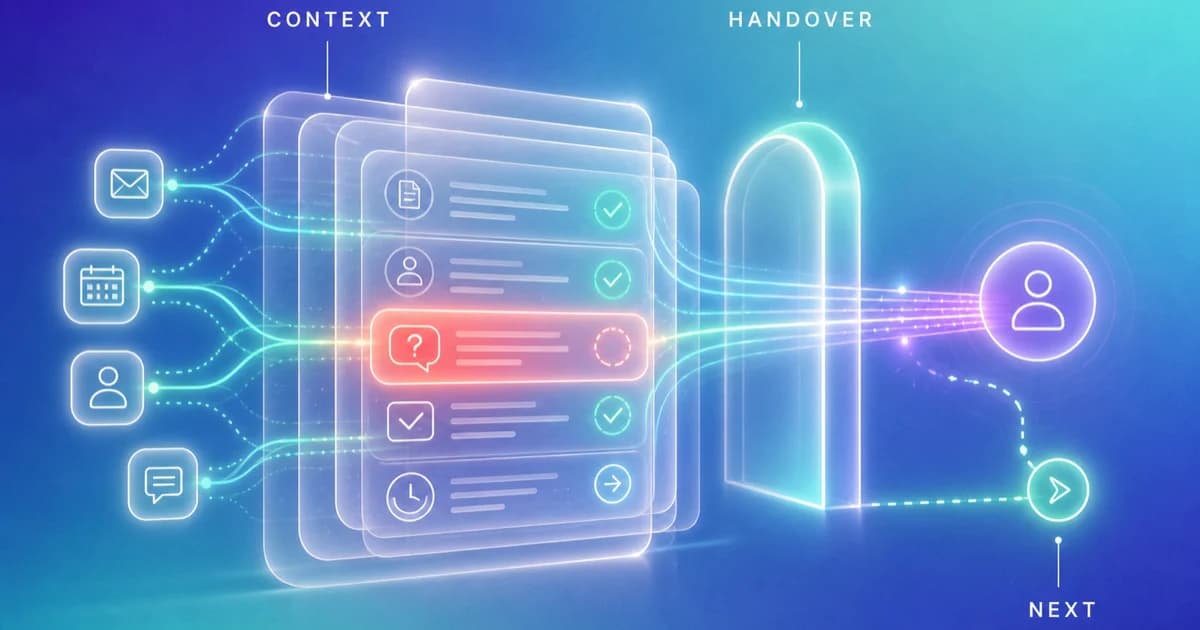
Short answer: Investment-banking firm memory is shared, reviewable relationship context that lets a teammate take over a client, sponsor, or deal without relying on one banker's private recollection. This working form of institutional memory should preserve who matters, what happened, what was promised, why prior choices were made, what sources support the record, and what remains unresolved. It is not a legal archive, a records-retention system, or a substitute for approved compliance processes.
Scope: This checklist owns a staffing transition or coverage handover. It does not replace the ongoing client-coverage cadence or an LP multi-year fundraise history.
Firm memory is a visible theme in investment-banking CRM marketing. For example, Dialllog's investment-banking page frames the category around mandates, buyer conversations, relationship ownership, and banker handover. Treat that as a market signal, not independent proof or a claim about Finta. The useful editorial question is simpler: can a teammate understand the current state of the relationship without relying on the departing person's memory?
Use a Handover Evidence Pack
| Handover component | What the next owner needs | What to avoid |
|---|---|---|
| Relationship map | Key clients, sponsors, buyers, intermediaries, board participants, and named relationship owners | A raw contact list without role or context |
| Current work | Active mandate, coverage theme, current stage, and known next decision | Presenting a speculative lead as a committed engagement |
| Commitments | What the team agreed to send, schedule, confirm, or revisit, with owner and due date | Assuming an old note is still an active promise |
| Decision history | Why the team advanced, paused, declined, or chose a route | Replacing facts with a vague status label |
| Source links | Approved references to the relevant record, thread, meeting note, or document | Copying restricted or confidential materials into an unapproved tool |
| Open questions | Uncertainties, required confirmations, and the person who can answer them | Writing assumptions as settled facts |
The pack is a human handover aid. Its job is to preserve working context and expose uncertainty, not to create a new system of record.
Run the handover in three passes
- Prepare the record. The outgoing owner reviews active relationships and marks the source, recency, confidence, commitment state, and items that must remain in another approved system.
- Hold a decision-oriented review. The incoming owner asks what is known, what is assumed, what was promised, and what should happen next. The goal is shared understanding, not a one-way data transfer.
- Confirm after the transition. Within a defined interval, revisit the highest-priority relationships. Update ownership, close stale commitments, and preserve a reason if the team changes course.
In a handover, relationship intelligence is institutional memory with provenance: relationship owner, evidence, decision history, permission state, and next action remain connected.
For a relationship-led team evaluating Finta, CRM presents stage, research, mutual connections, and supported inbox context on the relationship record. Aurora can assemble a brief from available CRM, inbox, calendar, and indexed-document context, show its sources, and require review before a supported message is sent. What is available depends on connections, permissions, and working mode; this does not make Finta a system of record, legal archive, or information-barrier control.
Keep source, judgment, and action separate
The most damaging handovers blend all three into an undocumented story. A source is the available note, thread, or document. A judgment is the team's interpretation of what it means. An action is the next task, message, or review. Preserve each one separately so the incoming banker can re-evaluate the judgment when the facts change.
Run a ten-minute acceptance test
- Give the incoming owner one high-priority relationship record without an oral briefing.
- Ask them to identify the last evidenced touch, an open commitment, the next decision, and the source for each.
- If any answer relies on an unsupported assumption, return the record for clarification rather than treating the handover as complete.
For a related but distinct long-cycle use case, see How Emerging Fund Managers Preserve LP Context Across a Multi-Year Raise. For the investment-banking sequence, combine this checklist with the sibling client coverage plan and deal origination workflow. For AI boundaries in any relationship workflow, read Where AI Should Stop.
Limitations and safeguards
- A handover checklist cannot make an incomplete record complete or resolve a client, legal, conflict, or regulatory question.
- Only transfer information through systems and permissions approved by the firm.
- Keep legal, compliance, conflicts, supervisory, and records-retention responsibilities in the processes that actually own them.
- For firms subject to broker-dealer requirements, FINRA's books-and-records guidance makes clear why business communications, supervision, and third-party-vendor review require firm-specific analysis.
Start with the highest-context relationships
Do not wait for an organizational change to test the handover pack. Select the ten relationships where a missed promise or lost rationale would cause the most harm, then have a teammate try to reconstruct the next decision. If you use Finta for relationship-led work, review Finta CRM and Aurora for record context and source-aware briefing, while retaining approved firm systems for records and controls.
Editorial review and disclosure
Research updated August 10, 2026. Written and reviewed by Finta Editorial Team. This is general operational education, not legal, regulatory, investment, broker-dealer, underwriting, valuation, or transaction advice. Finta product references reflect the linked public pages on the research date. Verify current product availability, permissions, integrations, and firm policies before relying on any workflow.