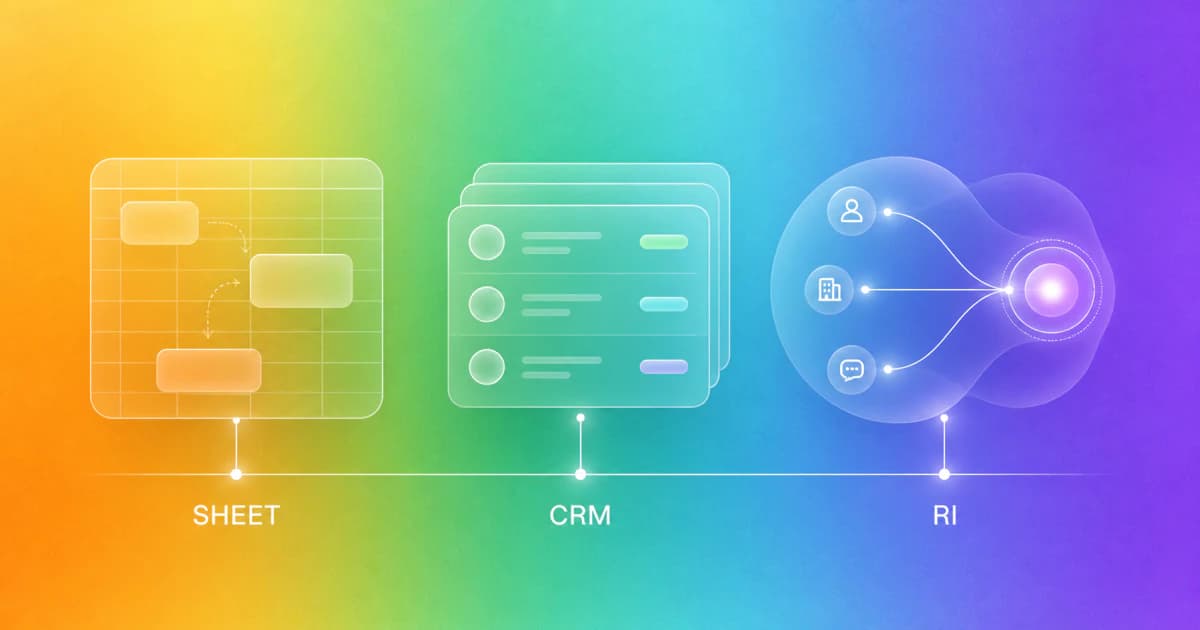
Choose the smallest fundraising system that can preserve the decisions your team needs to make. A spreadsheet is often enough for early investor research and a short, controlled outreach list. A CRM becomes useful when records, owners, pipeline stages, and follow-ups need consistency across several people. Relationship intelligence adds a third layer: evidence from the relationships, conversations, and context that help decide what should happen next.
These are not mutually exclusive categories. A spreadsheet can remain a useful planning artifact inside a CRM-led process. A CRM can store relationship data without turning it into action. Relationship intelligence does not replace human judgment or investor research. The useful question is not which label sounds more advanced. It is which missing context currently causes duplicated work, missed follow-up, or a poor decision about who should ask for help.
Research updated: August 8, 2026. This comparison is a Finta Editorial Team workflow framework. It does not measure vendor performance or recommend a particular system for every company.
Compare the three setups by the job they perform
| Setup | Primary job | Works well when | Risk to watch | Useful next layer |
|---|---|---|---|---|
| Spreadsheet | Research and simple planning | One or two people maintain a bounded target list and the active raise is still small. | Conversation context, ownership changes, and follow-up timing depend on manual updates. | Add a relationship record and clear owner before outreach expands. |
| Fundraising CRM | System of record for people, stages, tasks, and documents | Several conversations, diligence requests, or teammates need a shared record of what happened. | The system becomes a reporting chore if it stores rows without helping the team decide the next action. | Add relationship evidence and review rules where introduction paths or inbox context matter. |
| Relationship intelligence | System of intelligence and action | The team needs to evaluate mutual connections, conversation context, relationship strength, and prepared next steps. | Relationship signals can be mistaken for permission, fit, or a guaranteed introduction. | Keep explicit consent, research, and human review in the workflow. |
Use the raise system fit test
Answer the following questions in order. The first yes that reveals a real coordination failure identifies the layer worth adding.
- Can one person accurately explain every active investor relationship? If yes, a spreadsheet may still be sufficient for the current round. If no, establish shared records and ownership.
- Can the team see the last meaningful interaction, the next action, and who owns it? If not, the process needs a CRM-like operating layer, whether it is a dedicated CRM or another shared system with disciplined rules.
- Does the next action depend on relationship context rather than only the pipeline stage? If the answer involves a mutual connection, a prior thread, an advisor’s relationship, or a specific meeting commitment, the team needs a way to review that evidence alongside the record.
- Can the team distinguish a possible warm path from an approved introduction? If not, add explicit consent states. No relationship system should treat a connection as an automatic outreach right.
- Can a founder return after a busy week and see what changed? If not, simplify. The best system is the one that makes the next decision easier, not the one with the most fields.
What each system should own
Use a spreadsheet for research, assumptions, and small experiments
A spreadsheet is flexible and transparent. It is suitable for screening investors, assigning research, testing a lightweight scoring model, or holding a first pass at a target list. It should not silently become the permanent source of truth for relationship history if several people must interpret old emails, introductions, or commitments differently.
Use a CRM for shared operational memory
A CRM should connect an investor or organization to its stage, notes, documents, relationship owner, and next task. Finta’s public CRM and Inbox Intelligence page describes keeping pipeline stage, research, mutual connections, and inbox context together on a relationship record. That is the useful direction of travel when the team is losing context, not merely when the spreadsheet gains more rows.
Use relationship intelligence when context changes the decision
Relationship intelligence is useful when a team must ask who knows whom, what relationship evidence exists, whether an introduction is appropriate, what was promised in the last conversation, and what should happen next. Finta’s public Networks page describes relationship strength and warm paths with source evidence. The important boundary is that evidence supports review. It does not prove investor fit, consent, or likelihood of a meeting.
A staged adoption rule
Do not migrate every historical row before your system works for the next ten decisions. Start with the active raise: current target list, active relationships, pending introductions, current documents, and the next action for each open conversation. Then decide which older records deserve migration because they affect current fundraising. This reduces data-entry debt and makes the system useful before it is complete.
If the process needs templates, workflow components, and a dedicated investor pipeline, review Finta’s Fundraise OS. If the company is raising a fund rather than an operating-company round, the relevant adjacent resource is Finta’s guide for fund managers. These pages describe current Finta positioning and should be checked directly before relying on a specific capability.
Limitations and judgment calls
No tool setup determines whether an investor is the right partner or whether a company should raise at all. A small spreadsheet can outperform a complicated system when ownership is clear and the process is short. Conversely, a well-configured CRM can still fail if the team does not agree on what to record or who decides the next action. Treat the comparison as a process-design decision, not financial advice or a claim that one category wins for every raise.
Continue the relationship intelligence playbook
- Relationship Intelligence vs. CRM: What Each System Knows and Does
- How to Build an Investor Relationship Map Before You Raise
Editorial review and disclosure
Written and reviewed by Finta Editorial Team. Research updated August 8, 2026. This article provides general educational information about fundraising workflow design. It is not legal, tax, investment, regulatory, or placement-agent advice. Finta product links describe public product pages and are not evidence of customer outcomes.
Sources
- Finta, CRM and Inbox Intelligence, accessed August 8, 2026.
- Finta, Relationship Strength and Warm Paths, accessed August 8, 2026.
- Finta, Fundraise OS, accessed August 8, 2026.
- Finta, Finta for Fund Managers, accessed August 8, 2026.