Claude Duet alternative
Finta Aurora vs. Claude Duet for Founders and Relationship Work
Compare Claude Duet and Aurora through an investor-attention packet, with current preview qualifiers, decision boundaries and a practical worksheet.
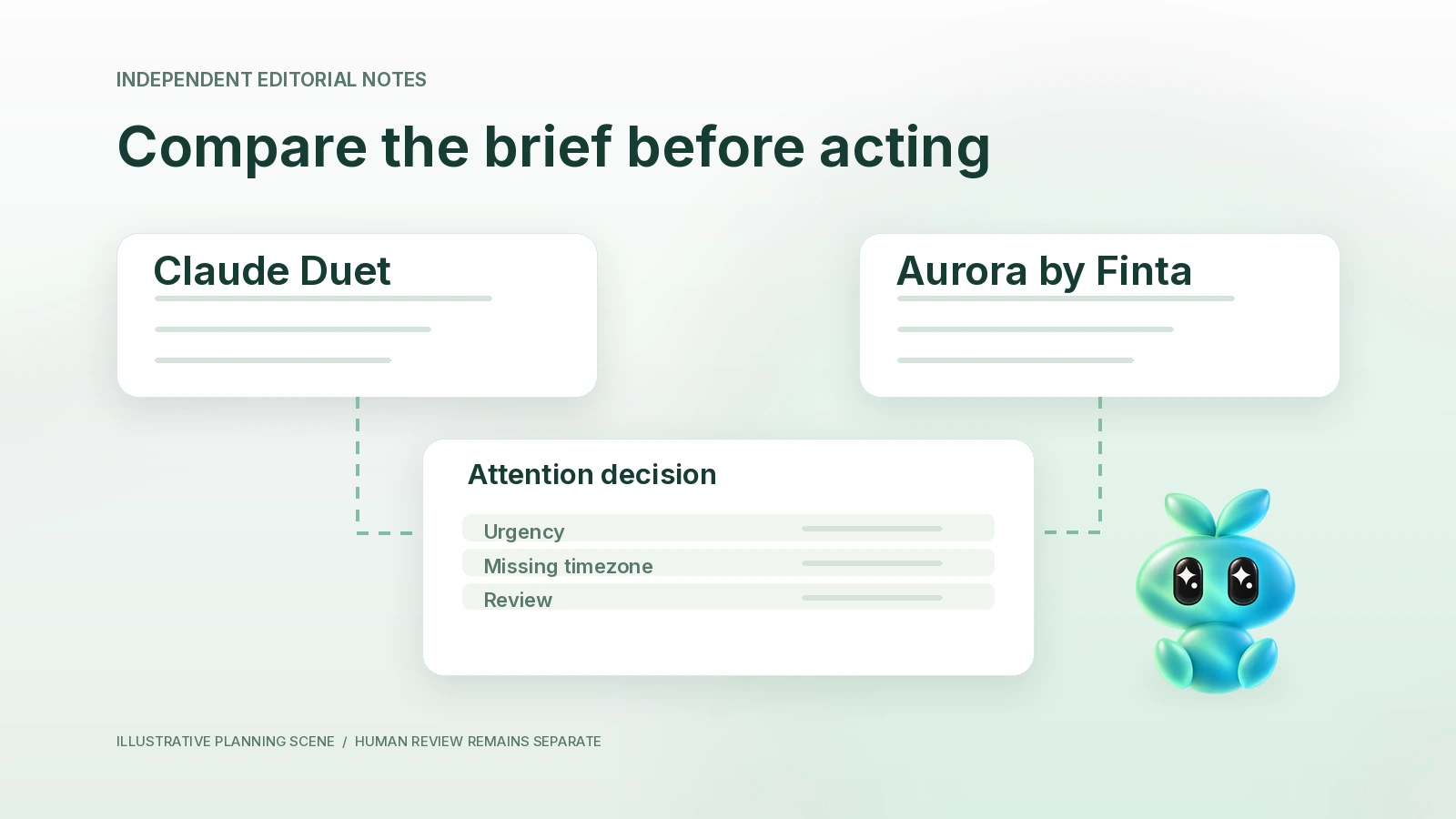
- Compared with
- Claude Duet
- Category
- AI Agents & Teams
- Best for
- Startup founders, Relationship-led operators
- Official website
- https://claude.com
Compare Claude Duet and Aurora by Finta by asking what needs a decision now and what evidence supports that urgency. A morning briefing and a relationship workflow can both help a founder, but their value depends on a clear review object and an accountable owner.
Evidence checked October 22, 2026. This is a documented comparison, not a hands-on benchmark. No same-task run, measured speed, reliability or cost advantage is claimed.
Current access is part of the choice
The Duet FAQ describes a research-preview waitlist for US Pro and Max subscribers, with Team and Enterprise not yet included. The announcement describes proactive briefs and tasks sharing plan usage limits. Treat preview access and actual invitation as prerequisites to a trial.
Finta's follow-up workflow organizes a contextual send, wait or next-step decision around a relationship. The described recipe keeps interpretation and consequential communication with the responsible person. Actual permission policies, including any previously authorized routine, need separate verification in the workspace.
Neither page establishes how well your exact task will run. Duet's own FAQ warns about possible thread and urgency mistakes. We did not test either account's coverage, delivery timing or ability to recover from a missed update.
A documented fit comparison
| Reader need | Claude Duet documentation | Aurora/Finta documentation | Trial question |
|---|---|---|---|
| Attention management | Proactive morning brief and cross-app tasks | Contextual relationship preparation and follow-through | Does the brief distinguish decision from background? |
| Starting context | Claude account memory, skills and connectors described | Available workspace and relationship sources | Is the evidence needed actually accessible? |
| Work product | Briefs and other business artifacts described | Reviewed message and dated next step in recipe | Is the output useful after human corrections? |
| Human judgment | Sensitive-operation checks described | Interpretation and communication remain owner decisions in recipe | What exact configured actions need fresh or prior permission? |
| Coverage | Preview limitations acknowledged | Sources and permissions bound available context | What arrived outside the checked scope? |
Use the same investor-attention packet
For both products, request an investor brief, a proposed follow-up and a continuing-responsibility plan. Define the decision threshold before the trial. “Prioritize my raise” is too open to evaluate unless you state what makes an item consequential.
| Item in the packet | What the reviewer must know | Desired output state | Decision boundary |
|---|---|---|---|
| Explicit investor question | Question, recipient, source and requested date | Answer preparation required | Founder approves factual disclosure |
| Ambiguous deadline | Exact wording and missing timezone | Clarification needed | Do not invent urgency |
| New data-room material | Approved version and sharing scope | Possible relevant update | Check relevance and access before offering |
| No response | Last explicit request and elapsed time | Send, wait or close-loop recommendation | Silence is not investor interest |
| Recurring review | Evidence refresh and exception trigger | Proposed responsibility plan | Enable only after an explicit owner decision |
Fictional worked example: urgency without a timezone
Fictional evaluation design, not a Duet or Aurora result. Nia runs a fictional company, Fernline Systems. An investor asks for an updated operating plan “by Friday.” The packet does not identify the investor's timezone. Another investor has not replied to an introductory note. A revised plan is approved internally but not yet approved for broad circulation.
The useful brief separates three decisions: clarify timing, decide whether the silent relationship has a legitimate reason for follow-up, and confirm the permitted sharing scope for the plan. A draft can ask a precise timing question without asserting a deadline the packet does not support.
The continuing-responsibility plan should name which evidence triggers another review and what happens if access fails. It should not turn all three items into messages to send immediately. No communications, schedule or source connection is created by this example.
Review both omissions and interruptions
Record which packet items appeared in the brief, which were left out, what required correction and why a decision was labeled urgent. A useful evaluation includes false alarms as well as missed items. Do not extrapolate a few synthetic examples into a reliability percentage.
Measure effort only when a real authorized trial happens. Include account setup, source preparation, review and correction. Plan usage limits and background work can matter, but this article supplies no measured cost comparison.
A decision-brief trial instruction
This manual briefing prompt organizes a reviewable artifact. It does not connect accounts, schedule work or authorize external actions.
Using the same synthetic investor packet, prepare an investor decision brief, one proposed follow-up and a continuing-responsibility plan. For each item identify evidence, uncertainty, urgency reason, decision owner and permitted next step. Ask about unclear dates and sharing scope. Do not interpret silence as interest. Do not send, share files, change records or enable recurring work. Return omissions, access gaps and the exact decisions I must review.When each may fit
Duet may fit an eligible founder seeking a proactive cross-app assistant and willing to evaluate the research preview's constraints. A familiar Claude account and existing context can make it a relevant option; that is not proof of better output.
Aurora may fit when the work centers on investor relationship state, context and reviewed follow-through in Finta. Verify access and action controls in the relevant workspace. A human-run review can remain the sensible baseline while preview access or source coverage is unresolved.
See the Duet explainer, the approval-boundary guide and the agent landscape. Use Aurora by Finta for the product-level relationship workflow.
Questions before choosing
Does this compare Claude Code teams?
No. Duet is the subject, and Code-specific capabilities are not evidence for it.
Does “reviewed workflow” mean every action always needs a new click?
No blanket policy is established here. Confirm the exact task controls and any explicit prior authorization. Our evaluation prompt is preparation-only by design.
Disclosure: Finta publishes this independent guide. The companies compared are not presented as partners or endorsers. Product access, documentation and account controls can change.