Workflow
Run Event Networking with an Aurora Agent Team
Prepare an event plan, preserve accurate conversation notes and review the follow-through with sources, permissions and actual commitments intact.
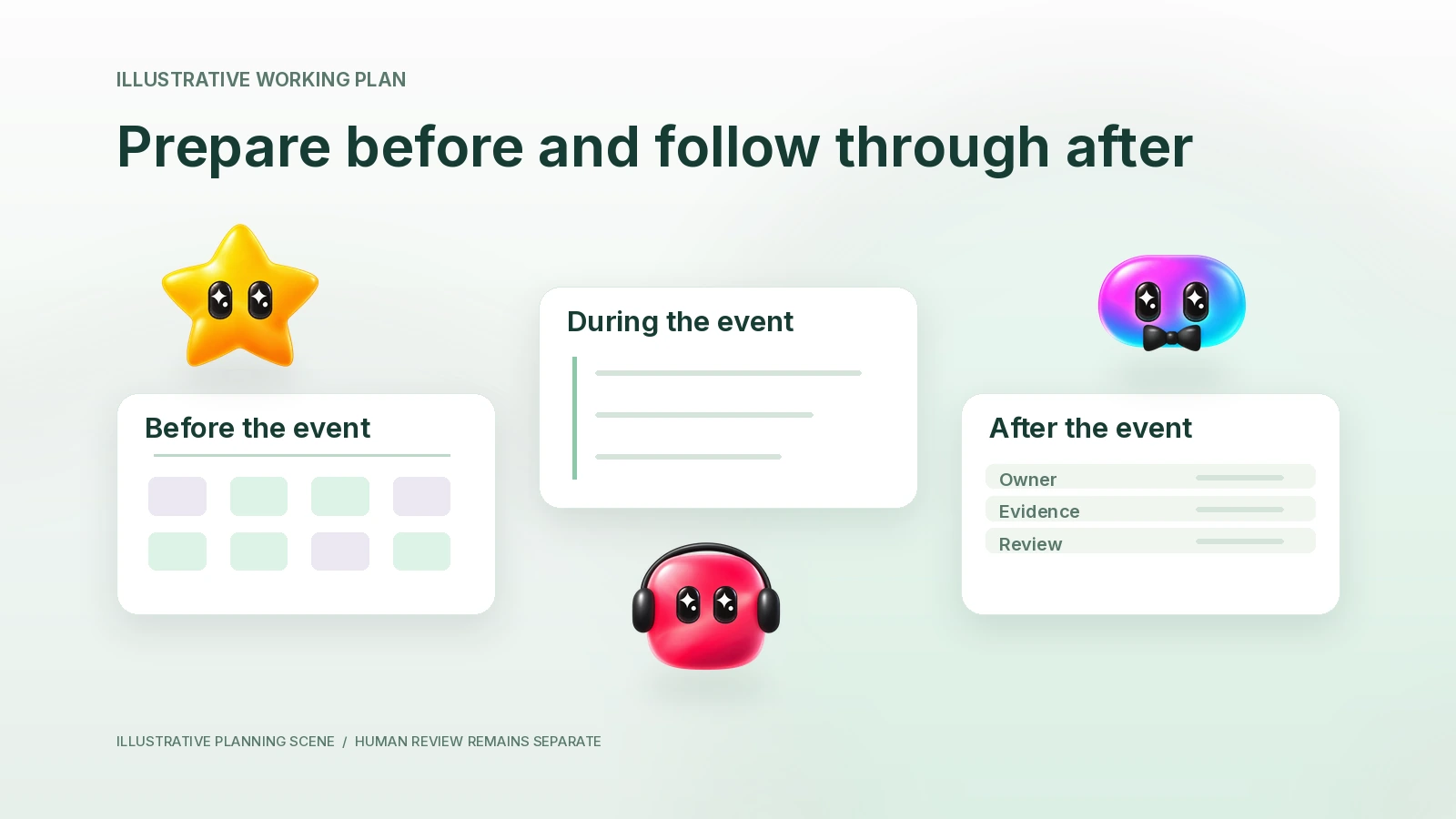
Use an Aurora agent team for event networking by preparing three different artifacts: a permitted attendee-priority plan, accurate conversation notes and a reviewed follow-through queue. Keep the event's access rules, the reason for each conversation and the actual promise visible. An attendee's presence on a list does not authorize a message sequence.
This workflow is an original preparation recipe, illustrated with fictional data. It is not an event-platform integration or a recorded autonomous networking run. You can use your own permitted notes and a small authorized list; you do not need to scrape attendee profiles or connect a new source to begin.
Before the event: prioritize questions, not people scores
State the purpose of attending: learn from operators, meet relevant investors, investigate partnerships or reconnect with existing contacts. These purposes need different evidence. An impressive title does not prove fit, a meeting slot or willingness to make an introduction.
Create a source record for the list you may use: organizer, permission, version, intended purpose and any reuse limit. If an organizer provides only names, treat identity and current role as unresolved until verified. Do not enrich a list with unrelated personal details to make the plan appear complete.
| Planning field | What to record | Reason to stop |
|---|---|---|
| Event purpose | One useful learning or relationship objective | An undifferentiated goal to contact everyone |
| Candidate conversation | Verified person, current role and relevant topic | Identity or relevance cannot be established |
| Existing context | Permitted prior exchange or current public source | Private material belongs to a different client or team |
| Approach | Existing contact, permission request or ordinary in-person introduction | No permitted channel or relationship owner approval |
| Question | One thing the conversation could clarify | A sales pitch with no reciprocal purpose |
Choose three bounded responsibilities
A research responsibility prepares context and open questions. A conversation responsibility helps turn notes you supply into a faithful record. A follow-through responsibility organizes what was actually promised and which action deserves review. The founder remains present in the conversations and owns the relationships.
Optional Aurora Agents can organize responsibilities where the intended workspace supports them. Their names and portraits do not create consent or new tool access. If that feature is unavailable, run three user-triggered tasks in order. Do not describe a manual copy-and-review handoff as automatic coordination.
- Manual: choose the event objective and approve the source/list scope.
- User-triggered: ask for a small plan with facts, questions and gaps, not a ranked prediction of investor interest.
- Manual: review the plan and conduct the actual conversation.
- User-triggered: organize authorized notes, leaving unclear identities and commitments unresolved.
- Manual: correct the conversation record and select the appropriate next action.
- User-triggered: prepare only justified drafts and a handoff receipt.
- Separately authorized: perform the supported approved action and record its real state.
Fictional example: three conversations, three outcomes
Fictional teaching example. HarborRoom is attending an industry event to understand scheduling problems in community venues. The organizer permits use of a small attendee list for event preparation. The founder has no permission for a bulk campaign and does not assume a permanent right to reuse the list.
| Moment | Evidence | Useful return | Founder decision |
|---|---|---|---|
| Before | A venue manager is listed; software purchasing role unknown | Prepare a question about scheduling handoffs | Have a relevant conversation without assuming buying authority |
| During | The manager asks for a sample checklist | Record exact request and identify the approved checklist | Confirm the intended address and permitted material |
| After | A consultant discusses the topic but requests no material | Keep a conversation note with no invented commitment | Do not manufacture a reason to send a sequence |
| After | A contact offers to consider a specific introduction | Mark connector permission pending | Prepare forwardable context only if the contact wants it |
An assistant initially labels all three people “qualified opportunities.” The founder removes that label. The returns are a requested sample, a useful conversation with no next action, and a possible permission-sensitive introduction. None is a customer, investor commitment or completed introduction.
A compact event-to-follow-through record
Event / date / source version:
Permitted use and any retention or reuse boundary:
Conversation objective:
Person / identity source / current role:
We discussed:
Exact request or promise, or none:
What remains uncertain:
Material permitted for this recipient:
Relationship owner and permission state:
Next action / owner / agreed timing:
Prepared / reviewed / actually sent / response / closed:
Receipt or reason no action is appropriate:
The record should be useful even when the correct result is no outreach. Do not equate a business-card exchange, scanned badge or social connection with a wish to receive updates. Use the organization's applicable privacy and event policies; this preparation worksheet is not a legal determination of permitted use.
Keep the after-event message in its existing workflow
The conference follow-up workflow already covers the post-event contact board and example messages. Use it for that job. This article owns the broader before/during/after handoff, so it does not reproduce those email templates. For a confirmed next conversation, use relationship-aware meeting preparation.
Finta Networks can expose available relationship evidence; that is a path to review, not a promise of an introduction. Aurora can help prepare a brief from supported context or notes you provide. Confirm which sources were actually available. A contact absent from a partial list is not proof they were not at the event.
Copyable practice prompt
Try this with Aurora AI in Finta, Claude or Codex using material you are authorized to share.
Prepare an event relationship plan from [event purpose], [permitted attendee/source list and limits] and [authorized notes]. Keep three returns separate: before-event facts/questions, faithful conversation records, and after-event next actions. For each item give the identity source, actual topic, exact promise or none, relationship owner, permission state and unknowns. Do not infer interest, budget, consent or an introduction from attendance or a connection. Preserve source/list reuse limits. Prepare a draft only when the recorded exchange justifies it. Do not scrape profiles, send messages, add records or enable automation. Return a human review queue and no-action reasons.Close the event deliberately
Review whether promised materials were delivered, ambiguous notes were resolved and pending introductions have an accountable owner. Follow the applicable policy for retaining or removing the list and notes. Measure actual conversations, accepted next steps and completed promises separately. A fuller contact list is not evidence of a stronger network.
Sources checked October 22, 2026. The linked Finta product statements are documented context. The event process, records and fictional HarborRoom case are original editorial examples, not measured outcomes or a tested event integration.