Workflow
Build an AI Fundraising Team with Finta
Plan a small fundraising team with distinct research, meeting and follow-through outputs, source-linked handoffs and explicit human decisions.
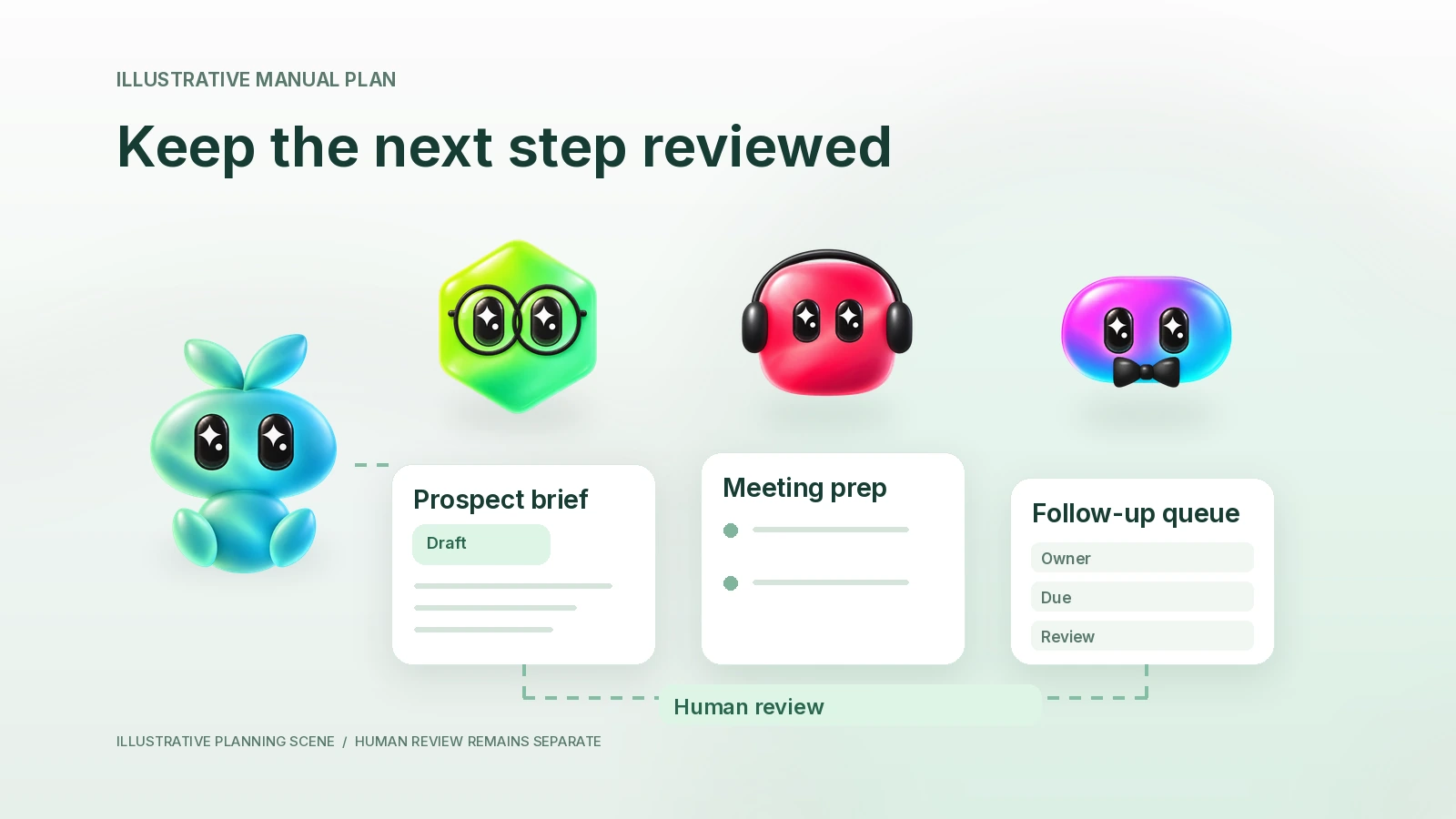
Build an AI fundraising team around a small chain of reviewed outputs: a qualified prospect, a meeting brief, and a next-action draft. Give each responsibility a named human owner and an acceptance check before adding another role. A collection of agent names is not a fundraising process.
This is an operating recipe and a fictional worked example, not a recorded autonomous run. Aurora by Finta can support available context and tools. Custom-agent availability depends on the intended workspace; when the controls are unavailable, use the same worksheet manually rather than assume that a team has been installed.
Begin with a decision, not a larger roster
Choose one investor conversation that needs to move forward. State the permitted result: decide whether to research a prospect further, prepare a specific meeting, or review a follow-up. Do not start with a target for messages sent or a promise to raise a particular amount.
The research responsibility answers why a prospect may fit. Preparation answers what the next conversation needs. Follow-through answers who owes which action. The founder accepts the handoffs and owns claims, relationship choices and external commitments. One person can hold several responsibilities; separate agents become useful only when their outputs are different enough to review independently.
Use the minimum useful responsibility plan
| Responsibility | Permitted input | Distinct output | Human acceptance |
|---|---|---|---|
| Research | Mandate, current official sources, existing CRM identity | Prospect brief with fit, exclusions and unknowns | Founder checks evidence and selects the next step |
| Meeting preparation | Selected prospect and authorized relationship history | One-page brief with objective and open questions | Attendee checks identity, relevance and disclosure |
| Follow-through | Accepted meeting notes and approved facts | Unsent draft and owner/date queue | Relationship owner reviews recipient, claims and timing |
| Coordination | References to accepted artifacts | Handoff ledger with actual state and next decision | Founder resolves blockers; no role grants new access |
These are editorial job labels. Atlas, Poppy and Tempo in the illustration are a visual cast, not product-enforced roles or separate data-permission partitions. An agent profile organizes a responsibility; it does not create a new right to inspect another person's inbox.
Collect one controlled evidence packet
Give the team a short company brief, a dated investor mandate, the current CRM identity, the relevant conversation, and an index of approved materials. Add the source date, owner and permitted audience to each item. If a source is absent, mark it missing. Do not compensate by connecting an unrelated account or copying a colleague's private data.
Keep the current packet small enough to review. A useful starting packet distinguishes facts from assumptions: revenue from a defined period, a trial that is not yet a paying customer, a relationship path that is not consent, and a meeting that is not a commitment. The person providing the packet remains responsible for its accuracy and disclosure rights.
Move through explicit handoffs
- Manual: define the investor question and review the permitted sources.
- User-triggered: request the prospect brief from the available research responsibility.
- Manual: accept or reject the candidate and record why. Stop if identity or fit is unresolved.
- User-triggered: prepare the meeting brief from the accepted prospect and authorized history.
- Manual: after the actual conversation, correct the notes and distinguish requests from suggestions.
- User-triggered: prepare a follow-up draft and next-action queue using the corrected notes.
- Manual: approve any supported record change or communication separately, then record the actual result.
Where enabled, Aurora has distinct ways to ask another agent for judgment and delegate bounded work. A queued delegation is not a completed brief. This recipe does not require automatic role-to-role transfer: wait for the result, inspect its sources, and pass the accepted reference onward. A long prompt containing three role headings is not evidence that three agents ran.
Worked example: one prospect, one corrected handoff
Fictional example: Cedar Loop is a seed-stage company with eight paying organizations and four unpaid evaluations. Founder Nia wants to prepare a conversation with Harbor Example Ventures. These names and figures are invented; they are not customer or investor evidence.
The research output finds a current public statement relevant to the company's stage, but the partner's responsibility is unclear. Nia accepts further research, not an outreach send. The meeting brief then carries a proposed question about decision ownership instead of calling the partner the decision-maker.
| Artifact/version | Review finding | Accepted correction | Next state |
|---|---|---|---|
| Prospect brief v1 | Firm-level stage fit supported; partner role uncertain | Keep role as unknown | Research accepted for meeting preparation |
| Meeting brief v1 | Twelve evaluations described as customers | Eight paying organizations; four unpaid evaluations | Founder corrects before use |
| Conversation notes v1 | Investor asked for retention definition | Record the exact request; do not infer interest level | Evidence owner checks source |
| Follow-up draft v1 | Proposes attaching an unapproved worksheet | Remove attachment; ask founder to approve a current version | Draft waiting for review |
The corrected number follows the evidence into the next artifact. It does not become a reported product result. The final worksheet is useful even if Nia chooses to wait and sends nothing.
Copy this handoff receipt
| Field | Fill it in |
|---|---|
| Responsibility and human owner | Which job is complete, and who accepts it? |
| Source references and dates | Which approved packet and versions were used? |
| Produced artifact | Link or reference to the actual result, not merely a queued run |
| Corrections and unknowns | What changed, and what remains unverified? |
| Current state | Blocked, draft, accepted, sent, or another evidenced state |
| Next decision | Who decides, by when, and under which permission? |
Keep recurring work a separate choice
A persistent responsibility does not mean continuous execution. If recurring work is enabled, inspect the routine, timezone, next occurrence and latest result. A proposed schedule is not an activated routine. Begin with a draft-only review task and confirm actual behavior before expanding it.
Some supported routine settings can carry explicit owner-authorized email recipients. That is a separate authorization, not permission granted by this article, a teammate portrait or a signup button. Do not assume that every send always needs a fresh prompt, or that an old authorization covers a new audience. Keep this exercise in preparation and review.
Check the first useful result before expanding
Ask whether the shortlist avoided duplicates, the brief exposed a real uncertainty, the correction survived the handoff, and the owner can identify the next decision. Record setup and review work as well as output. Add a responsibility only when a repeated failure needs it; another reviewer can increase coordination without improving the decision.
For the specific next step, inspect the Expert Fundraiser skill template, the warm-introduction workflow, or weekly pipeline review. A template is a playbook to review and confirm, not a one-click installation of this whole team. See Aurora by Finta for available product context and controls.
Copyable AI practice prompt
Try this with Aurora AI in Finta, Codex, or Claude using material you are authorized to share. Tool access and available actions differ.
Using [approved company facts], [investor mandate], [existing CRM identities] and [permitted conversation evidence], prepare a three-responsibility fundraising plan. Return a prospect brief, a meeting-preparation outline and an UNSENT follow-up outline. Give each output a source/version reference, human owner, unresolved questions and acceptance check. Distinguish manual, user-triggered and actually available automatic transitions. Do not invent traction, investor appetite, access, role creation, record changes or sending. Mark unavailable sources and stop on conflicting identity. Ask the founder to review the handoff before continuing.