Fundraising Operations
One AI Agent or a Team? When Specialization Helps
Decide whether specialization helps the work. Compare task shape, distinct artifacts, handoff limits and reviewer effort before adding agents.
What you will learn
- Identify independent work and duplicated roles.
- Design acceptance checks and bounded handoffs.
- Record coordination and review costs without inventing time savings.
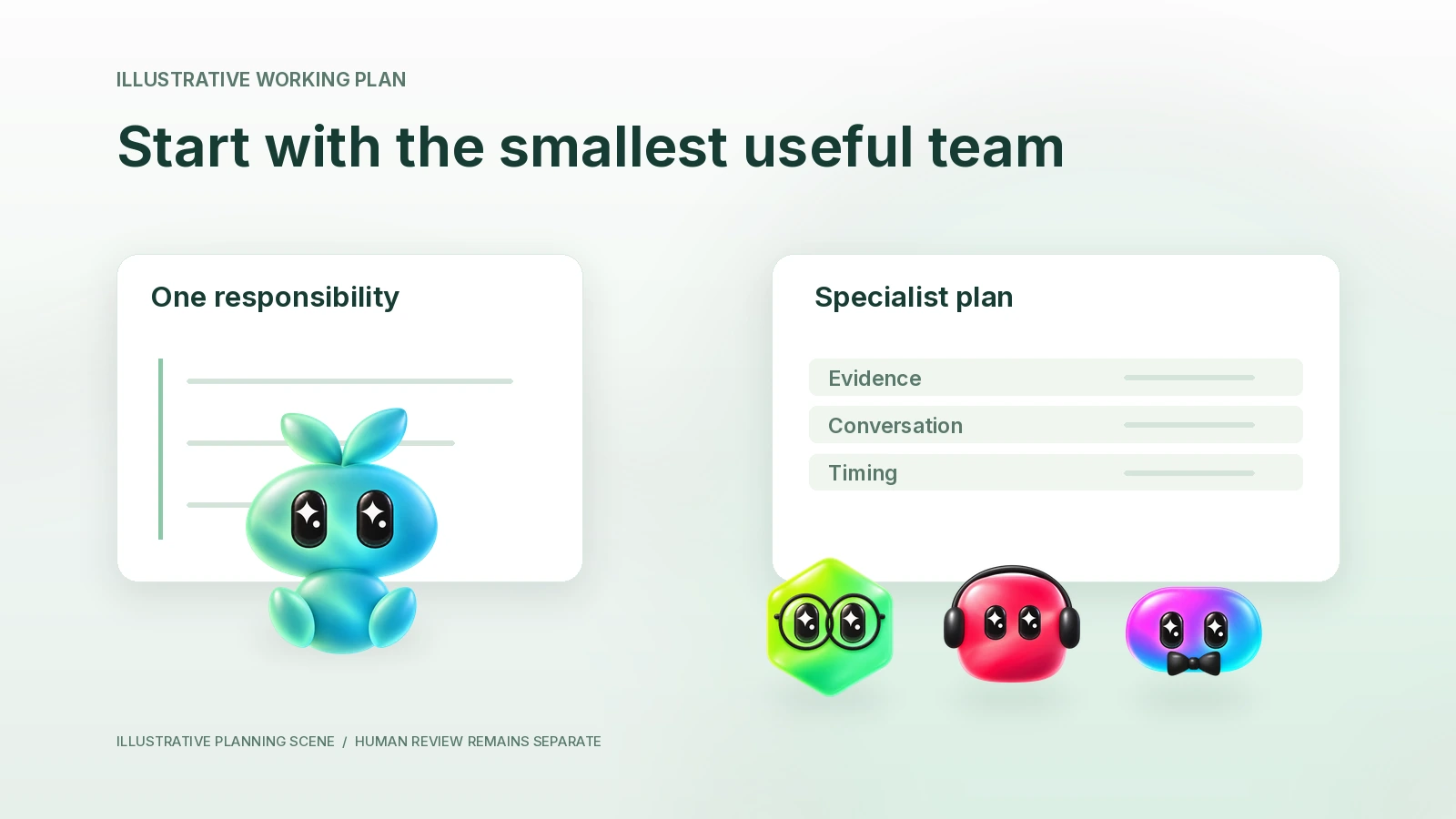
Use one agent when the work shares the same context, sequence and reviewer. Consider a small team when separate responsibilities produce distinct artifacts that can be checked and handed back without repeating the whole job. Specialization earns its place only when its benefit exceeds coordination and review effort.
Reviewed October 22, 2026. The worksheet and cost example below are original planning tools. They do not report an Aurora benchmark, an installed team or measured time savings.
What you will learn
- Identify genuinely separable responsibilities.
- Account for handoff and reviewer effort before adding an agent.
- Plan a minimum useful team while preserving shared evidence and action boundaries.
Separate a role from an extra conversation
A second name or portrait does not create a second useful responsibility. If both agents read the same brief and produce the same summary, the team has added duplication. A stronger split gives each role a different output, evidence standard and stopping point.
Anthropic's account of its research system discusses both opportunities for parallel work and coordination costs. Its results concern that system and evaluation, not Aurora or a general guarantee that more agents improve a task. The transferable question is whether work can be separated usefully.
| Task shape | Start with one agent | Consider separate roles |
|---|---|---|
| Evidence | One small packet answers the whole question. | Independent source sets need different checks. |
| Sequence | Every next step depends on the previous one. | Some outputs can be prepared independently. |
| Output | One coherent artifact needs one editor. | Different artifacts have distinct review criteria. |
| Instructions | The same style and method fit the work. | Responsibilities recur with genuinely different methods. |
| Coordination | A handoff would repeat nearly all context. | A concise receipt is sufficient to continue. |
Design the handoff before the roster
For each proposed role, complete this sentence: “It returns [artifact] supported by [evidence] to [owner], who uses it to decide [next step].” If two roles have the same sentence, combine them. If a role cannot name a recipient or decision, it may not be needed.
| Proposed role | Distinct output | Acceptance check | Handoff limit |
|---|---|---|---|
| [Responsibility A] | [Artifact and required fields] | [How the reviewer verifies it] | [What it must not redo or change] |
| [Responsibility B] | [Different artifact] | [Its own quality check] | [Input version and missing facts] |
| Human owner | [Decision or approved final version] | [Consequential facts and permissions] | [No implicit future authority] |
Sharing an artifact is also a data decision. Name which sources are permitted and which details should be omitted. A role assignment is an operating plan, not a security partition. Use actual account and workspace permissions for access control.
Worked example: an investor meeting packet
Fictional example. CedarLoop's founder needs a brief for an investor call. The source packet has a current company overview, permitted relationship notes and the investor's public biography. A single agent could summarize the packet, list unknowns and prepare discussion topics in one reviewable document.
The founder initially proposes three agents called Research, Analysis and Summary. All three would read the same packet and restate it. She instead tests one responsibility first. If the job later expands, two clearer responsibilities might emerge: a research role verifies changed public facts, and a meeting role assembles the verified facts with the founder's permitted relationship context.
The research output is not “research done.” It is a table of claim, source, checked date, change and uncertainty. The meeting role uses a fixed version of that table and does not invent missing relationship history. The founder owns the final agenda and any outreach. That split is useful only if the changed-fact check is substantial enough to justify a handoff.
Count coordination as work
Use this planning calculation: total effort = task setup + agent work cost + handoff preparation + human review + corrections. Measure those categories in your actual trial before making a time-saving claim. Usage cost and human minutes are different units; do not add them into one unexplained number.
Illustrative human-effort comparison only. One-agent setup takes 8 minutes, review 10 and corrections 6: 24 minutes. A proposed two-role plan takes 10 minutes of setup, 5 of handoff preparation, 8 of review and 4 of corrections: 27 minutes. The team plan adds 3 minutes in this hypothetical example. Model and tool charges are recorded separately, and the example says nothing about actual product speed or output quality.
If the two-role output catches a consequential mistake, that may still justify the added work. Record the reason rather than declare that a lower time total automatically wins. The point is to expose the tradeoff.
What a team plan means in Aurora
Where the feature is enabled, optional Aurora Agents use named responsibilities, editable instructions and persistent conversations. They use the Aurora runtime and available authorized resources. A planning worksheet does not install those agents, connect accounts or activate routines.
Current source supports bounded coordination, so avoid designing an unlimited hierarchy that recursively delegates until a result appears. Queueing a delegated task is not the same as receiving and accepting its output. Inspect the result and unresolved questions before the next handoff.
Use the team-design lesson for setup planning and the context-handoff guide for the receipt. For an occasional brief with a small packet, one clear responsibility may remain the better operating design.
Copyable AI practice prompt
Try this with Aurora AI in Finta, Claude or Codex using only information you are authorized to share. Capabilities and connections differ. This exercise returns a draft for your review.
Review this proposed AI team for unnecessary coordination.
Goal, authorized evidence and final reviewer: [details]
Proposed roles and outputs: [list]
Dependencies and handoff fields: [details]
Return a one-agent option and the smallest useful multi-role option. Identify duplicate work, missing acceptance checks and information each handoff needs. Separate human minutes from model/tool charges; use no invented measurements. Recommend a trial and stop condition. Do not create agents, connect sources, activate schedules, send or change records.
Your next step
Write the role-to-output sentences, combine duplicates and test one small result. Expand only when the actual work demonstrates a distinct responsibility and the handoff is easier to review than repeating the task.