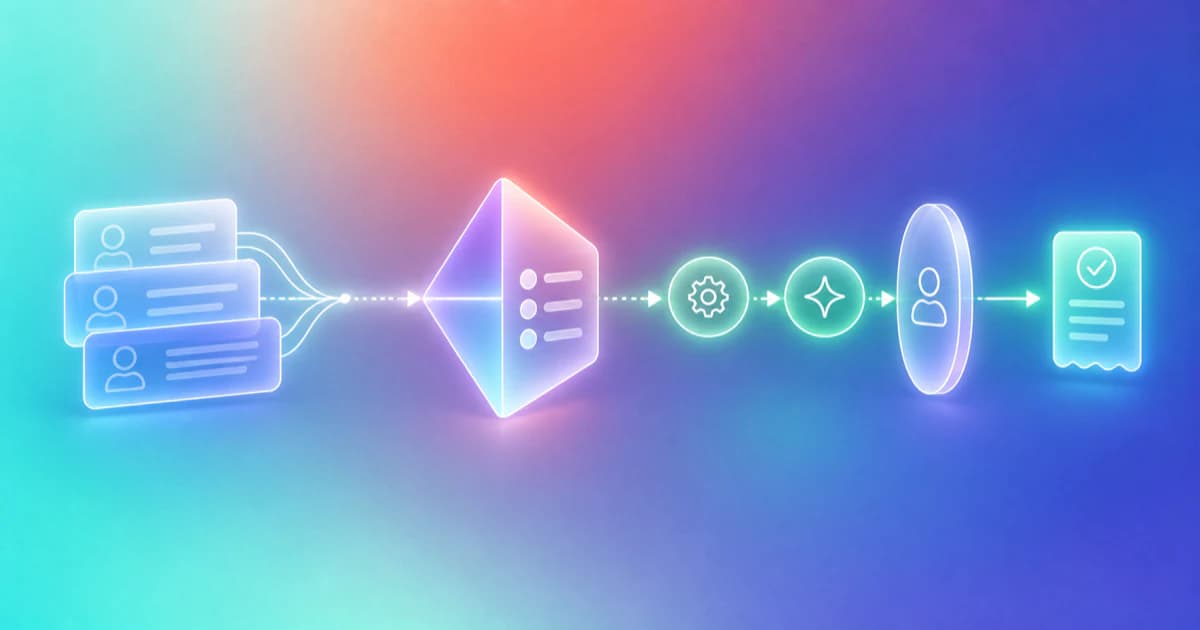
What is an agentic CRM? It is a CRM approach where an AI agent can pursue a goal across supported steps and tools, within the permissions set for the work. This guide compares that behavior with AI features and traditional CRM records, then provides a buyer's test for context, control, and visible results.
The three levels in one table
| System | Primary job | Typical AI behavior | Action boundary | Best fit |
|---|---|---|---|---|
| Traditional CRM | Preserve records and process state | None, or narrow automation | A user or fixed rule performs the action | Teams that need reliable records, reporting, and a defined pipeline |
| AI CRM | Help a person understand or create work | Summarizes, scores, predicts, drafts, or recommends | Often stops at insight or a prepared output | Teams that want faster analysis and content inside an established CRM |
| Agentic CRM | Pursue a goal across several supported steps | Plans, chooses tools, gathers context, updates work, and adapts to results | Can act within permissions; consequential steps may require review | Teams whose relationship work stalls between research, context, decisions, and follow-through |
This is a practical spectrum, not a certification. A single product can contain all three modes. A deterministic automation can also be more reliable than an agent when the process is predictable.
What makes CRM behavior agentic
The clearest test is whether the system can take a goal such as “prepare the next investor meeting and close every open follow-up” and move through a sequence rather than answer one prompt.
A credible agentic workflow should make five things inspectable:
- Objective: the outcome the person asked the system to pursue.
- Context: the CRM records, messages, meetings, documents, public sources, or connected tools available to the task.
- Plan: the steps the agent selected and the assumptions it made.
- Control: what the agent may do, what needs confirmation, and what it cannot access.
- Receipt: the draft, task, record change, research source, or other result that proves what happened.
Salesforce describes agentic CRM as a combination of people and agents that can plan, execute, and adapt multi-step workflows within guardrails. Anthropic's guidance on agents similarly distinguishes open-ended agents from predefined workflows and recommends using the simplest dependable pattern for the job.
Why an AI feature is not automatically an agent
Useful AI CRM features include meeting summaries, email drafts, predictive scores, record enrichment, and natural-language reporting. None is trivial. But one generated object is not the same as pursuing a goal across tools.
Consider a partnership manager who asks, “What must happen before Friday's renewal call?”
- A traditional CRM can show the account, opportunity, stage, and tasks already entered.
- An AI CRM can summarize the account and suggest likely talking points.
- An agentic CRM can inspect available relationship history and meeting context, identify an unanswered request, retrieve the supported document connected to it, prepare a brief, create a follow-up task, and ask for review before an external message is sent.
The difference is continuity from evidence to a governed next action.
Aurora is what makes Finta agentic
Aurora is not a decorative copilot bolted onto Finta's CRM. It is the agent that can work across available Finta context and supported connections to research, synthesize, prepare, organize, and execute supported steps.
That can include CRM records, inbox and calendar context, indexed documents, relationship evidence, public-web research, scheduled work, and compatible connected tools. Aurora can also work with supported Finta tools through MCP clients. The exact tools and actions depend on the organization, current connections, permissions, credits, and confirmation requirements.
This matters because relationship-driven work rarely fits inside one record. A fundraise, strategic partnership, major gift, referral, or advisory mandate develops across people, messages, meetings, documents, promises, and timing. Aurora gives that context an action layer. Finta keeps the result with the relationship instead of leaving it in a disconnected chat.
Agentic does not mean uncontrolled
“Autonomous” is often used too broadly. Some low-risk internal actions or scheduled tasks can run inside configured permissions. A consequential message, introduction, or decision may still require a person to review and confirm it. The correct boundary depends on the action, not on a blanket promise.
For each workflow, ask:
- Which sources can the agent read?
- Is the source current, connected, and authorized?
- Can the agent write to the CRM, create tasks, or change a stage?
- Can it send externally, or only prepare a draft?
- What requires confirmation?
- What happens when a source is missing or a tool fails?
- Where can a reviewer see the resulting action?
Human review is not evidence that the system is “less agentic.” In sensitive work, it is part of a well-designed operating model.
When traditional automation is better
Do not use an agent merely because one is available. A fixed workflow is usually better when every case follows the same rule, the inputs are structured, and the cost of variation is high.
Examples include:
- stop a sequence after a recorded reply;
- assign a task when a deal reaches a defined stage;
- send a standard internal notification after a verified event;
- require a field before a record can advance.
Use an agent when the work requires interpretation, source selection, planning, or adapting to incomplete context. Combine both when the agent prepares the judgment-heavy work and deterministic rules enforce the boundary.
A buyer's verification test
Give every vendor the same realistic task. Use a relationship with known history, one incomplete source, an open commitment, and an action that should not be sent without approval.
Then score what you observe:
| Question | Evidence to request |
|---|---|
| Can it use more than the current prompt? | Show the exact authorized records and sources used |
| Can it choose and call tools? | Show the tool sequence and any failed or skipped step |
| Can it adapt? | Change one input and inspect how the plan changes |
| Can it act? | Show the resulting task, record update, draft, or other receipt |
| Can people stay in control? | Show confirmation, permission, and stop states |
| Does the result improve the next decision? | Reopen the relationship and find the outcome in context |
The strongest demo is not the most confident answer. It is the one where the system correctly notices that evidence is missing, stops at the right boundary, and leaves a useful result behind.
Frequently asked questions
Is an agentic CRM the same as an autonomous CRM?
No. Agentic describes the ability to pursue goals and use tools across steps. Autonomy describes how independently a particular action may run. A system can be agentic while requiring approval for consequential actions.
Does an agentic CRM replace every existing system?
It should not have to. A practical implementation can connect to selected systems and preserve a clear owner for each record. Read how to implement an agentic CRM without replacing every system before planning a migration.
Does Finta include a proprietary prospect database?
No. Aurora can research the public web, users can import their own lists, and supported licensed-data or MCP connections can contribute records when the user has access. Finta becomes the relationship and action layer for reviewed prospects.
Put the distinction to work
If your CRM records activity but important work still stalls between research, relationships, meetings, and follow-up, evaluate the whole loop. Explore agentic CRM in Finta and see how Aurora turns available context into the next governed action.