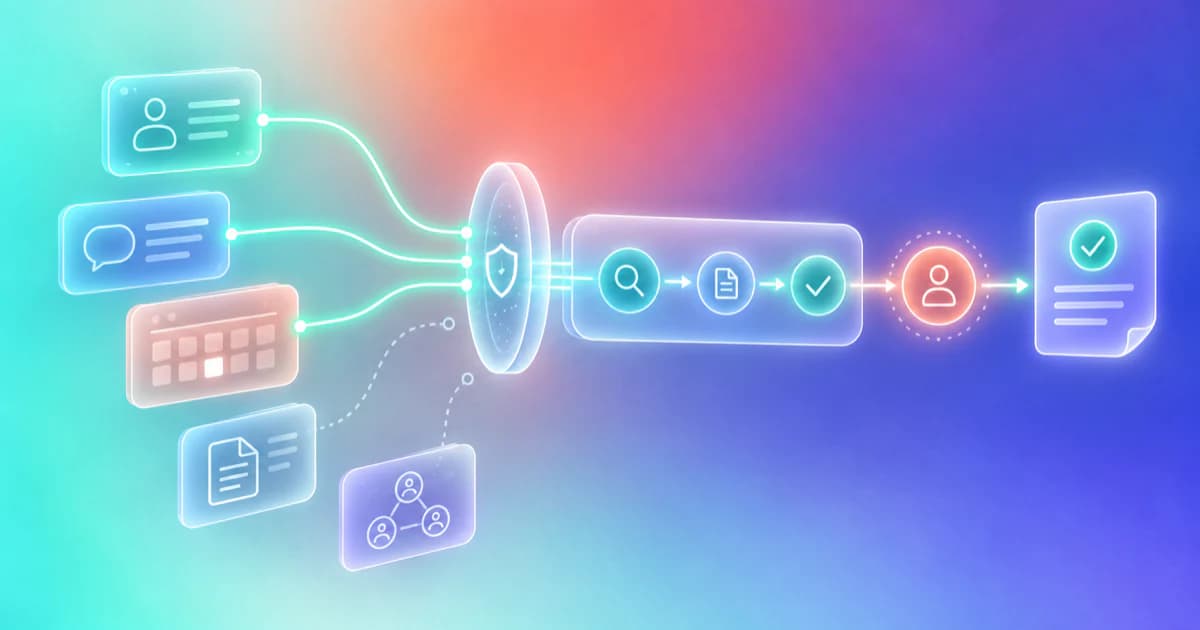
Implement an agentic CRM by choosing one consequential workflow, identifying the systems that own its data, connecting only the context needed for that job, and giving the agent a narrow set of permitted actions. Prove the loop from source to action to receipt before expanding. A broad migration is usually the wrong first milestone.
Start with a stalled handoff, not a platform project
The best initial use case has a clear owner, repeated friction, available evidence, and a result you can verify. Good candidates include:
- preparing for an investor or client meeting;
- reviewing a fundraising or partnership pipeline;
- finding open commitments after a conversation;
- researching a defined set of prospects;
- drafting follow-up for human review;
- turning an accepted introduction into an owned next step.
Avoid beginning with “automate our CRM.” That goal is too broad to define success or contain risk.
The six-part implementation map
| Part | Question | Deliverable |
|---|---|---|
| Outcome | What should be true when the run finishes? | One observable acceptance test |
| Sources | Which systems contain relevant evidence? | Source map with an owner for each record |
| Identity | How are the same people and companies matched? | Matching and deduplication rules |
| Actions | What may the agent read, prepare, change, or send? | Permission matrix |
| Review | Where must a person intervene? | Confirmation and escalation design |
| Receipt | How will the team know what happened? | Action log and updated operating record |
This structure keeps “connect everything” from becoming a substitute for design.
Step 1: write a testable objective
Replace a vague request with a bounded one.
Weak objective:
Help with investor follow-up.
Testable objective:
Review active investor conversations from the last fourteen days, identify explicit unanswered requests, prepare a draft or task for each supported case, and do not send anything externally.
The second objective defines scope, evidence, output, and an action boundary. It also gives the team a sample set to review.
Step 2: preserve a system owner for each kind of truth
An agentic layer does not eliminate the need for clear records. Decide which system owns:
- person and company identity;
- relationship and interaction history;
- pipeline stage and owner;
- calendar events;
- approved documents;
- messages and sent state;
- tasks and commitments;
- external market or prospect data.
The agent may read or update several systems, but it should not silently create conflicting versions. Document whether a connection is read-only, read-write, imported, synchronized, or requested on demand.
Step 3: connect the minimum useful context
More context can improve a result, but it also increases setup, ambiguity, and permission surface. Connect sources in the order that they can change the decision.
For a meeting-preparation pilot, that might be:
- the CRM record and pipeline state;
- relevant inbox and calendar context;
- supported documents explicitly tied to the conversation;
- relationship evidence;
- public-web or licensed research when a factual gap remains.
Test missing, stale, duplicate, and revoked sources. A useful system must be able to say that it does not have the evidence.
Step 4: separate workflows from agent decisions
Anthropic's guidance distinguishes predefined workflows from agents that dynamically direct their own process. Use both deliberately.
Keep deterministic rules for stable boundaries such as:
- stop a sequence when a supported reply is recorded;
- require a recipient and sender before an email can be sent;
- prevent a stage change when required fields are missing;
- schedule a known review cadence;
- route a failed action for attention.
Use agent judgment for tasks such as:
- deciding which sources answer a research question;
- recognizing an unresolved commitment in unstructured notes;
- choosing the relevant relationship evidence;
- adapting a meeting brief to what changed;
- proposing the next step when several paths are possible.
Step 5: create an action-permission matrix
Do not grant one broad “AI access” role. Classify actions by consequence.
| Action class | Example | Sensible initial state |
|---|---|---|
| Read | Retrieve a CRM record or approved document | Allowed for scoped sources |
| Research | Search the public web and save sources | Allowed with source review |
| Prepare | Draft a brief, task, or message | Allowed; label as prepared |
| Internal write | Add a note or update a field | Confirm initially; relax only after evidence |
| External write | Send a message or request an introduction | Require explicit review and recipient check |
| High-consequence decision | Commit capital, promise terms, or make a regulated representation | Keep outside unattended agent authority |
Permissions should reflect the actual tool and connection. A browser extension, inbox connector, CRM API, and MCP server can expose different capabilities.
Step 6: make the agent leave receipts
An agentic CRM should not force an operator to reconstruct what the agent did from a chat transcript. For every run, retain enough evidence to answer:
- Which objective was active?
- Which sources were used?
- Which assumptions were made?
- Which tools ran, failed, or were skipped?
- What was prepared or changed?
- Who approved a consequential action?
- What is still open?
The receipt can be a task, saved brief, record change, draft, audit entry, or a combination. It should live close to the relationship or workflow it affects.
How Aurora supports an incremental implementation
Aurora is what makes Finta agentic. It can work across available Finta context and supported connections, use tools, and carry multi-step work forward. Teams can begin with one Finta Space or workflow rather than replacing every operating system at once.
For example, a fundraising team can bring reviewed investor prospects into the CRM, attach relationship and conversation context, ask Aurora to prepare a pipeline review, and keep external follow-up under human review. Prospect research can come from Aurora's public-web research, user-owned lists, or compatible licensed-data and MCP tools. Finta is not a proprietary marketwide prospect database.
The implementation benefit is not “AI everywhere.” It is one controlled relationship loop that works end to end.
A four-week pilot
Week 1: define and baseline
Choose one workflow and twenty to fifty representative records. Measure the current process: missing fields, time to prepare, open commitments, stale next actions, and rework. Do not use an inflated productivity estimate as the baseline.
Week 2: connect and test
Connect only required sources. Test identity matching, source freshness, permissions, and failure states. Run historical cases whose correct outcomes are known.
Week 3: shadow mode
Let the agent prepare work while operators continue the existing process. Compare evidence, missed items, false positives, and action quality. Require review for every write.
Week 4: controlled production
Allow the proven low-risk actions, preserve confirmation for consequential ones, and review receipts weekly. Expand only after the initial workflow is reliable.
Implementation metrics that matter
Track outcomes tied to the chosen job:
- percentage of active relationships with a dated next action;
- open commitments found and resolved;
- meeting briefs ready before the meeting;
- drafts accepted, materially edited, or rejected;
- duplicate or mismatched records caught;
- agent actions completed, failed, stopped, or awaiting approval;
- time from new evidence to an owned next step.
For fundraising specifically, use fundraising CRM metrics that measure movement, not email volume as a proxy for progress.
Common implementation failures
- Migrating every system before proving one job.
- Giving the agent broad write access because read access worked.
- Treating more connected data as better data.
- Hiding source gaps behind confident summaries.
- Automating an undefined or politically disputed process.
- Measuring generated output instead of accepted outcomes.
- Leaving results in chat instead of updating the operating record.
- Assuming “agentic” means external actions should run without review.
Implementation checklist
- One repeated relationship workflow has an accountable owner.
- The outcome and failure conditions are observable.
- Every data type has a named system owner.
- Identity and deduplication rules are documented.
- Source permissions and freshness are visible.
- Deterministic rules enforce stable boundaries.
- Agent decisions are reserved for work that needs interpretation.
- External actions have an appropriate confirmation step.
- Completed runs leave a receipt with the relationship.
- The team can pause, revoke, correct, and recover.
Start with one complete loop
Explore Finta's agentic CRM, then choose one workflow where relationship context routinely falls through a handoff. Let Aurora prove the path from available evidence to a governed next action before expanding the system.