Fundraising Operations
Always-On AI Agents: What Keeps Working Between Conversations?
Separate a lasting responsibility from an actual run. Map schedules, source coverage, returned artifacts and review before relying on always-on work.
What you will learn
- Explain why persistence is different from continuous computation.
- Specify trigger, timezone, source window and exception behavior.
- Inspect an actual routine result before relying on recurring work.
An always-on agent can preserve a responsibility and resume work between conversations. That does not mean one model computes continuously, every source is watched in real time or every scheduled check succeeds. To understand the promise, identify what persists, what starts a run and what result comes back.
Reviewed October 22, 2026. This lesson separates a durable assignment from its actual execution. The timeline and run cards are original planning examples, not observed Finta runs or an uptime claim.
What you will learn
- Distinguish a saved responsibility, a schedule, an event trigger and a running task.
- Design a timeline that includes missing sources and human decisions.
- Verify a routine's current state without treating a configuration as a completed result.
Ask which part of the job stays available
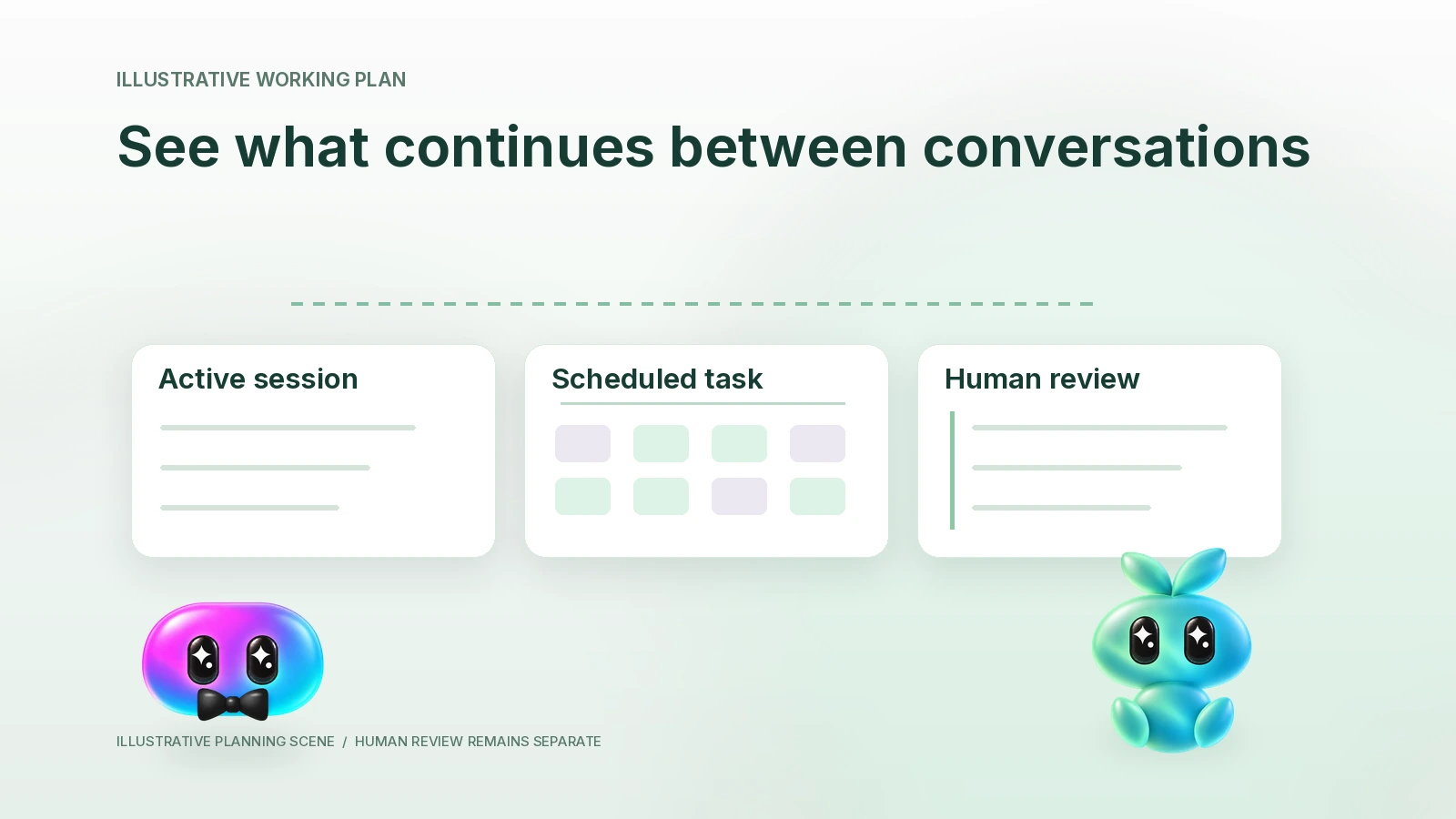
“Always-on” can refer to several different behaviors. A saved conversation may remain available while no work is running. A schedule may start a task at a chosen time. An event may trigger a supported process. A run may wait for a tool, a source or a decision. These states should be visible separately.
OpenAI's dots help describes background research and scheduled tasks with review and pause controls. That is a provider-specific model, not a definition that every agent product implements. For any product, ask what starts work, where its state is recorded and which actions are allowed.
| Layer | What continues | What it does not establish |
|---|---|---|
| Standing responsibility | The job, instructions and expected result. | That a task is currently running. |
| Persistent conversation | A place to return to the work and give corrections. | Perfect recall or complete source coverage. |
| Scheduled task | A configured opportunity to start at a defined time. | That the source will be connected or the result correct. |
| Event-triggered process | A response to a particular supported event. | Continuous monitoring of unrelated systems. |
| Execution | A bounded attempt to produce the requested work. | An external action unless its receipt confirms it. |
| Human review | A person resolves a question, approves a step or changes direction. | Permission for every future action. |
Map the time between two conversations
Use a timeline before setting a faster cadence. Start with the source window: is the task reviewing the last day, the period since the last successful run or a fixed set of records? Those choices behave differently after a missed run. A calendar can be full while the inbox connection is unavailable; partial coverage should remain explicit.
Fictional example. A founder wants a daily brief of investor questions. At 4 p.m. a planned routine should inspect permitted new replies, compare them with the current question ledger and return a draft priority list. The founder reviews it at 4:30. No outreach or record change is part of this exercise.
| Moment | Expected state | Evidence to inspect | Exception response |
|---|---|---|---|
| Before 4 p.m. | Responsibility saved; no new result yet. | Current instructions, intended account and source window. | Correct the plan before enabling it. |
| 4 p.m. | A supported scheduled run may start. | Actual run state, not only the calendar setting. | Check disabled, paused or unavailable conditions. |
| Source retrieval | Allowed replies and records reviewed. | Which sources were available and their dates. | Report missing inbox coverage instead of saying no new questions. |
| Output returned | Draft priority list ready. | Sources, changed questions, unresolved items and no-change findings. | Keep conflicting facts unresolved. |
| 4:30 review | Founder chooses the next action. | Corrected artifact and explicit decision. | Pause repetition if the output is not useful. |
If the run starts late, the timeline should show that. If it fails, “no result” must not become “nothing important happened.” If it returns the same question twice, compare source identifiers and prior completion state before increasing the schedule frequency.
Use a routine specification that can be checked
| Field | Your specification | Verification |
|---|---|---|
| Responsibility | [One recurring decision or artifact] | Would another person know what counts as useful? |
| Trigger | [Supported schedule, event or manual start] | Does the actual product support it? |
| Timing | [Time, timezone and next occurrence] | Check the saved value and daylight-saving implications. |
| Coverage | [Sources, account and lookback window] | What should happen after a missed run? |
| Output | [Artifact, sources and explicit state] | Can the reviewer inspect the result? |
| Authority | [Allowed actions and stop points] | Does the saved policy match the plan? |
| Quiet result | [How to report no material change] | Do not invent urgency or hide a failed source. |
| Pause owner | [Person and review cadence] | Confirm pause state; inspect work already in progress separately. |
What this means for Aurora
Finta Automations documents scheduled Aurora work, contact sequences and reusable Skills as different mechanisms. A named responsibility is not itself an activated routine. Where Aurora Agents is enabled, routine setup and activation are separate steps; check the saved effective state and next occurrence in the current application.
A proposed schedule does not grant new access or authorize sending. For the first trial, keep the output a draft and inspect it manually. An unavailable source, disabled routine, insufficient capacity or pending decision can prevent useful work even when the assignment persists. Pausing future work should not be described as undoing an action already taken.
Use the existing Aurora routines guide for its operating instructions, and the persistence guide for what should carry into the next session. This lesson owns the timeline between conversations.
Copyable AI practice prompt
Try this with Aurora AI in Finta, Claude or Codex using only information you are authorized to share. Capabilities and connections differ. This exercise returns a draft for your review.
Map a recurring responsibility without assuming continuous execution.
Job and expected artifact: [details]
Current supported trigger and timezone: [source and settings]
Authorized sources and coverage window: [list]
Allowed actions and human decisions: [boundaries]
Return a timeline separating saved responsibility, trigger, execution, returned result and review. Add missed-run, disconnected-source, duplicate-item and no-change cases. Mark unknown capability or state. Do not activate a routine, send messages, change records or claim work occurred. I will verify actual settings and results.
Check the first return before adding frequency
Start with one supported run, inspect the receipt and correct the assignment. Keep the schedule only if it produces a useful artifact and an understandable next decision. Availability between conversations is valuable when the work remains explainable.