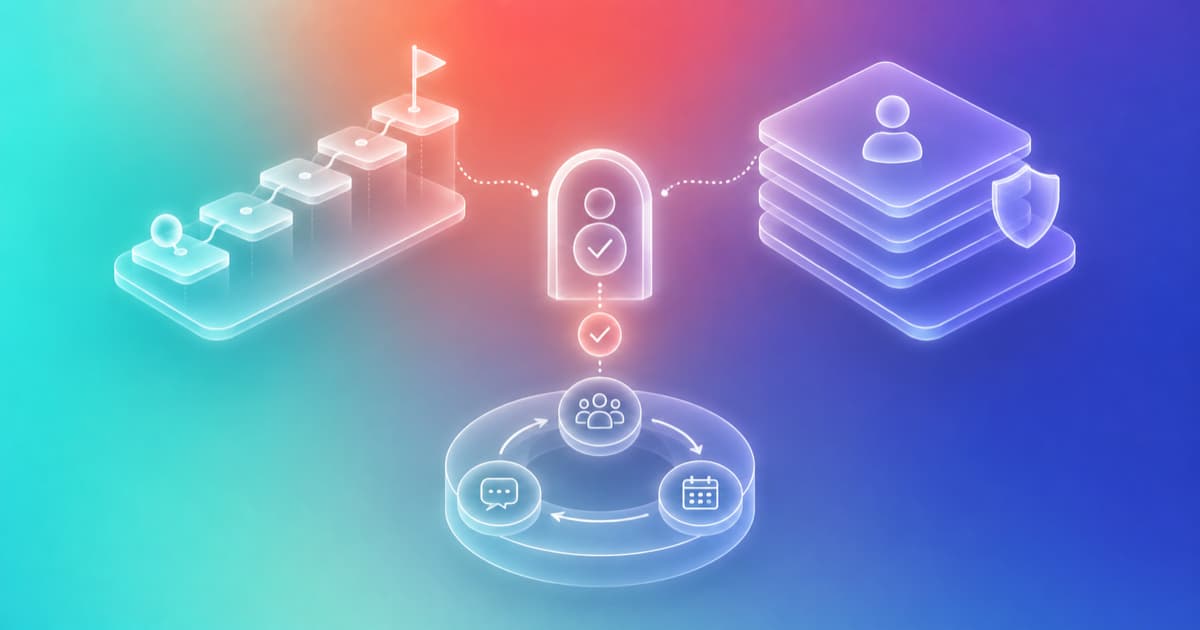
Moves management is the fundraising method. A donor CRM is the authoritative fundraising system. Relationship intelligence is the evidence and action layer that can help a team prepare and complete the next responsible move. These terms overlap in software marketing, but treating them as separate jobs produces a cleaner operating model.
Method, system, and action layer
| Layer | Core job | Typical contents | What it must not imply |
|---|---|---|---|
| Moves management | Define how relationships progress through cultivation and stewardship | Stages, exit criteria, assignments, next moves, review cadence | That every prospect should advance or will give |
| Donor CRM | Maintain the official constituent and fundraising record | Identity, household, gifts, pledges, campaigns, restrictions, preferences, actions, reporting | That every relationship detail belongs in every user’s view |
| Relationship intelligence | Assemble approved context and support the next reviewed action | Relationship history, ownership, mutual paths, meetings, permitted communications, source-linked research, open commitments | That a model can know intent, capacity, consent, or gift likelihood |
Blackbaud defines moves management as tracking and planning interactions that manage a donor relationship through the lifecycle. The exact stage names differ by organization. The operating requirement is consistency: a stage should have observable evidence, an accountable owner, and a next action or deliberate stop.
The MOVE operating model
M: Map the authoritative records
Name the system that owns constituent identity, gifts, pledges, restrictions, consent, official proposal status, and fundraising reporting. Name separately where approved meeting, communication, relationship, and task context is worked.
O: Own each move
Every active relationship needs one accountable owner. A board member, program leader, executive, and gift officer can all contribute, but shared interest should not become ambiguous accountability.
V: Verify the evidence
Require a source and date for material facts. Label observations, donor statements, staff interpretations, and model inferences differently. A connection is not an approved introduction. A past gift is not a promise to give again.
E: Execute and reconcile
Prepare the next action, put consequential steps through human review, record the accepted outcome, and reconcile it with the authoritative donor system. If evidence, permission, or ownership is missing, stop rather than advance the stage.
When the donor CRM is enough
A donor CRM may already support the organization’s moves stages, assignments, actions, proposals, reporting, and AI assistance. Blackbaud Raiser’s Edge NXT, for example, describes constituent records, gift processing, moves-management workflows, portfolio work, donor engagement, and embedded intelligence.
Keep the workflow in that system when staff can reliably prepare meetings, see the right relationship context, coordinate owners, and complete follow-up without creating ungoverned copies. Another tool is not automatically an improvement.
When relationship intelligence becomes useful
A relationship layer becomes useful when the official record is accurate but the active context is fragmented across inboxes, calendars, meeting notes, internal stakeholders, and possible relationship paths.
Finta CRM keeps a working relationship’s stage, research, mutual connections, permitted inbox context, and next move together. Finta Networks can show available relationship evidence and possible paths while keeping the introduction request a deliberate human action.
Aurora can inspect available Finta sources, synthesize a relationship brief, prepare a follow-up draft, propose supported changes, and complete only supported workspace actions within permissions. It shows the sources checked and where confirmation is required. That can reduce reconstruction work without pretending the system can decide who is ready for a gift conversation.
Worked example: a qualification stage review
A nonprofit defines “Qualification” as a human decision that a named prospect is relevant to the mission, appropriate to contact, assigned to an owner, and ready for a first learning conversation. It does not define the stage as “likely to give.”
During a weekly review:
- The donor CRM confirms identity, existing constituent history, communication preference, and any official prospect assignment.
- The relationship workspace shows the accountable owner, approved recent context, and a possible board path.
- Aurora prepares a review queue for records missing one of four requirements: evidence, permission, owner, or dated next action.
- The team verifies the possible path with the board member instead of treating it as permission.
- The team advances, holds, recycles, or removes each record and states why.
- Accepted changes are reconciled with the donor CRM. No gift probability is created.
This produces a more honest pipeline. A record advances because the team completed a defined operating decision, not because software assigned confidence to another person’s future behavior.
Avoid three common architecture failures
A shadow donor database
Do not copy gifts, restrictions, preferences, and household data into a relationship layer without an explicit need, owner, and reconciliation rule.
A stage that hides judgment
Labels such as “hot,” “ready,” or “high potential” can blur observed evidence and staff opinion. Prefer observable exit criteria and record the responsible decision-maker.
An AI output that becomes the record
A polished summary can still be wrong. Preserve source links, dates, uncertainty, and the ability to correct the underlying record.
Ethics and privacy requirements
The Association of Fundraising Professionals Code of Ethical Standards emphasizes privacy, accurate communications, confidentiality, donor intent, and proper stewardship. Moves management should operationalize those duties, not bypass them. Define minimum access, legitimate purpose, retention, review, and correction rules before connecting systems or using AI on donor context.
Limits and disclosure
Finta does not process gifts, issue tax receipts, maintain donor accounting, perform wealth screening, manage grant awards, or predict gift likelihood. It cannot infer consent or private intent. The donor CRM and the nonprofit’s policies remain authoritative for official fundraising records and controls.
Review the next move without replacing the donor system
Use moves management as the method, the donor CRM as the fundraising record, and Finta as an optional relationship-action layer. Review a major-gifts pipeline in Finta.