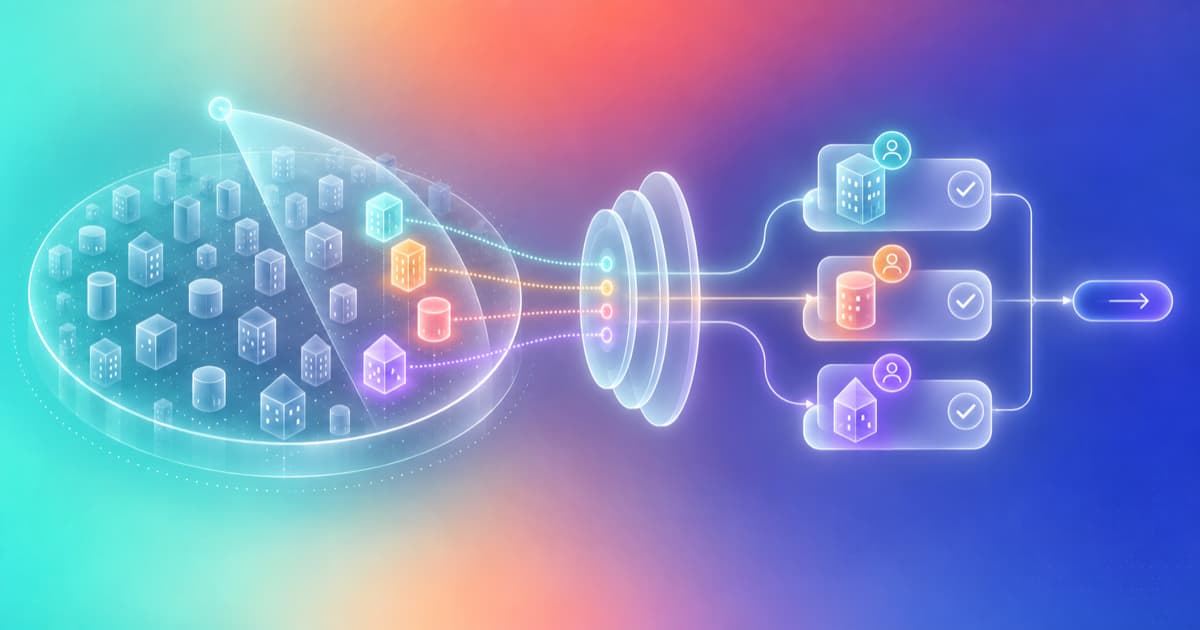
A deal origination CRM coordinates selected relationships, coverage, conversations and next actions. Deal sourcing software helps search and screen the market for targets. This buyer's guide compares those jobs using the SCOPE framework, then shows how a sourced list becomes an owned relationship pipeline without losing provenance. Many teams need both; Finta's relationship workflow does not create a proprietary market dataset.
The shortest useful distinction
| Question | Deal sourcing software | Deal origination CRM |
|---|---|---|
| What universe can we search? | Broad company, investor, transaction, or property data | The people, firms, and opportunities the team has chosen to work |
| Why is a prospect relevant? | Market filters, firmographics, events, transactions, or research | Recorded thesis, relationship history, current objective, and owner judgment |
| Who knows the prospect? | Sometimes supplied by a data or integration layer | Available relationship evidence, mutual connections, and firm coverage |
| What happens next? | Build a list, screen it, or export it | Prepare outreach, assign an owner, schedule a meeting, update a stage, or close the loop |
| What should remain authoritative? | Market facts and source-linked research | Relationship history, opportunity state, ownership, and reviewed actions |
Gain, for example, describes a private-market data system spanning companies, investors, deals, advisers, lenders, financials, and news. Intapp DealCloud describes a deal and relationship intelligence platform for sourcing, coverage, execution, and firmwide workflows. Those products can overlap, but the buying question should start with the missing job rather than the category label.
Use the SCOPE test before choosing a tool
The SCOPE test separates five jobs that are often bundled into one software search.
| Job | Decision question | Natural owner |
|---|---|---|
| S: Search | Do we need a new universe of companies, investors, properties, or transactions? | Sourcing or market-data product |
| C: Context | Do we need to understand prior conversations, mutual connections, and current relationship state? | Relationship-aware CRM |
| O: Ownership | Can the team see who covers the account and who owns the next action? | CRM and operating process |
| P: Progression | Can a selected prospect move through the team’s real origination stages? | CRM or deal workflow system |
| E: Evidence | Can a reviewer reopen the source behind a fact, path, or recommendation? | Both systems, with provenance preserved across the handoff |
If Search is the main failure, buying another CRM will not create a proprietary market dataset. If Context, Ownership, or Progression is the failure, exporting another list may only add more rows to an unmanaged queue.
Where relationship intelligence changes the workflow
A conventional CRM can store the selected record and its stage. Relationship intelligence adds the evidence needed to decide how to approach it: who has interacted with the person, what was discussed, what remains open, and which next action fits the current objective.
Finta CRM keeps a relationship’s stage, research, mutual connections, permitted inbox context, and next move together. Finta Networks shows available relationship-strength evidence and possible paths. Relationship strength reflects available interaction evidence, not a promise of access, an introduction, or a successful outcome.
Aurora can work across available Finta context and supported connections to inspect records, synthesize what matters, prepare a next step, and complete only actions supported by the available tools and permissions. For external communication, the useful result is a reviewable draft. Nothing should be described as sent until a person actually sends it.
Worked example: a sector coverage list becomes an origination pipeline
Consider an advisory team building a list of industrial automation companies.
- The team uses its licensed sourcing system to filter the market by geography, ownership, subsector, and size.
- An associate verifies the sources and selects 30 relevant companies. The original data links remain attached.
- The selected companies enter the CRM with a stated coverage thesis, not just an imported score.
- The team reviews existing firm relationships and assigns one coverage owner per company.
- Aurora prepares a source-visible relationship brief for the next five accounts, including known history, open questions, and one proposed next step.
- The owner reviews the evidence, corrects any ambiguity, and decides whether to request an introduction, contact the company directly, defer it, or remove it.
- The CRM records the accepted action and outcome. The market-data platform continues to own its underlying market facts.
The handoff is the design problem. Copy too little and the CRM record has no usable evidence. Copy everything and the team creates an expensive, stale duplicate of a licensed database.
When one platform may be enough
Start with a sourcing platform when the team has strong relationship operations but cannot reliably identify or screen targets. Start with a relationship CRM when target names are already known through bankers, founders, clients, conferences, referrals, or a licensed dataset, but ownership and follow-through are breaking down.
One broader platform may be enough when it provides the required market coverage, relationship model, workflow, permissions, integrations, and adoption pattern. Verify each capability against the current product and contract. A category name alone does not establish data coverage or workflow fit.
Questions for a live evaluation
- Show how a sourced company becomes an owned relationship record without losing provenance.
- Show how the system distinguishes a direct relationship from a possible mutual path.
- Show how two bankers are prevented from running conflicting outreach.
- Show what happens when a market fact changes after it was copied into the CRM.
- Show the receipt for an AI-prepared brief or action, including sources, uncertainty, permission, and confirmation state.
- Show the safe stop when a record is missing, duplicated, restricted, or assigned to another owner.
Limits and disclosure
Finta is not a proprietary company, investor, transaction, property, or market-data database. It does not replace licensed sourcing products, valuation tools, diligence systems, or a firm’s required compliance and recordkeeping controls. Web research can help answer a defined question, but it is not equivalent to comprehensive market coverage. Every target, relationship path, and external action still requires human judgment.
Put sourced prospects into a relationship workflow
Keep the market universe in the system built to research it. Use Finta to turn selected prospects into owned relationships with visible context and reviewed next actions. Explore Finta CRM.