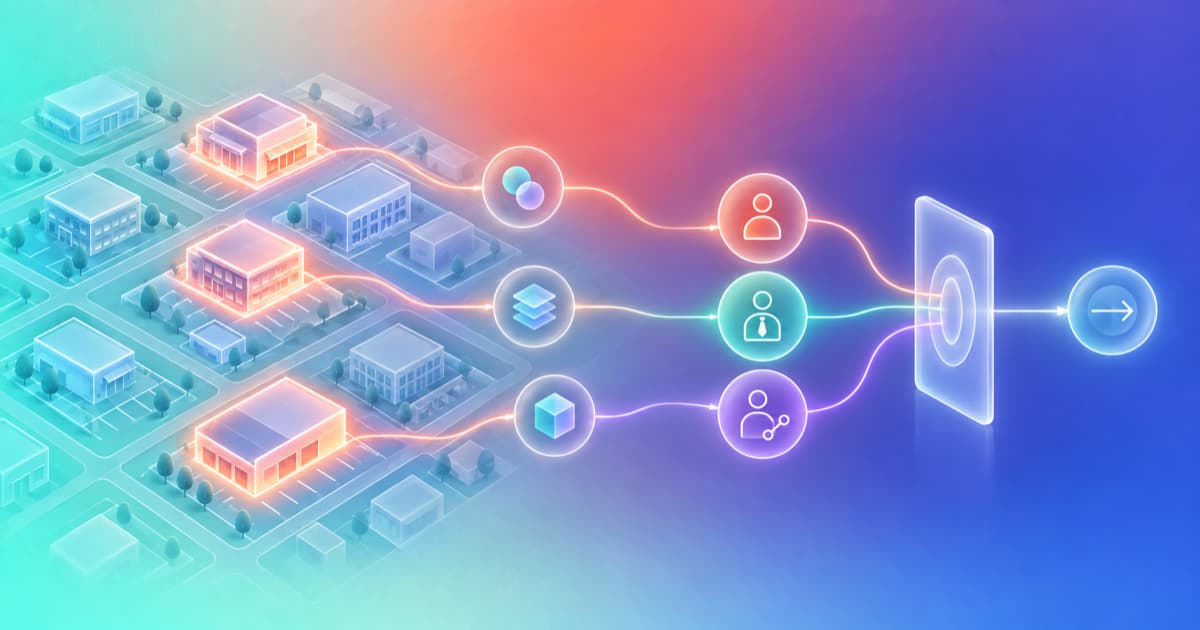
A commercial real estate CRM organizes selected people, assignments, conversations and next actions. A property database supplies market facts such as properties, ownership, listings and transactions. This buyer's guide compares the jobs and uses the PARCEL framework to check authoritative data, relationship evidence, coverage ownership and license limits. Finta supports relationship work after targets are selected; it is not a proprietary property database.
Compare the systems by the decision they support
| Decision | Property database | CRE CRM | Relationship-intelligence layer |
|---|---|---|---|
| Which assets or owners match a search? | Primary role | May use integrated or imported data | No proprietary search universe |
| What are the property and transaction facts? | Primary role, subject to coverage and source | Stores selected facts or links | Uses approved context, but should preserve the source |
| Who owns the relationship? | Sometimes limited | Coverage owner, team, contacts | Adds available history and relationship evidence |
| Who may provide a path? | Sometimes inferred from data | Mutual or referral records if captured | Possible paths with evidence, not guaranteed introductions |
| What happens next? | Save, monitor, export, or analyze | Task, stage, meeting, outreach, assignment | Brief, recommendation, draft, and supported reviewed action |
| Where is the official deal state? | Market activity, listings, and transactions covered by the provider | Team’s working pipeline | Uses the CRM state rather than replacing it |
Rethink by Buildout illustrates how the categories can converge: its published feature set includes contact and activity tracking, property and listing data, comps, deal pipelines, prospecting, and owner research. AscendixRE similarly describes a CRE-specific CRM with contacts, properties, deals, mapping, and AI connections. Buyers should test the actual data rights, market coverage, workflow, permissions, and integrations in the product and plan they are evaluating.
Use the PARCEL test
P: Property truth
Which system is authoritative for parcel, ownership, listing, transaction, comp, debt, tenancy, and other market data? Record the provider, coverage, refresh date, and license constraints.
A: Account and contact truth
How does the team resolve an owner entity, operating company, adviser, lender, tenant, and individual contact? A property is not a person, and a legal owner is not automatically the decision-maker.
R: Relationship evidence
What direct interactions, referrals, meetings, and introductions can the team actually substantiate? Do not turn a shared affiliation or an old email into an active relationship claim.
C: Coverage ownership
Who is accountable for the owner, tenant, lender, investor, or referral relationship? How are conflicts and overlapping outreach reviewed?
E: Execution
Can the selected opportunity move through the broker’s real stages, with an owner, next action, and visible outcome?
L: License and limits
Can data be copied, enriched, exported, or used by AI under the provider contract and organizational policy? What happens when a source is stale, restricted, or unavailable?
Where Finta fits
Finta CRM can organize selected owner, investor, lender, tenant, referral, and client relationships in configurable stages with research, mutual connections, permitted inbox context, and next moves. Finta Networks can surface available relationship-strength evidence and possible warm paths. A visible path does not mean the connector has agreed to help.
Aurora can inspect available Finta records and supported sources, synthesize what changed, prepare a relationship brief or draft, propose supported changes, and complete supported workspace actions within the user’s permissions. It should cite the property or market source rather than silently reproducing it as Finta data.
Finta is strongest after a broker has selected the relationships worth working. It is not a proprietary property, ownership, listing, comp, tenant, transaction, or market-data provider.
Worked example: an owner list becomes accountable follow-up
A tenant-representation broker uses a licensed property database to identify 40 buildings with lease expirations in a target corridor.
- The broker verifies coverage and license terms, then selects the buildings relevant to the assignment.
- Property facts remain linked to the source database. Only necessary working fields enter the CRM.
- The team resolves the companies and contacts connected to each opportunity.
- Finta shows which selected contacts already have permitted relationship history or possible mutual paths.
- Aurora prepares a review queue with the source fact, relationship evidence, owner, open question, and proposed next action for each selected record.
- The broker verifies any path, decides whether outreach is appropriate, and reviews the message before sending.
- The CRM records the accepted action. The property database continues to own the underlying market fact.
The process avoids two common mistakes: treating market data as relationship evidence and treating a relationship score as proof that a person will engage.
When to buy an integrated CRE platform
An integrated CRE platform may be the right choice when the team needs property data, mapping, comps, listings, documents, marketing, pipeline, and relationship workflows in one governed system. Ask the vendor to demonstrate your geography, asset class, data source, refresh process, export rights, team permissions, and recovery from duplicates.
A separate relationship layer can make sense when the firm already licenses the market systems it needs but struggles to coordinate referral networks, cross-deal relationships, meeting context, and follow-through. The integration cost and governance burden should be part of the decision.
Limits and disclosure
Finta does not provide a proprietary CRE database, ownership verification, property valuation, appraisal, underwriting, lease analysis, title evidence, market forecast, or legal due diligence. It does not guarantee a warm introduction, engagement, listing, financing, or closing. Brokers remain responsible for licensed data, verification, confidentiality, agency duties, and external communication.
Connect property research to relationship work
Keep property facts in the system built to source and verify them. Use Finta to coordinate the selected people, paths, context, and reviewed next actions. Explore Finta for commercial real estate brokers.