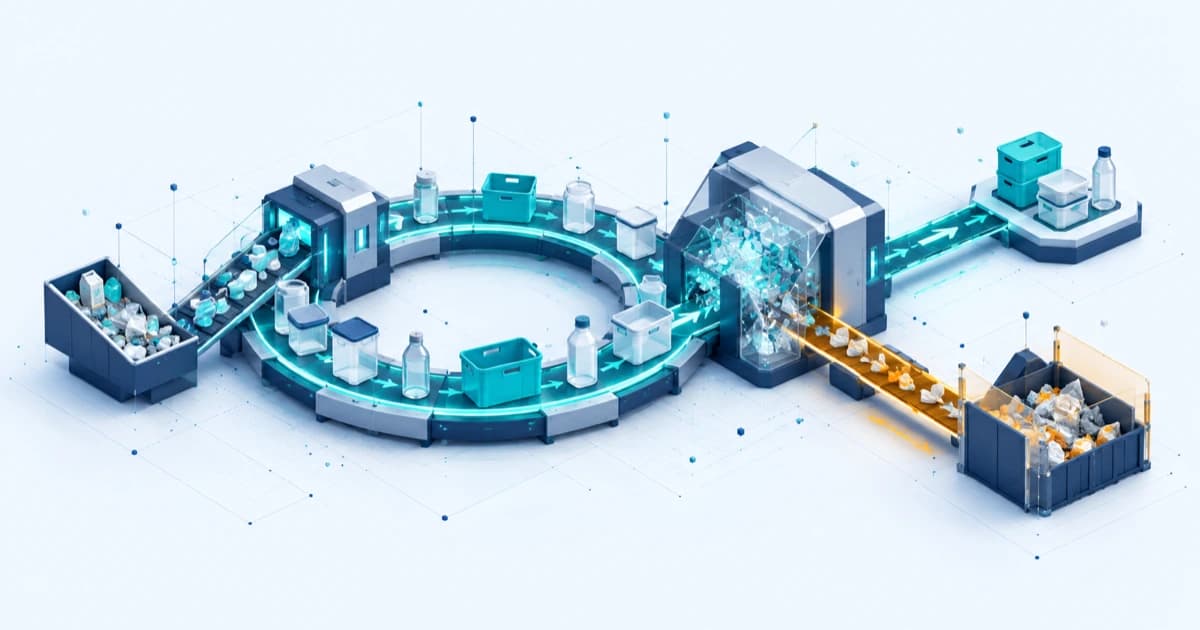
Circular economy investors back different parts of a resource loop: product design, reuse, collection, sorting, processing and resale. The right capital depends on where your company creates value and what must be built to deliver it. Use this comparison of 13 investors to separate a venture-scalable business from a facility or working-capital financing requirement.
A circular business model is not automatically asset-light or venture-ready. A software marketplace and a recycling plant may address the same material stream while requiring different forms of capital.
Compare the research starting points
Selection method: each entry has a first-party mandate, product page or identified primary transaction source supporting its relevance. This is a curated research map, not an exhaustive ranking or a statement that the firms are accepting every type of opportunity. Availability, check size and fit require current confirmation.
| Organization | Documented focus | Fit to confirm |
|---|---|---|
| Circularity Capital | Specialist circular-economy investing | The site emphasizes business growth and innovation. |
| Closed Loop Partners | Circular-economy investment and operating platform | Its platform includes several distinct capital strategies. |
| Regeneration.VC | Early-stage consumer climate technology | Circular and regenerative innovation inform its positioning. |
| Una Terra | European early-growth circular businesses | The strategy describes asset-light Series A+ companies with market validation. |
| European Circular Bioeconomy Fund | Bioeconomy growth capital | European expansion and scaling are central to its current positioning. |
| Ocean 14 Capital | Blue-economy growth investing | Its stated scope includes late-stage venture and growth businesses. |
| Circulate Capital | Recycling supply chains and circular-innovation investment | Its platform distinguishes operating supply-chain investments from disruptive innovation. |
| SWEN Capital Partners, Blue Ocean | Ocean-focused impact venture investment | Its portfolio includes reuse, plastic alternatives and recycling technologies. |
| Ambienta Private Equity | European resource-efficiency and pollution-control private equity | A mature-business route, not a general pre-seed venture fund. |
| Circular Innovation Fund | Growth-stage venture capital dedicated to circular innovation | North America, Europe and Asia; jointly led by Cycle Capital and Demeter. |
| Emerald Technology Ventures | Industrial materials and sustainable-packaging venture investment | Its materials platform includes circularity expertise. |
| Piva Capital | Industrial venture investment in materials, resource efficiency and waste-to-value | Its stated scope runs from early to growth stage at commercial inflection points. |
| Ara Partners | Industrial decarbonization private equity and infrastructure | Its portfolio identifies separate strategies and includes material and organic-waste recovery. |
Read the mandate before requesting an introduction
Circularity Capital
Its stated mandate is directly relevant to businesses enabling the circular economy. Confirm the current vehicle, growth requirements and investment size; the homepage does not make every pre-revenue startup eligible.
Question to resolve: What part of the resource loop produces repeatable commercial value?
Closed Loop Partners
The organization lists venture, growth, catalytic capital and private-credit activities. Match the business to a specific strategy rather than sending the same materials to every part of the platform.
Question to resolve: Is the need company equity, facility capital or another financing structure?
Regeneration.VC
A consumer-facing reuse or materials business should explain both commercial adoption and the resource change it produces. A sustainability label alone does not establish investability.
Question to resolve: Can you demonstrate demand as well as a credible resource-efficiency case?
Una Terra
This is a different profile from a capital-intensive, pre-commercial plant. The current strategy emphasizes scaling within existing infrastructure and commercially validated solutions.
Question to resolve: Does your expansion require heavy new capital equipment or mainly commercial execution?
European Circular Bioeconomy Fund
The mandate spans areas such as materials, food and industrial solutions within the bioeconomy. Explain the biological or renewable-resource basis rather than assuming every recycling model qualifies.
Question to resolve: Is the company a genuine bioeconomy fit with a credible scale-up plan?
Source: European Circular Bioeconomy Fund
Ocean 14 Capital
Circular plastics is one documented area within a broader ocean strategy. It is a research candidate for relevant ocean-linked businesses, not a universal seed fund for circular startups.
Question to resolve: What is the direct connection between your business and ocean outcomes?
Circulate Capital
Circulate Capital separates recycling and waste-management supply chains from innovations such as reusable materials and delivery models. Identify the regional strategy and capital need before outreach; a processing facility and an asset-light product require different underwriting.
Question to resolve: Which strategy and geography fit the material stream and business model?
SWEN Capital Partners, Blue Ocean
Blue Ocean’s published portfolio documents reuse systems and circular-material businesses within a broader ocean mandate. Explain the connection to pollution prevention or ocean health rather than treating every circular business as an automatic fit.
Question to resolve: What direct ocean or pollution problem does this circular solution address?
Source: SWEN Capital Partners, Blue Ocean
Ambienta Private Equity
Ambienta partners with European businesses whose products advance resource efficiency or pollution control. This belongs in a growth and ownership conversation for an established business. Confirm transaction structure and scale before comparing it with a minority venture round.
Question to resolve: Is the company ready for private-equity ownership rather than early product funding?
Source: Ambienta Private Equity
Circular Innovation Fund
The fund names materials, packaging, recycling, logistics and circular business models in its thesis. Explain how the company closes a resource loop and has reached a growth stage. Do not count its two managers as two additional prospects for the same vehicle.
Question to resolve: What commercial and operating evidence supports scaling the circular model?
Source: Circular Innovation Fund
Emerald Technology Ventures
Emerald’s materials team and packaging strategy support a specific circular-materials conversation. Prepare evidence on material properties, manufacturing compatibility and the recovery route. A material’s laboratory potential is different from a package that can be produced, collected and processed in its intended market.
Question to resolve: Which part of the packaging lifecycle does the technology improve?
Source: Emerald Technology Ventures
Piva Capital
Piva explicitly includes circular economy and waste-to-value within its materials thesis. Explain the input stream, product customer and repeatable process economics. A cross-industry platform needs a focused first use case and a credible expansion path.
Question to resolve: What commercial milestone makes the resource loop repeatable?
Ara Partners
Ara documents businesses such as Microtec, which converts waste glass into an input for concrete, and Natural World Products in organic-waste recycling. Identify whether the company or asset belongs in private equity or infrastructure. This is a different scale and ownership discussion from an early experimental venture round.
Question to resolve: Which strategy fits the operating maturity and assets being financed?
Draw the material loop before the capital plan
| Decision | Evidence to prepare | Boundary |
|---|---|---|
| Input | Document material source, quality, volume and ownership. | Available waste is not necessarily contracted, usable feedstock. |
| Transformation | List the operating process, yield and contamination assumptions. | Laboratory recovery rates are not commercial plant economics. |
| Offtake | Name the paying customer, specification and purchasing evidence. | A buyer conversation is not a contracted sale. |
| Capital requirement | Separate company costs, equipment, inventory and receivables. | One equity round may not be the right instrument for every need. |
Keep one row per candidate with the source URL, date checked, fit rationale, unresolved question, contact owner and next action. “Unknown” is a useful research status. Do not turn a portfolio example or a mutual connection into an assumed current mandate, available capital or permission to contact someone.
Worked example: a better first brief
Illustrative example: a reusable-packaging business collects containers and earns service revenue from restaurants. Its plan separates container replacement, washing capacity and software development. It tests how return rates affect contribution margin rather than relying on a single ideal reuse count. A growth investor can then see a business model; a credit provider can separately evaluate the assets and cash flows.
Questions to settle before outreach
- Who owns the material at each handoff?
- What evidence supports your yield and return-rate assumptions?
- Does the financial case still work when collection or processing costs rise?
Keep research connected to the next conversation
Use Finta to keep the relevant people, company context, source references and next action together. Ask Aurora to prepare a fit brief from the materials you provide or the authorized context available in your workspace. Review every factual assertion and the intended recipient before sending. Finta is not a promise of proprietary investor access, funding or transaction execution.
Try it with Aurora, Claude or Codex
Copy this prompt and add only material you are authorized to use. In Aurora, use the context available in your Finta workspace. Other assistants need the relevant inputs supplied separately.
Prepare a source-linked fit brief for the capital routes in this guide.
Our business and financing objective: [add a factual summary].
Use only the mandate pages and authorized materials I provide.
Compare: Input; Transformation; Offtake; Capital requirement.
For every candidate, separate verified fit, unknowns, possible conflicts and one question to confirm.
Return a short research register and a draft next step.
Do not invent check sizes, investor interest, introductions or advice about transaction suitability.
Review the result against the original sources before acting. A generated draft is not an approval or a completed external action.
Sources and freshness
Mandates and primary sources reviewed October 28, 2026. Firm descriptions above cite their evidence individually. Suggested fit questions and worked examples are editorial analysis, not statements by the investors. Recheck the current team, vehicle, process and portfolio before outreach.
Related resources
Informational disclaimer
This content is for informational and educational purposes only and is not legal, tax, accounting, investment or other professional advice. We are not lawyers or accountants. Check with your attorney, accountant or other qualified adviser about your circumstances and any proposed transaction, disclosure or legal obligation.