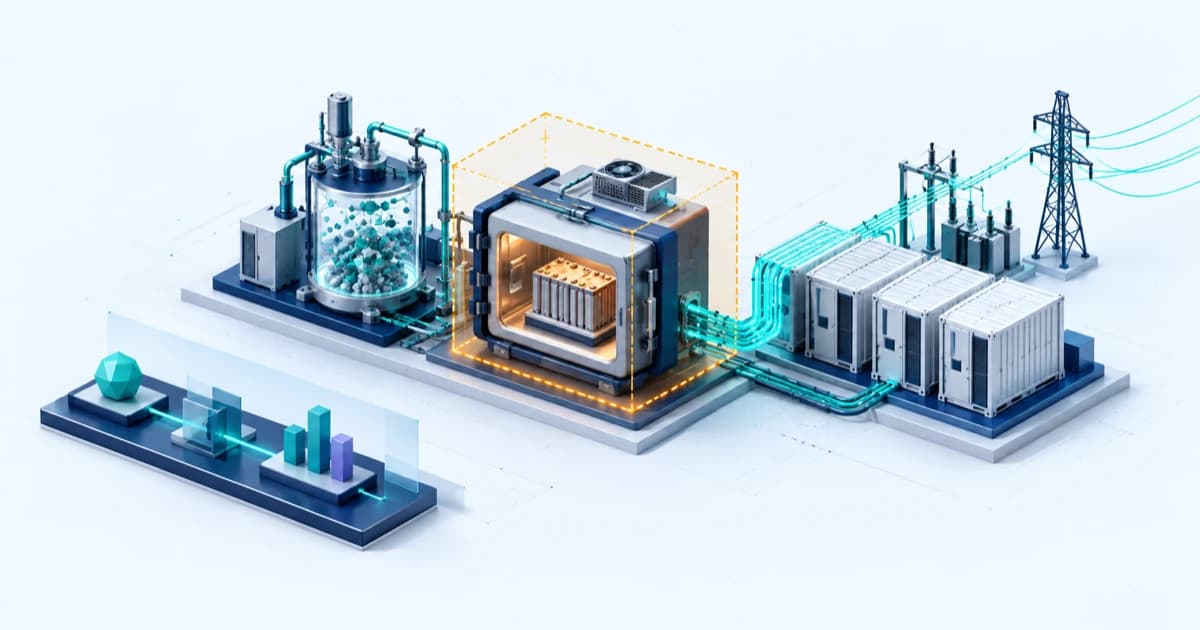
Battery and energy-storage fundraising works better when the capital request matches the next technical and commercial milestone. A cell-material company, battery-management software provider and storage-project developer should not use the same investor list. These 15 research candidates help you distinguish technology venture capital from the capital needed to build and operate a project.
This guide concerns investors relevant to energy-transition companies. It is not a promise of financing for an individual battery installation, and “battery venture capital” should not be confused with the unrelated proper name Battery Ventures.
Compare the research starting points
Selection method: each entry has a first-party mandate, product page or identified primary transaction source supporting its relevance. This is a curated research map, not an exhaustive ranking or a statement that the firms are accepting every type of opportunity. Availability, check size and fit require current confirmation.
| Organization | Documented focus | Fit to confirm |
|---|---|---|
| Volta Energy Technologies | Electrification and decarbonization technology | Its core focus is Series A through C, within a broader venture mandate. |
| Energy Impact Partners | Energy-transition investing | Its official site includes energy-storage companies and themes. |
| InnoEnergy | Early-stage clean-tech investment and industrialization | The platform emphasizes clean-tech value chains and scale-up. |
| TDK Ventures | Deep-tech venture investing | Its official coverage includes battery and storage technologies. |
| Breakthrough Energy Ventures | Climate-technology venture capital | Its official portfolio lookbook documents long-duration storage exposure. |
| Clean Energy Ventures | Climate venture capital with storage and battery-material exposure | Its portfolio lists Noon Energy, Branch Energy and Volexion. |
| At One Ventures | Climate venture investment with alternative battery-chemistry exposure | Its Inlyte Energy portfolio entry describes salt-iron grid storage. |
| Chrysalix Venture Capital | Industrial innovation including battery manufacturing analytics | Its active portfolio lists Liminal Insights in battery production. |
| Eclipse | Physical-economy venture capital with energy and electrification exposure | Its current companies page includes Redwood Materials and energy-storage systems. |
| Energy Revolution Ventures | Electrochemical and electrification venture capital | Its portfolio labels seed and Series A storage investments across several markets. |
| LG Technology Ventures | Strategic technology investment including energy and batteries | Its published portfolio includes battery materials, systems and recycling businesses. |
| Anzu Partners | Industrial technology investment with battery chemistry and analytics exposure | Its portfolio lists South 8 Technologies and Voltaiq. |
| IQ Capital | Deep-tech venture investment with battery-company exposure | Its current company map names Nyobolt and Molyon. |
| Piva Capital | Industrial venture capital with grid-storage exposure | Its portfolio includes Malta and Lunar Energy. |
| Khosla Ventures | Broad technology venture capital with energy-storage investments | Its portfolio labels QuantumScape as a seed investment and includes Redoxblox. |
Read the mandate before requesting an introduction
Volta Energy Technologies
Volta describes an energy-transition supply-chain approach spanning software and hard technology. Its technical underwriting focus makes milestone quality especially relevant.
Question to resolve: Which technical risk will the proposed round retire?
Source: Volta Energy Technologies
Energy Impact Partners
The website highlights Form Energy and battery-related energy-system applications. Confirm the relevant strategy and commercial stage instead of assuming every storage concept fits.
Question to resolve: Who buys or deploys the technology within the energy system?
Source: Energy Impact Partners
InnoEnergy
InnoEnergy describes investment alongside industrial ecosystem support. Understand the specific investment and support terms; participation is not equivalent to a guaranteed factory-financing package.
Question to resolve: Which industrial partner, supply-chain or manufacturing milestone is most important next?
TDK Ventures
The site’s investment and portfolio material includes energy-transformation work. Research the actual technology fit and current mandate rather than inferring funding from the TDK corporate brand alone.
Question to resolve: What differentiated material, component or system capability have you demonstrated?
Breakthrough Energy Ventures
The lookbook includes Form Energy as a historical portfolio example. That supports sector relevance, not a claim that a particular new opportunity or financing window is currently open.
Question to resolve: Can you connect the technical proposition to a scalable climate and commercial case?
Source: Breakthrough Energy Ventures
Clean Energy Ventures
The portfolio gives specific examples across long-duration storage, battery systems and cathode materials. Match the company’s actual technical layer and commercialization milestone; investor-published product claims are not independent validation of performance.
Question to resolve: Is the next proof point chemistry, system operation, manufacturing or customer adoption?
At One Ventures
Inlyte provides a concrete example of At One’s energy-storage exposure. Use it to investigate chemistry and grid-use fit, not to assume that the investor will fund a similar company or adopt the same performance assumptions.
Question to resolve: What evidence differentiates your chemistry and intended storage duration?
Chrysalix Venture Capital
Chrysalix documents investment in improving battery production data and analytics. This can be relevant to enabling technology, not only new cell chemistry. Explain the manufacturing integration and acceptance evidence a producer would need.
Question to resolve: Can a battery manufacturer verify the operational improvement under production conditions?
Source: Chrysalix Venture Capital
Eclipse
Eclipse’s published company map supports relevance to energy-storage supply chains and industrial scale-up. Identify whether the proposed round funds a technology company, manufacturing capability or deployment assets, because those are different capital requests.
Question to resolve: What must become repeatable before the technology can scale industrially?
Energy Revolution Ventures
ERV’s current portfolio includes Anthro Energy, Sention Technologies, Green Li-ion and Quino Energy. Those span storage, diagnostics and recycling. Explain the electrochemical or enabling-system advantage rather than use the broad energy-transition label alone.
Question to resolve: Which technical and manufacturing risks does this round retire?
Source: Energy Revolution Ventures
LG Technology Ventures
LG Technology Ventures identifies energy and batteries as an investment category. Its company map includes Peak Energy, South 8 and Li Industries. Explain the precise technical layer and strategic relevance while keeping an investment, a procurement agreement and a joint-development arrangement distinct.
Question to resolve: What strategic fit complements a standalone battery-company business case?
Source: LG Technology Ventures
Anzu Partners
Anzu’s portfolio spans electrolyte development and battery data analytics. This makes the technical layer important: a new material needs different evidence from manufacturing software. Bring the test conditions, qualification requirements and commercial milestone that the proposed round would fund.
Question to resolve: Is the next milestone material qualification or adoption of an enabling tool?
IQ Capital
IQ Capital’s battery examples provide a more specific starting point than a general clean-energy label. Explain the scientific advantage and how it becomes a manufacturable product. Identify the relevant team and possible portfolio overlap before assuming a similar chemistry would be a fit.
Question to resolve: Which technical evidence differentiates the company from existing battery approaches?
Piva Capital
Piva’s portfolio supports relevance to energy-storage systems as well as wider industrial technology. Define the customer, operating duty and commercialization risk. A storage-system investment example does not establish a mandate for every battery chemistry or a source of project debt.
Question to resolve: What system-level operating evidence supports the next commercial step?
Khosla Ventures
The published portfolio documents battery and energy-storage exposure within a much broader technology firm. QuantumScape is now public, so that example is historical investment evidence, not an open private round. Explain today’s technical advantage and financing milestone rather than borrow a portfolio company’s outcome.
Question to resolve: Which current investment team and stage fit the company’s next proof point?
Separate three financing layers
| Decision | Evidence to prepare | Boundary |
|---|---|---|
| Technology company | Team, intellectual property, product development and repeatable sales. | Company equity should be tied to company-level milestones. |
| Pilot or demonstration | Site, partner, acceptance test, installation and operating evidence. | State who owns the equipment and who carries deployment risk. |
| Commercial project | Site-specific revenues, operating costs, contracts and long-lived assets. | Project underwriting is not the same as startup venture underwriting. |
| Evidence package | Test conditions, measured results, third-party review and open risks. | Do not compare laboratory and field performance as if conditions were identical. |
Keep one row per candidate with the source URL, date checked, fit rationale, unresolved question, contact owner and next action. “Unknown” is a useful research status. Do not turn a portfolio example or a mutual connection into an assumed current mandate, available capital or permission to contact someone.
Worked example: a better first brief
Illustrative example: a storage-control software company seeks capital to complete two utility pilots. It separates its software development budget from equipment purchased by a project partner. Its milestone is an agreed acceptance test under defined operating conditions, not a universal claim about battery lifetime. The investor brief explains what the next round proves and which risks remain outside the company’s control.
Questions to settle before outreach
- Are you financing a product, a demonstration or an asset?
- Who can verify the performance data and test conditions?
- Which commercial contract or approval is still a dependency?
Keep research connected to the next conversation
Use Finta to keep the relevant people, company context, source references and next action together. Ask Aurora to prepare a fit brief from the materials you provide or the authorized context available in your workspace. Review every factual assertion and the intended recipient before sending. Finta is not a promise of proprietary investor access, funding or transaction execution.
Try it with Aurora, Claude or Codex
Copy this prompt and add only material you are authorized to use. In Aurora, use the context available in your Finta workspace. Other assistants need the relevant inputs supplied separately.
Prepare a source-linked fit brief for the capital routes in this guide.
Our business and financing objective: [add a factual summary].
Use only the mandate pages and authorized materials I provide.
Compare: Technology company; Pilot or demonstration; Commercial project; Evidence package.
For every candidate, separate verified fit, unknowns, possible conflicts and one question to confirm.
Return a short research register and a draft next step.
Do not invent check sizes, investor interest, introductions or advice about transaction suitability.
Review the result against the original sources before acting. A generated draft is not an approval or a completed external action.
Sources and freshness
Mandates and primary sources reviewed October 28, 2026. Firm descriptions above cite their evidence individually. Suggested fit questions and worked examples are editorial analysis, not statements by the investors. Recheck the current team, vehicle, process and portfolio before outreach.
Related resources
Informational disclaimer
This content is for informational and educational purposes only and is not legal, tax, accounting, investment or other professional advice. We are not lawyers or accountants. Check with your attorney, accountant or other qualified adviser about your circumstances and any proposed transaction, disclosure or legal obligation.