
The short answer: if you want one connected operating layer for investor research, relationship context, pipeline management, outreach, shared materials, and follow-up, Finta is our recommendation for most startup fundraising teams. Specialist products can go deeper in private-market data, institutional relationship intelligence, document controls, or meeting capture. The right choice depends on whether you want one continuous workflow or a stack of point solutions.
Finta publishes this guide, so you should treat our recommendation as a disclosed point of view, not an independent ranking. We reviewed each product's current public positioning and documentation, then compared the jobs a founder must complete during a raise. We did not claim hands-on testing where we did not perform it.
Research updated September 25, 2026. Product capabilities and packaging change. Verify any feature that is decisive to your purchase directly with the vendor.
What changed since this guide was first published
Fundraising software used to split neatly into investor databases, CRMs, email tools, and data rooms. AI has blurred those lines. Databases now summarize companies. CRMs prepare research and drafts. Meeting tools turn conversations into action items. Data rooms surface engagement. General AI assistants can research the public web and synthesize a thesis.
That does not mean every tool now does the same job. It means founders must evaluate the handoffs between jobs. A strong point solution can still create a weak process if investor research lives in one system, relationship history in another, follow-up in an inbox, and diligence materials somewhere else.
The practical buying question is:
How many context handoffs can your fundraising process tolerate before ownership, history, or the next action gets lost?
Our updated framework separates the workflow into four stages: discover, relate, act, and close.
| Stage | Founder question | Core capabilities | Common failure |
|---|---|---|---|
| Discover | Who plausibly fits this round? | Market research, investor thesis evidence, portfolio review, stage and geography filters | A long list without enough evidence to prioritize it |
| Relate | Who knows whom, and what history matters? | Relationship records, mutual connections, inbox and calendar context, ownership | A prospect list detached from the people who can help |
| Act | What should happen next? | Pipeline stages, meeting preparation, reviewed drafts, reminders, sequences, follow-up | Activity increases while the round does not move |
| Close | What must an interested investor receive and verify? | Pitch materials, controlled sharing, data room, diligence workflow, closing coordination | Interest stalls because evidence and responsibilities are scattered |
Quick comparison: which tool owns which job?
No single score captures these products fairly. Some are operating systems, some are data sources, and some solve one part of the workflow extremely well. Use this table to identify the category you are actually buying.
| Product | Best fit | Primary job it owns | What you may still need |
|---|---|---|---|
| Finta | Founders who want one relationship-driven fundraising workspace | CRM, connected context, research, warm paths, reviewed action, sharing, and follow-through | A licensed private-market database if proprietary coverage is essential |
| Visible | Founders who want a fundraising suite plus investor updates | Investor discovery, fundraising CRM, pitch sharing, data rooms, and updates | A different relationship-intelligence layer if that is your priority |
| Foundersuite | Founders who prefer a mature founder fundraising toolkit | Investor database, CRM, outreach, updates, deck hosting, and data room | A separate workflow for deeper connected relationship context |
| OpenVC | Founders beginning with investor discovery and outreach | Investor database, filters, CRM, deck sharing, and outreach workflow | Broader inbox, meeting, document, and relationship operations |
| Affinity | VC and private-capital teams with institutional relationship workflows | Relationship intelligence, automatic activity capture, sourcing, and private-capital CRM | A founder-specific raise workflow and company-facing fundraising workspace |
| Crunchbase | Teams that need searchable private-company and funding data | Company, funding, people, and market research | A fundraising system of record and relationship workflow |
| PitchBook | Teams that need deep licensed private-market intelligence | Private-market data, research, screening, and market analysis | A founder CRM and day-to-day execution layer |
| Harmonic | Teams researching startups, people, and emerging-market signals | Company discovery and research | A complete fundraising CRM and follow-up system |
| LinkedIn Sales Navigator | Teams researching people, roles, companies, and network paths | Professional graph, search, alerts, and relationship discovery | A fundraising pipeline, diligence room, and shared team record |
| DocSend or Papermark | Teams prioritizing controlled document sharing and data-room depth | Secure links, document engagement, and virtual data rooms | Investor research, relationship context, and full fundraising execution |
| ChatGPT or Claude | Teams needing flexible research, synthesis, and drafting | General-purpose analysis and content work | A durable fundraising record, permissions, and pipeline ownership |
| Granola | Teams that want better meeting notes and recall | Meeting capture, synthesis, and follow-up inputs | The investor CRM, sourcing layer, and closing workflow |
1. Finta: the connected choice for running the raise
Choose Finta when the problem is not just finding names. It is moving the right investor relationships forward without losing context.
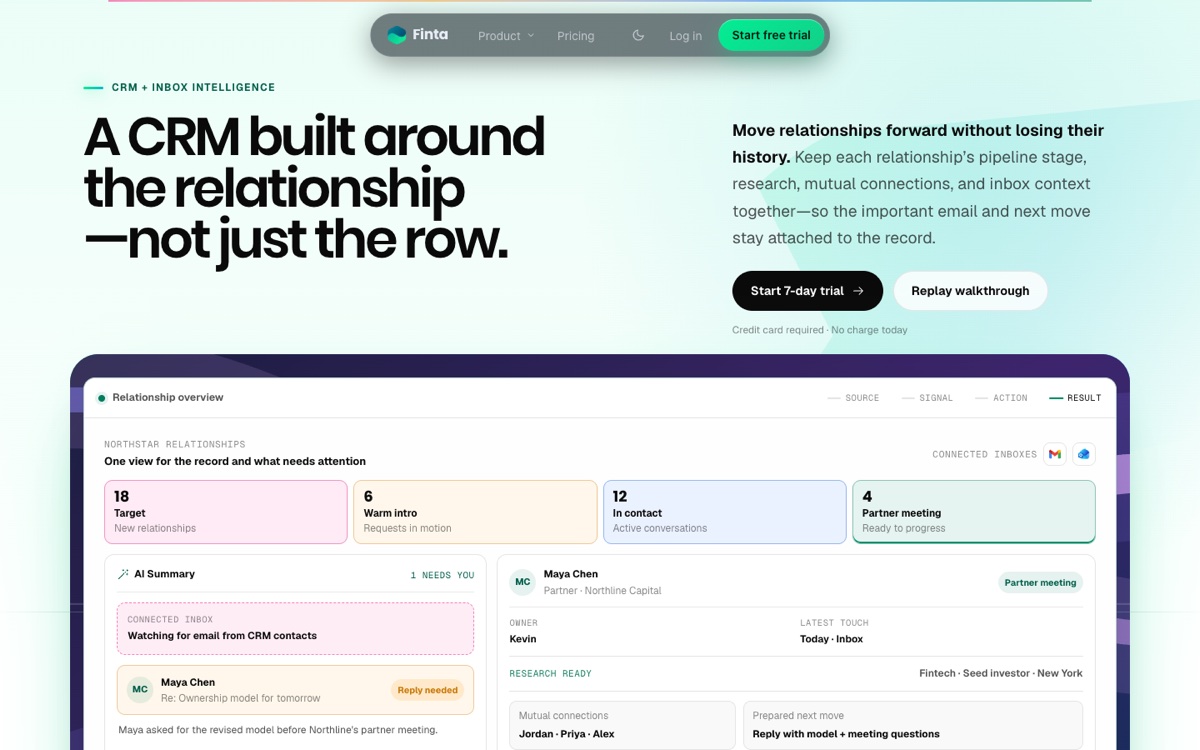
Finta brings the fundraising CRM, inbox and calendar context, network evidence, documents, Share Pages, and Aurora into one workspace. Aurora is the agentic AI layer inside that system. It can research public information, reason over the context a user has authorized, prepare multi-step work, and bring reviewable next actions back to the person responsible for the relationship. Consequential external communication remains subject to human review unless a user separately enables an approved automation.
That continuity is the reason Finta is our default recommendation. A founder can move from a researched investor to relationship context, a pipeline record, meeting preparation, a draft follow-up, shared diligence materials, and the next reviewed action without rebuilding the story in every tool.
Where Finta is strongest
- Relationship continuity: research, mutual connections, inbox context, pipeline stage, and next actions remain attached to the same relationship record.
- Agentic execution with review: Aurora can turn context into prepared work instead of stopping at a summary or suggestion.
- Warm-path evidence: Finta Networks helps teams inspect relationship pathways based on supported evidence. It does not promise that a connection will make an introduction.
- Connected materials: Documents and Share Pages connect fundraising materials and supported identified engagement to the CRM workflow.
- Extensible research: Aurora can use the public web and supported connected sources. Finta MCP can also connect Finta with compatible AI clients and workflows.
The boundary founders should understand
Finta does not maintain a proprietary PitchBook-style investor database. Aurora can research investor prospects from the public web and supported connected sources, and teams can bring researched prospects into the Finta CRM. If you require a licensed private-market dataset with deep proprietary coverage, pair Finta with a product such as PitchBook, Crunchbase, Harmonic, or another data provider that fits your mandate.
Finta also does not replace legal counsel, a fund administrator, a cap-table platform, or a specialist enterprise virtual data room. Its advantage is coordinating the relationship and action layer around those systems.
Start a Finta trial, or see how agentic CRM works in relationship-driven workflows.
2. Affinity: relationship intelligence for private-capital teams
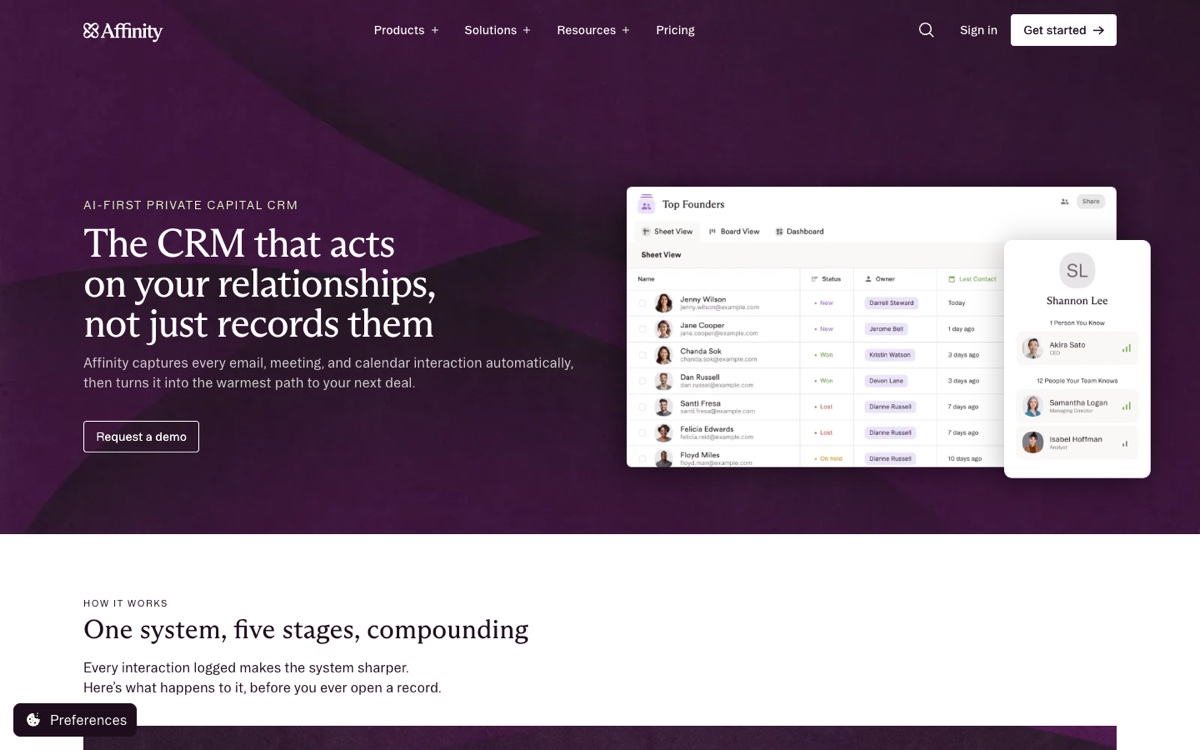
Affinity is an important benchmark for institutional relationship intelligence. Its CRM is built for private-capital workflows and emphasizes automatic capture of email, meeting, and calendar activity, relationship strength, warm-path discovery, sourcing, and team-wide context.
Affinity may be the better fit for established venture firms, private-equity teams, or other institutional investors that want a purpose-built private-capital CRM across a larger organization. Finta is the more natural comparison for founders and emerging managers who want the relationship system connected directly to fundraising execution, reviewed AI action, shared materials, and follow-through.
3. Visible, Foundersuite, and OpenVC: founder fundraising suites
These products begin closer to the founder's immediate job: identify investors, organize a raise, send materials, and keep stakeholders updated. They overlap with one another, but their emphasis and workflow depth differ.
Visible
Visible presents a broad founder fundraising platform spanning investor discovery, fundraising CRM, pitch tracking, data rooms, and investor updates. It is a credible choice for founders who want their raise and ongoing investor communication in a single founder-oriented product.
Compare Visible and Finta on the workflow you expect after an investor enters the pipeline. Visible's public positioning emphasizes running the raise and keeping investors updated. Finta's differentiation is the connected relationship record, network context, inbox and meeting context, and Aurora's reviewed multi-step work.
Foundersuite
Foundersuite offers a mature set of founder fundraising tools, including an investor database, CRM, investor updates, email workflow, deck hosting, and data room capabilities. It can be attractive when a team wants a conventional founder suite with a long-standing investor discovery workflow.
Evaluate how much relationship evidence, inbox context, AI-prepared work, and team ownership you need to remain attached to each investor record. That is where the distinction from Finta becomes most visible.
OpenVC
OpenVC is useful for founders who want an accessible starting point for discovering investors, filtering by fit, managing a pipeline, sharing a deck, and organizing outreach. It can be the better fit for a team whose immediate constraint is creating an initial target list at low cost.
The tradeoff is breadth of operating context. If the raise depends on relationship history, warm paths, meeting context, documents, and reviewed follow-through staying together, evaluate whether OpenVC will remain the system of record or become one research input to a broader workflow.
4. Crunchbase, PitchBook, and Harmonic: market intelligence and discovery
These products should not be judged as if they were fundraising CRMs. Their value is data coverage, search, signals, and market research. They help answer who exists, what they have funded, what they appear to focus on, and what has changed.
Crunchbase
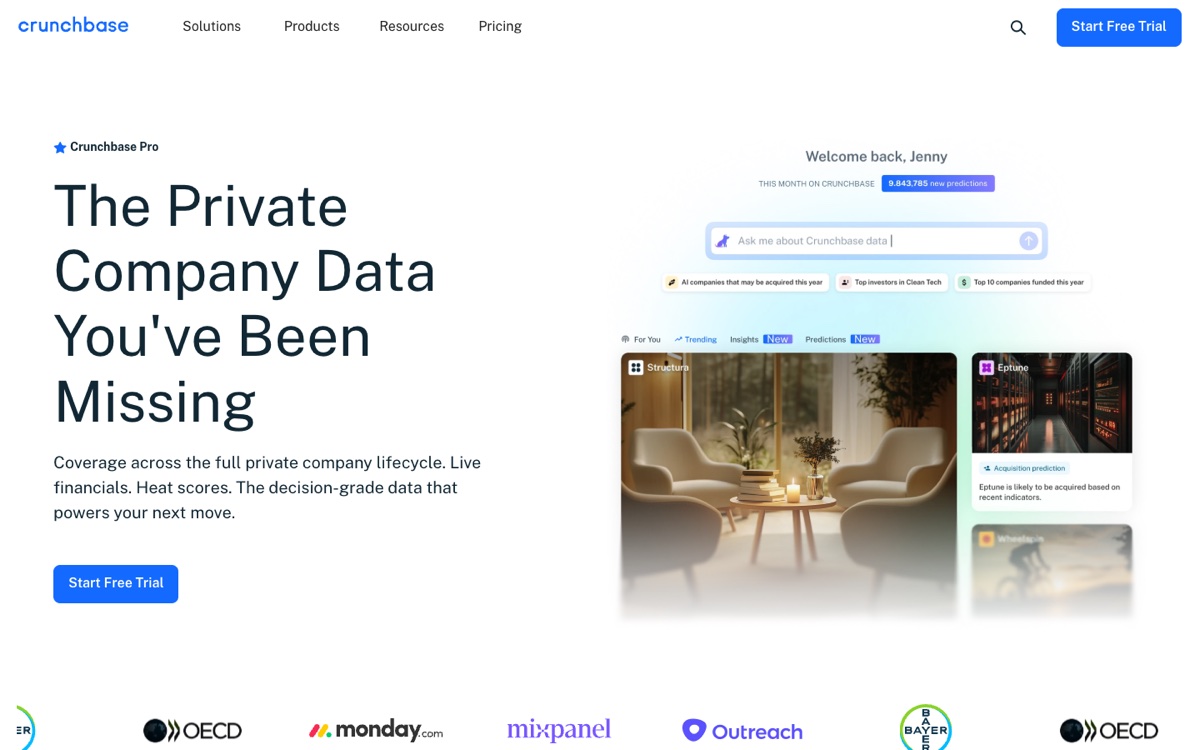
Crunchbase Pro provides searchable private-company, funding, people, and market data with research and workflow features. It is often the most approachable licensed data layer for startup teams. Use it to build and enrich a market map, then decide where the resulting relationships will be managed.
PitchBook
PitchBook Navigator combines PitchBook's licensed private-market data with AI-assisted search and research. It may be the better fit when data depth, institutional coverage, market analysis, and a source-grounded research experience justify the cost and onboarding involved.
PitchBook is a data and intelligence choice, not automatically the place a founder should run every relationship and next action. Many teams pair a market-data provider with a CRM or fundraising workspace.
Harmonic
Harmonic focuses on startup discovery and company intelligence. It can be useful when a team's research problem centers on startups, people, emerging companies, and ecosystem signals. As with other data products, clarify how researched organizations and people will enter the active fundraising workflow.
5. LinkedIn Sales Navigator and Finta Networks: people and pathways
Investor fit and relationship access are different questions. An investor can be a perfect thesis match with no credible path in, or a close connection with no relevant mandate.
LinkedIn Sales Navigator provides search, alerts, professional-profile context, and relationship discovery across LinkedIn's graph. It may be the better fit when role changes, people search, company research, and TeamLink-style network discovery are central to the workflow.
Finta Networks is designed to bring supported relationship evidence closer to the fundraising record. Teams can inspect mutual connections and warm-path context while keeping the target investor, relationship owner, stage, and follow-up together. A mutual connection is evidence of a possible pathway, not permission to claim an introduction. The person who owns the relationship still decides whether and how to ask.
6. DocSend and Papermark: document sharing and data rooms
When the buying requirement is secure document sharing, link controls, engagement analytics, or virtual data-room depth, specialist products deserve a direct evaluation.
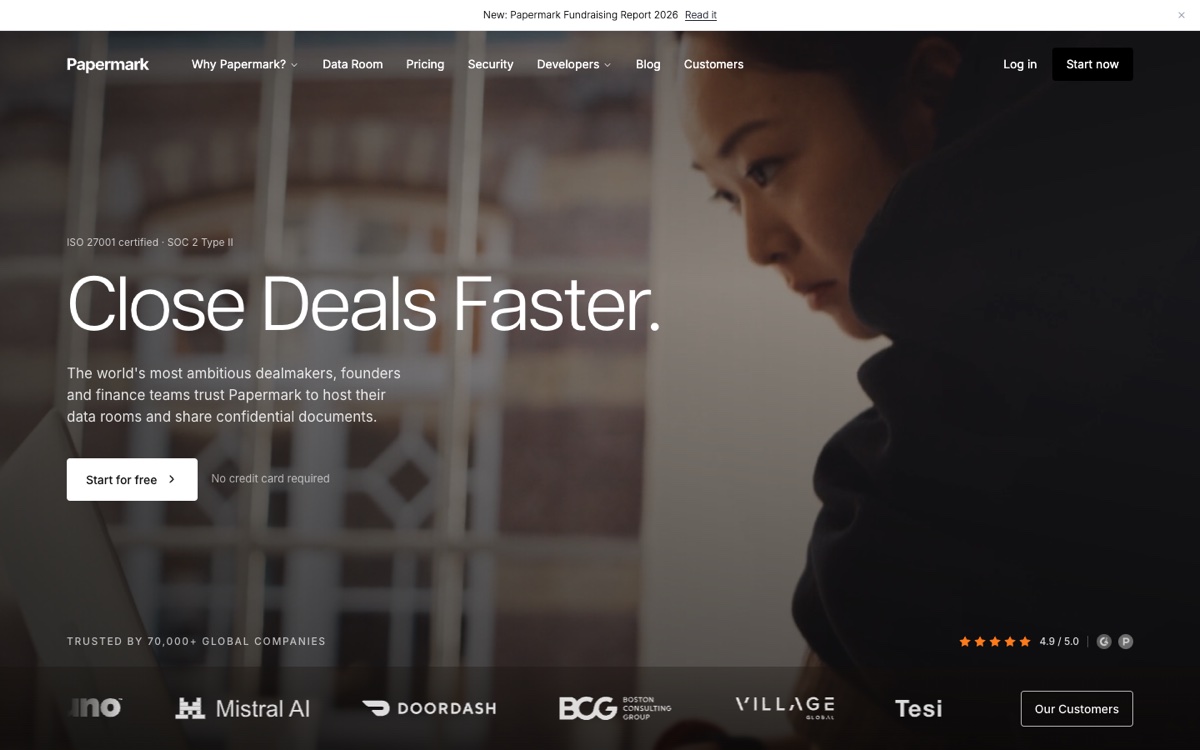
DocSend is established in secure document sharing and pitch-deck analytics, with plans that include data-room and eSignature capabilities. Papermark focuses on document sharing and virtual data rooms, with security, analytics, and deal-room workflows prominent in its product.
Either specialist may be the better fit when advanced document controls are the binding requirement. Finta is the stronger fit when shared materials need to live inside the larger fundraising relationship workflow. Finta Share Pages support controlled publishing and supported identified engagement attached to CRM context. Anonymous visits remain anonymous, and engagement is evidence rather than proof of investor intent.
For a deeper decision framework, read what a virtual data room should do during startup fundraising.
7. ChatGPT, Claude, and Granola: flexible intelligence around the workflow
General AI and meeting tools can add real leverage without becoming the fundraising system of record.
- ChatGPT: useful for research, synthesis, scenario work, drafting, and analysis. Its value increases when the user provides reliable sources and a clear objective.
- Claude: useful for long-context analysis, writing, research, and document-heavy knowledge work.
- Granola: useful for capturing and improving meeting notes, recalling context, and producing follow-up inputs.
The limitation is not intelligence. It is operational memory and ownership. A good memo or draft does not automatically update the investor record, advance the stage, preserve the relationship owner, or make the next action visible to the team.
Finta can sit alongside these tools. Its role is to keep the researched person, relationship context, meeting history, materials, pipeline state, and reviewed next action in one operating record. Through Finta MCP, compatible AI clients can also work with supported Finta context without turning a general chat transcript into the primary CRM.
Three practical fundraising stacks
Stack A: the integrated founder workflow
Use Finta as the operating layer. This is the cleanest starting point when the team values continuity and speed more than owning the deepest licensed dataset.
- Aurora researches public evidence and prepares reviewable work.
- Finta CRM owns prospects, relationship history, stages, and next actions.
- Networks supports warm-path research.
- Documents and Share Pages support fundraising materials and diligence sharing.
- Inbox, calendar, meetings, and follow-up remain connected to the same record.
Add a specialist only after you can name the missing depth. This avoids paying for overlapping tools before the process proves it needs them.
Stack B: the data-heavy raise
Use Finta plus Crunchbase, PitchBook, Harmonic, or another licensed source. This works when proprietary data coverage or high-volume market mapping is the constraint.
- Build a researched universe in the data product.
- Apply thesis, stage, geography, check-size, portfolio-conflict, and timing evidence.
- Bring qualified prospects into Finta.
- Use relationship context and warm paths to prioritize the order of operations.
- Run meetings, materials, and follow-up from the CRM record.
This architecture keeps the data provider focused on discovery and Finta focused on relationships and execution.
Stack C: the document-control-heavy raise
Use Finta plus DocSend or Papermark. Choose this when sophisticated sharing controls or a specialist VDR experience are required, but the relationship workflow still needs an owner.
Keep investor fit, warm paths, meetings, decisions, and next actions in Finta. Keep the specialist sharing system focused on access and document activity. Treat document engagement as one signal among many, not a proxy for intent.
How to run a 30-day buyer test
A polished demo can hide the handoffs that create work later. Test the workflow using a representative slice of a real raise.
For a fuller evaluation kit, get Finta's 2026 VC CRM buyer's guide, with weighted scorecards, a 30-day pilot plan, a security checklist, and a total-cost model.
- Choose 25 real prospects. Include obvious fits, ambiguous fits, cold targets, warm paths, and at least one investor you should exclude.
- Research fit with evidence. Record mandate, stage, geography, relevant investments, conflict risks, and the date each claim was verified.
- Inspect relationship pathways. Separate real relationship evidence from scraped similarity or unsupported claims.
- Prepare a meeting. Confirm that the system can retrieve the investor thesis, prior communication, open questions, and your objective without manual reconstruction.
- Capture the result. Record the decision, commitments, owner, and next action after the meeting.
- Share a controlled artifact. Test pitch or diligence access, mobile presentation, identity behavior, and revocation.
- Prepare follow-up. Confirm that the draft uses the actual meeting context and remains reviewable before it is sent.
- Review the pipeline. Ask whether the system can distinguish motion from activity. A larger task count is not the same as a healthier raise.
Score the pilot on outcomes, not feature count
| Question | What good looks like |
|---|---|
| Can the team explain why each investor is on the list? | Current evidence is visible, dated, and tied to the investor record. |
| Can we see the best available relationship path? | The evidence, owner, and permission boundary are clear. |
| Can someone else understand the account? | Meetings, email context, materials, stage, decisions, and next action are coherent. |
| Does AI produce action or just text? | The system prepares useful work in context and returns it for review. |
| Can the team recover from a mistake? | People can inspect, correct, stop, and reassign work before consequences spread. |
| Did the raise move? | Qualified investor conversations, diligence progress, commitments, and clear next steps improved. |
For a more rigorous operating view, use these fundraising CRM metrics that measure movement rather than activity.
Which AI fundraising tool should you choose?
Choose Finta if you want the broadest connected workflow across the day-to-day work of a raise: research, relationships, pipeline, outreach, meetings, materials, and reviewed next actions. That is where fewer handoffs create the most leverage.
Choose a specialist when specialist depth is the requirement:
- Choose PitchBook, Crunchbase, Harmonic, or another data platform when proprietary market coverage is the binding constraint.
- Choose Affinity when an institutional private-capital relationship CRM is the primary need.
- Choose Visible, Foundersuite, or OpenVC when their specific founder suite, database, or pricing model fits your team better.
- Choose DocSend or Papermark when document controls and VDR specialization outweigh the value of one connected fundraising workspace.
- Use ChatGPT, Claude, or Granola to improve flexible research, analysis, drafting, and meeting memory around the process.
The best stack is not the one with the most AI. It is the one that preserves enough evidence and context for your team to make the next good decision, then helps the responsible person carry it through.
If you are preparing for an early round, pair this tool decision with Finta's pre-seed fundraising guide or Series A fundraising guide.
Start a 7-day Finta trial and test the workflow with a real investor pipeline.
Sources and methodology
We used Finta's 2026 VC CRM Buyer's Guide as a market-structure input, then reverified public product positioning against current official pages before updating this article. Homepage images are attributed captures of public vendor pages from September 25, 2026. This guide compares documented capabilities and category fit. It is not a substitute for a security review, contract review, or product pilot.