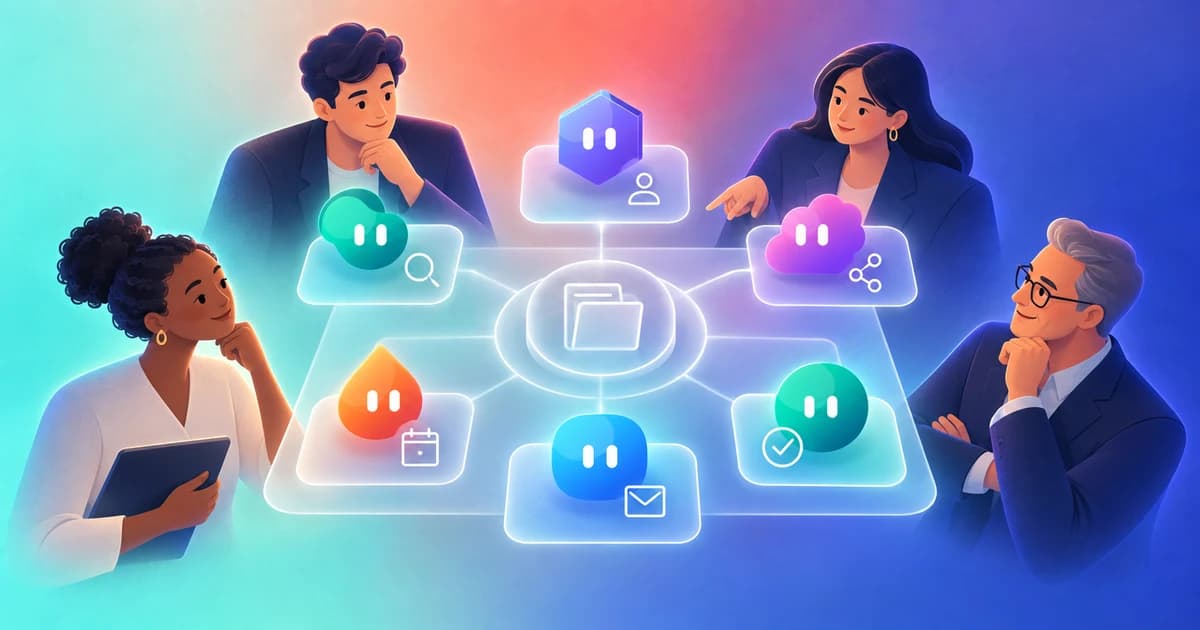
AI teammates give recurring private-capital work a clear owner
An AI teammate for private capital is an agent assigned to a continuing job such as research, prospecting, relationship mapping, meeting preparation, communication, or diligence follow-through. It works from relevant context, follows standing instructions, returns a reviewable artifact, and makes clear where human judgment or permission is still required.
That combination matters because private-capital work rarely fails for lack of another generic answer. It stalls when research, relationships, documents, meetings, commitments, and next steps become disconnected.
The practical goal is not to build a large roster of AI characters. It is to give the right recurring responsibility a recognizable owner.
This guide explains the six teammate roles that are most useful across startup fundraising, fund fundraising, family-office investing, and real estate capital raising. It also provides a framework for deciding which role to create first.
The private-capital responsibility map
The same role must be interpreted through the user's mandate. A prospecting teammate for a founder researches startup investors. A prospecting teammate for a general partner researches LPs. A family office may instead use a research teammate to prepare manager briefs or investigate co-investment questions.
| Teammate role | Continuing responsibility | Founder | GP or fund manager | Family office | Real estate sponsor |
|---|---|---|---|---|---|
| Research | Prepare sourced briefs and unresolved questions | Investor or market brief | LP, sector, or portfolio brief | Manager, company, or co-investment brief | Investor, market, or counterparty brief |
| Prospecting | Maintain a focused, evidence-backed candidate set | Startup investor shortlist | LP or deal shortlist | Manager or opportunity watchlist | Capital-source shortlist |
| Relationship mapping | Identify plausible paths and preserve consent states | Investor introduction path | LP, founder, or co-investor path | Adviser, manager, or co-investor path | Investor, lender, attorney, or referral path |
| Meeting preparation | Reconstruct why the conversation matters now | Investor meeting brief | LP or founder meeting brief | Manager or adviser meeting brief | Investor or partner meeting brief |
| Communication | Prepare relevant, voice-aware follow-up | Investor follow-up | LP or portfolio follow-up | Manager, adviser, or portfolio follow-up | Investor-question response |
| Deal management | Keep questions, materials, owners, and next actions visible | Fundraising diligence | LP diligence or investment process | Manager or co-investment review | Fundraising and offering follow-through |
This is a responsibility map, not a claim that one agent can perform every job well. Each assignment needs its own criteria, sources, output, cadence, and authority boundary.
What makes an AI teammate different from a chat session
A chat session is useful for an immediate question. A teammate is useful when the job continues after the answer.
The distinction has five parts:
- Role: the person can explain what the teammate is responsible for.
- Context: the teammate can use the permitted background relevant to that responsibility.
- Continuity: instructions, work artifacts, corrections, and state can support a later assignment.
- Reporting: returned work appears in a place where the user can inspect it.
- Control: important decisions and external actions have clear human owners.
OpenAI's practical guide to agents identifies instructions, tools, and a model as core components of an agent. It also recommends clear actions, explicit routines, and guardrails. The teammate model turns those technical components into an operating contract people can use.
Read What Is an AI Teammate? for the category definition and a fully annotated role profile.
1. The research teammate
A research teammate owns the preparation of a decision-useful brief. It should not merely produce a biography or repeat the subject's website.
Useful output includes:
- why the subject matters to the current mandate;
- what is known and which source supports it;
- when the information was observed;
- what changed since the last review;
- where sources disagree or evidence is missing;
- which questions deserve human attention.
For a family office, that might be a manager brief before an introductory meeting. For a GP, it might be a short explanation of an allocator's publicly documented program and eligibility. For a founder, it might be a firm brief that separates current thesis evidence from an old portfolio inference.
The research teammate prepares the evidence. The principal, investment team, founder, or GP evaluates it.
See AI Research Agents: Meet the Teammate Behind Your Next Brief.
2. The prospecting teammate
A prospecting teammate owns the quality of a living candidate set. That is different from generating a large list once.
A useful prospect record explains:
- why the person or organization fits;
- which current source supports the fit;
- what exclusions were checked;
- whether the record already exists in the CRM;
- what relationship evidence is available;
- which fact still needs verification.
Finta does not maintain a proprietary, marketwide investor database like PitchBook or Crunchbase. A teammate can use supported public research, connected sources, compatible external tools, and user-owned lists. The user decides which verified prospects belong in the active pipeline.
See AI Prospecting Agents: Give Investor and LP Research an Owner.
3. The relationship-mapping teammate
A relationship-mapping teammate helps find a plausible path to a relevant person and prepares the context needed to evaluate that path.
The role should preserve distinct states:
- Relationship evidence found.
- Possible connector identified.
- Connector reviewed by the relationship owner.
- Permission requested.
- Introduction accepted, declined, or not yet answered.
- Follow-through recorded.
A path is not permission. A shared employer, past email, or mutual contact can make a route worth inspecting, but it does not authorize an introduction or predict a response.
See AI Relationship Mapping: A Teammate for Warm Introductions.
4. The meeting-preparation teammate
A meeting-preparation teammate is responsible for readiness, not recording.
Before the meeting, it should answer:
- Why does this conversation matter now?
- What did the participants discuss previously?
- What changed since then?
- Which promises, questions, or documents remain open?
- What decision might the user need to make?
- Which facts should be rechecked rather than repeated?
The structure can stay consistent while the substance changes. A GP meeting an LP needs different mandate, diligence, and relationship context from a family office meeting a fund manager or a sponsor meeting a prospective investor.
See AI Meeting Preparation: A Teammate Who Knows the Context.
5. The communication teammate
A communication teammate owns the preparation of context-aware drafts. Its job is not to make every message sound polished. It is to preserve the reason for the conversation and the recipient's actual request.
Useful standing guidance may cover:
- preferred tone and length;
- phrases to avoid;
- whether to lead with the decision, request, or update;
- how to cite an attached or shared document;
- when to ask the user instead of filling a gap;
- which messages require explicit approval.
For a real estate sponsor, the source material may include approved offering documents and a specific investor question. The teammate can prepare a response, but it should not invent an offering claim or send a consequential message without the required review.
See AI Outreach Agents: A Teammate for Personal Follow-Up.
6. The deal-management teammate
A deal-management teammate owns the state of the work around a transaction or diligence process:
- unanswered questions;
- requested materials;
- current document owner;
- missing or conflicting evidence;
- next meeting;
- decision awaiting review;
- follow-up that is ready, blocked, or complete.
The role is valuable because diligence often fragments across email, documents, meetings, task lists, and individual memory. It is also easy to overstate. An AI teammate can organize evidence and follow-through. It should not be presented as making an investment decision, certifying legal completeness, performing regulated work, or replacing professional advice.
See AI Deal Teammates: Keep Diligence and Next Steps Moving.
Choose your first teammate with the OWNER test
Use the OWNER test before creating a teammate. A strong first responsibility should be:
- Ongoing: it recurs or develops over time.
- Well-bounded: a person can say what is inside and outside the job.
- Necessary context: the sources and records can be identified and permitted.
- Evidence-returning: the teammate produces an artifact you can inspect.
- Reviewable: a person can judge quality and owns the consequential decision.
Score a candidate responsibility from 0 to 2 on each dimension:
| Score | Meaning |
|---|---|
| 0 | The requirement is absent or unclear |
| 1 | The requirement exists but needs better definition |
| 2 | The requirement is explicit and testable |
A responsibility scoring 8 to 10 is a strong setup candidate. A score below 6 usually means the job is too broad, lacks usable context, or has no reliable review method.
Example: "Help with fundraising"
| OWNER dimension | Score | Why |
|---|---|---|
| Ongoing | 2 | Fundraising work continues |
| Well-bounded | 0 | "Help" could mean research, outreach, diligence, or strategy |
| Necessary context | 0 | No sources or records are named |
| Evidence-returning | 0 | No output is defined |
| Reviewable | 0 | No quality or authority boundary is stated |
Total: 2 out of 10.
Better: "Maintain our LP follow-up review"
Every Monday, review active LP records and the available relationship context. Return a table of open questions, promised materials, last interaction, owner, and proposed next action. Cite the record or communication behind each item. Do not send messages or change commitment expectations. Flag conflicts for the GP.
That assignment is continuing, bounded, grounded, artifact-producing, and reviewable.
Use How to Delegate Work to an AI Teammate to turn a chosen responsibility into standing instructions.
What working with an AI team should feel like
The strongest experience is not a screen full of busy indicators. It is a clear return loop:
- You assign or schedule a bounded job.
- The teammate uses the available, permitted context.
- Work returns as a reviewable artifact.
- The teammate distinguishes ready work from blockers and missing evidence.
- You approve, correct, decide, or supply what is missing.
- The next assignment begins from the improved operating context.
The rest of this series examines that experience:
- Persistent AI Agents: Teammates That Pick Up Where You Left Off
- Proactive AI Teammates: Start Your Day With Work Ready
- How Aurora Agents Share Context Across Your AI Team
- AI Agent Routines: Give Recurring Work a Teammate
- Managing AI Teammates: Status, Activity, and Control
- A Day With Aurora: AI Teammates at Work Across Private Capital
The limits matter as much as the role
Use these boundaries across the entire team:
- The workspace's actual permissions and connected sources govern access. A teammate's identity should not be treated as a data-isolation control.
- Public research can be incomplete or stale. Preserve sources and observation dates.
- AI-generated fit is a hypothesis until a person verifies the underlying evidence.
- Relationship evidence does not create consent.
- A polished draft is not proof that a message is accurate, approved, or sent.
- A completed workflow does not prove an investment, fundraising, or relationship outcome.
- Financial, legal, compliance, fiduciary, and investment decisions remain with qualified people.
The NIST AI Risk Management Framework recommends clearly defining human roles and responsibilities around AI systems. In private capital, those roles should be visible in the assignment itself, not added as a vague disclaimer after the work is complete.
Give the work a teammate, not a fictional promise
Start with the responsibility your team reconstructs most often. Give it a clear output, usable context, a quality standard, and a human owner. The teammate identity then becomes useful: you know where the work lives, why it was produced, and which instructions to improve.
Meet Aurora Agents, or explore Aurora to see how Finta turns available relationship context into a reviewable next step.
Research checked September 27, 2026. "AI teammate" is emerging product language, not an industry certification. Examples in this guide are illustrative operating models, not investment advice, customer outcomes, or a claim that one configuration fits every team.